A short #BookReview of ‘Form & Number: A History of Mathematical Beauty’ in ‘Mathematics Magazine’ has been pointed out to me: https://doi.org/10.1080/0025570X.2025.2587000 (not open-access)

I am quite pleased by the reviewer's evaluation :-) ‘a very careful and absolutely thorough survey of the “rich heritage of scholarship” about both beauty in mathematics and the study of that topic’.

There was a more detailed review by Viktor Blåsjö in ‘TUGboat’ last year: https://doi.org/10.47397/tb/46-2/tb143reviews-cain (open-access)

#review #MathematicalBeauty #HistMath #HistSci

"Official math manifests itself as a formal deduction system where you start from axioms and mechanically derive theorems. This is a nerd’s paradise, a world where truth takes binary values, reasoning is either valid or invalid, and there is technically no room for bullshit.

Secret math is the human part of the story—why official math was invented, how we can successfully interact with it, its effects on our brains, and the bizarre mental techniques through which mathematicians continuously expand its territory.

Secret math never made it to the curriculum, because it lacks the defining qualities of official math, and also because it feels peripheral. Official math is cold, hard, logical, objective, and it is rumored to be the language of the universe. Secret math is soft, fuzzy, subjective and, by contrast, it looks like cheap pedagogical backstory."
#histsci #histmath

Math is magic on one page. #histmath
Saviez-vous que le garde du corps de Trotsky était spécialiste de logique ? Que la première personne à avoir utilisé l’écriture décimale en France est une femme (dont on ne sait quasiment rien) ?
https://www.albin-michel.fr/le-grand-almanach-mathematique-9782226494450 #histsci #histmath
Le Grand Almanach mathématique | Éditions Albin Michel

Retrouvez Le Grand Almanach mathématique par Roger Mansuy, publié par les éditions Albin Michel. Parcourez nos suggestions de livres Sciences

Each day of February I posted a fact/image/anecdote about the aesthetics of mathematics, which seemed to provoke a certain amount of interest.

The posts are all collected on my personal website, with minor fixes and improvements (including vector versions of diagrams).

The index is here: https://ajcain.codeberg.page/posts/2026-03-01-aesthetics-of-mathematics.html

#aesthetics #MathematicalBeauty #HistMath #elegance #beauty

February 2026 posts on the aesthetics of mathematics

[Auto-promo] Dans ma boîte aux lettres ce matin, le dernier numéro de la revue Tangente – l'aventure mathématique, dans lequel je signe un dossier d'une douzaine de pages sur Gabriel Cramer, savant genevois de la première moitié du XVIIIe siècle..

Si ce numéro tombe entre les mains d'amateurs ou amatrices d'histoire et de culture mathématique au sens large (en bibliothèque, au CDI...) qui passeraient par ici : n'hésitez pas à me faire signe et me livrer vos impressions !

#histmath

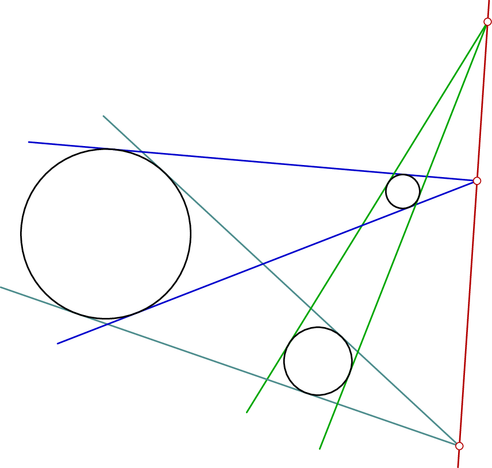
The philosopher, biologist, and political theorist Herbert Spencer (1820–1903) has a minor but curious role in the history of mathematical beauty, because of comments he made about Monge’s theorem, which states:

For any three circles in a plane, none contained within another, the intersections of the outside tangents of the three pairs of circles are collinear. (See attached image.)

Spencer said that when he thought of it he was

‘struck by its beauty at the same time that it excites feelings of wonder and of awe: the fact that apparently unrelated circles should in every case be held together by this plexus of relations, seeming so utterly incomprehensible.’

However, Spencer’s reaction of wonder and of awe may ultimately have been born of his limited mathematical ability.

1/3

#geometry #HerbertSpencer #MathematicalBeauty #HistMath

Friedrich Schiller's (1759–1805) poem ‘Archimedes and the Student’ (see 1st attached image for typeset text):

To Archimedes came an inquisitive youth
“Initiate me,” he said to him, “into the divine science,
That bore such splendid fruit for the nation
And shielded the walls of the city from the sambuca!”
“Divine you call the science? It is,” replied the sage,
“But it was so, my son, even before it served the state.
If you want only fruit from her, even mortals can provide it;
Who courts the goddess, seeks not in her the woman.”

(The sambuca was a ship-mounted siege engine; see 2nd attached image. During the Roman siege of Syracuse, it failed in the face of the war-machines designed by Archimedes.)

In 1808, Carl Friedrich Gauss (1777–1855) became director of the observatory at Göttingen and in his inaugural lecture declared that mathematics in general and astronomy in particular had a value — at least in part aesthetic — that was prior to and independent of any utility:

‘The happy great minds who created and expanded astronomy as well as the other beautiful parts of mathematics were certainly not inspired by the prospect of future use: they searched the truth for its own sake and found in the very success of their efforts their reward and their happiness. I cannot avoid at this point reminding you of ARCHIMEDES […]. You must all know the beautiful poem by SCHILLER.’

1/3

[Each day of February, I am posting a short interesting story/image/fact/anecdote related to the aesthetics of mathematics.]

#Archimedes #Schiller #Gauss #poetry #HistMath

The idea that the ‘golden’ ratio — $1.61803\ldots:1$ — has applications in visual art and architecture does not go back any further than the 2nd edition (1799–1802) of Jean-Étienne Montucla's (1725–99) (generally superb) ‘Histoire des Mathématiques’, in which he made the **incorrect** statement that Luca Pacioli's (c.1447–1517) book ‘Divina Proportione’ included illustrations of the ratio's application to architecture and font design.

This was shortly after the earliest known appearance of the term ‘golden section’ in Johann Samuel Traugott Gehler’s (1751–95) general scientific dictionary ‘Physikalisches Wörterbuch’.

The golden ratio was then taken up by Adolph Zeising (1810–76) as the basis for a system of aesthetic proportion in his book ‘New Theory of the Proportions of the Human Body’ (1854), where he argued — apparently to his own satisfaction — that his system agreed with the proportions of many masterpieces of art.

The psychologist Gustav Fechner (1801–87) made a much-misreported experiment in which people were asked to choose the most aesthetically pleasing of various rectangles (shown in the attached image). The most popular choice was the 34 ∶ 21 rectangle, whose proportions approximate the golden ratio. Fechner's conclusion was only that **a range of rectangles**, including the golden ratio rectangle, were considered most pleasing.

1/3

#GoldenRatio #GoldenSection #DivineProportion #HistMath #aesthetics #Zeising #Fechner

Gottfried Wilhelm Leibniz's (1646–1716) first great mathematical achievement was the ‘arithmetic quadrature’ of the circle through his alternating series: π/4 = 1 - 1/3 + 1/5 - 1/7 + 1/9 - 1/11 + ...

He communicated the result to his mathematical mentor Christiaan Huygens (1629–95), who thought it ‘very beautiful and very pleasing’. Isaac Newton (1642–1726) welcomed Leibniz’s work as ‘very elegant’. Leibniz himself wrote that there was no simpler or more beautiful way of expressing the area of a circle using rational numbers.

In a short note concerning the beauty of theorems, Leibniz wrote:

‘Theorems are not intelligible except by their signs or characters. […] The beauty of theorems consists in the beautiful arrangement of their characters.’

To illustrate ‘beautiful arrangement of characters’, Leibniz gave the example of a theorem concerning Berthet’s curve (shown in red in 1st attached image). The detail of its definition is not important here, but it is defined with reference to an arc AC centred at B.

Leibniz's result was a way of finding the tangent to the curve at E: take the tangent to the arc at its intersection with BE (i.e., at D), and find the point F such that FD ∶ DE ∶∶ EB ∶ BD. Then EF is the desired tangent (see 1st attached image).

Why is there a ‘beautiful arrangement of characters’? Because the proportion FD ∶ DE ∶∶ EB ∶ BD is easily remembered via a mnemonic: one can draw the path FD ⋅ DE ⋅ EB ⋅ BD without raising one's pen (2nd attached image).

1/2

#geometry #Leibniz #Huygens #Newton #MathematicalBeauty #aesthetics #HistMath