𝗪𝗜𝗞𝗜𝗣𝗘𝗗𝗜𝗔 𝗣𝗜𝗖𝗧𝗨𝗥𝗘 𝗢𝗙 𝗧𝗛𝗘 𝗗𝗔𝗬

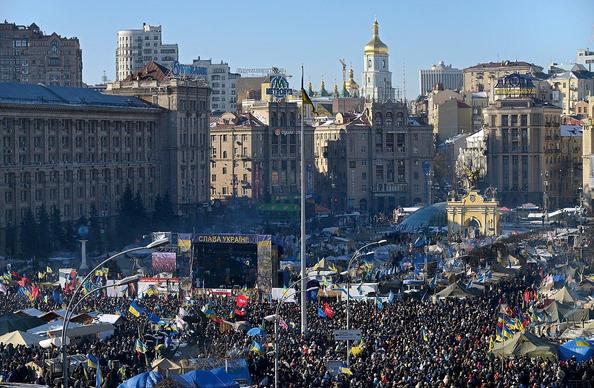
✧ Euromaidan ✧

Euromaidan was a wave of demonstrations and civil unrest in Ukraine, which began on 21 November 2013 with large protests in Maidan Nezalezhnosti in Kyiv. The protests were sparked by President Viktor Yanukovych's sudden decision not to sign the European Union–Ukraine Association Agreement, instead choosing closer ties to ...

#EurasianEconomicUnion #EuropeanUnion #Ukraine #Yanukovych #Euromaidan #Wikipedia
https://en.wikipedia.org/wiki/Euromaidan

The “Community Of Central Asia” Could Reduce Russia’s Regional Influence

The “Community Of Central Asia” Could Reduce Russia’s Regional Influence

By Andrew Korybko

This new group might foster a stronger sense of shared regional identity among its members, even ethnic in the pan-Turkic sense (Tajikistan being the exception), than the one that they share with Russia through their Imperial- and Soviet-era pasts with all that entails for future policymaking.

The Central Asian Republics (CARs) fall within Russia’s “sphere of influence” for historical, economic, and security reasons. The first stems from their shared history under the Russian Empire and USSR, the second from the Russian-led Eurasian Economic Union (EAEU) in which Kazakhstan and Kyrgyzstan participate, while the third relates to the Russian-led Collective Security Treaty Organization (CSTO) that includes them and Tajikistan. Russia’s influence, however, has waned in recent years.

Its understandable prioritization of the special operation created the opportunity for Turkiye to expand its influence through the “Organization of Turkic States” (OTS) in which Kazakhstan, Kyrgyzstan, and Uzbekistan participate with Turkmenistan as an observer. The OTS began as a socio-cultural integration group that now also promotes economic and even security cooperation, thus challenging the EAEU and CSTO. The US also made major trade inroads there earlier this month during the latest C5+1 Summit.

These developments were greatly facilitated by the US-mediated normalization of Armenian-Azerbaijani ties and the attendant “Trump Route for International Peace & Prosperity” (TRIPP) that was unveiled during their three leaders’ White House Summit in early August. This will essentially lead to Turkiye injecting Western influence along Russia’s entire southern periphery, especially through the expected ramping up of military exports there, which threatens to pose serious latent challenges to Russia.

The latest move on this front was the CARs inviting Azerbaijan to join their annual Consultative Meeting of Heads of State and then rebranding as the “Community of Central Asia” (CCA), coincidentally right after their meeting with Trump. Regional integration is always positive, but in this case, it could also reduce Russia’s regional influence. That’s because all six might deal with Russia as a group instead of individually. This could lead to tougher negotiating stances if they’re emboldened by Turkiye and the US.

Azerbaijan’s inclusion suggests that it’ll share its experiences managing this summer’s tensions with Russia and serve as its Turkish ally’s supervisor within the CCA to align it as closely as possible with the OTS (remembering that non-Turkic Tajikistan isn’t a member). This likely role coupled with the timing of the CCA’s announcement right after the C5+1 and three months after TRIPP’s unveiling suggests that they want to rebalance ties with Russia and could rely on Azerbaijan’s guidance if this results in tensions.

Russia still plays an enormous economic role in the five CARs and ensures three of the CCA’s six members’ security through their membership in the CSTO. Putin also hosted the CARs leaders in early October during the Second Russia-Central Asia Summit where he committed to scaling up investments. Concrete limits therefore exist in terms of how far and fast the CCA could rebalance ties with Russia, so nothing dramatic is expected anytime soon, but some reduction of Russian influence might be inevitable.

That’s because the CCA could foster a stronger sense of regional identity, even ethnic in the pan-Turkic sense (Tajikistan being the exception), than the one that they share with Russia through their Imperial- and Soviet-era pasts with all that entails for future policymaking. This aligns with Turkiye’s interests, which envisages becoming a Eurasian Great Power through its new influence in Central Asia via TRIPP and the OTS, and that in turn advances the US’ grand strategic goal of containing Russia.

Disclaimer: The views expressed in this article are author’s own and do not necessarily reflect the editorial policy of Voice of East.


#armenia #azerbaijan #car #centralAsia #csto #eaeu #eurasianEconomicUnion #geopolitics #kazakhstan #kyrgyzstan #russia #tajikistan #turkey #turkiye #turkmenistan #ussr #uzbekistan

The Establishment Of Armenian-Pakistani Diplomatic Ties Is Part Of A Larger Powerplay

The Establishment Of Armenian-Pakistani Diplomatic Ties Is Part Of A Larger Powerplay

By Andrew Korybko

It’s about turbocharging the emerging Turkish-Azeri-Pak bloc by giving Islamabad access to TRIPP for facilitating trade with Turkiye and Europe in order to consolidate this bloc’s sway across Central Asia.

The Armenian and Pakistani Foreign Ministers signed a joint communique on the sidelines of the SCO Summit in Tianjin establishing diplomatic ties. Pakistan was the only country in the world that didn’t recognize Armenia out of solidarity with Azerbaijan in the Karabakh Conflict. Now that it’s resolved and Pakistan’s US patron got those two former rivals to agree to the “Trump Road for International Peace and Prosperity” (TRIPP), which replaced Russia’s role, Pakistan saw an opportunity to recognize Armenia.

This isn’t being done as the prerequisite for free trade talks with the Russian-led Eurasian Economic Union of which Armenia is part and with whose leader Pakistan has recently drawn close. After all, Prime Minister Nikol Pashinyan confirmed long-running speculation in late August that Armenia might withdraw from that bloc as it moves closer to the EU, so this isn’t driving Pakistani policy. Rather, this is part of a larger powerplay in Central Asia, albeit one that’s cloaked in the guise of its rivalry with India.

The resumption of large-scale Armenian-Azerbaijani hostilities in late 2020 had the unintended consequence of expanding the Indian-Pakistani rivalry to the South Caucasus. Pakistan extended political (and reportedly also military) support to Azerbaijan for the previously mentioned reason while India did the same to Armenia as a counterweight to the emerging Turkish-Azeri-Pak bloc. India’s arms sales to Armenia then continued to grow to the point where India became Armenia’s largest arms supplier.

These purchases weren’t just driven by military-security considerations vis-à-vis Azerbaijan but also by political ones with respect to Armenia diversifying from its hitherto dependence on Russian equipment. The US-brokered TRIPP corridor, the resultant de-escalation of Armenian-Azerbaijani tensions, and the new establishment of Armenian-Pakistani diplomatic ties might soon lead to less Indian imports, which would then predictably be spun by the emerging Turkish-Azeri-Pak bloc as a victory over India.

The truth though is that the expansion of the Indian-Pakistani rivalry to the South Caucasus never had much of an influence over regional events. The most important factor by far wasn’t their growing ties with Armenia and Azerbaijan respectively, but the course of the Russian-US rivalry, which ultimately led to setbacks for the first and gains for the second. The outcome was that Armenia, which has since become an Azeri-Turkish protectorate, became receptive to establishing diplomatic ties with Pakistan.

While this might be sold to the Armenian public as opening up new markets, its leadership is really moving in this direction in order to turbocharge the emerging Turkish-Azeri-Pak bloc by giving Islamabad access to TRIPP for facilitating trade with Turkiye and Europe. If China’s attempts to mediate a rapprochement between Afghanistan and Pakistan succeed, which they may not, then Pakistani exports could transit through there to Turkmenistan and across the Caspian to Azerbaijan, TRIPP, and beyond.

Therefore, while the emerging Turkish-Azeri-Pak bloc might hype up the symbolic setback for India that the establishment of Armenian-Pakistani diplomatic ties represents, that would just be a diversion from the larger powerplay taking place along Russia’s entire southern periphery. A whole new centre of influence is forming there before the world’s eyes with the US’ full support, which could greatly undermine Russia’s, India’s, and Iran’s shared geostrategic interests in this space if it isn’t kept in check.

Disclaimer: The views expressed in this article are author’s own and do not necessarily reflect the editorial policy of Voice of East.

7 Courses in 1 – Diploma in Business Management

#Armenia #Azerbaijan #CentralAsia #EU #EurasianEconomicUnion #Geopolitics #Pakistan #SCO #USA

#russia #eurasianeconomicunion #belarus #armenia #kazakhstan #Kyrgyzstan #economics #government #eurasia #politics #https://abcnews.go.com/International/wireStory/altercation-erupts-high-level-meeting-russia-dominated-economic-117122692

"The war in Ukraine has caused tectonic shifts in Moldovan politics. Above all, there is a new and growing demand for representation from traditional pro-Russian voters who no longer seek closer ties with Moscow. Putin’s invasion of Ukraine has badly damaged the pro-Russian cause in Moldova"

https://carnegieendowment.org/eurasiainsight/90356?utm_source=rss&utm_medium=rss

#EAEU #EurasianEconomicUnion #EU #Moldova

Russia to attach Iran to its Eurasian Economic Union

A free trade zone between Iran, Russia and several countries that cover the vast region spreading from the bor

EURACTIV
India, Russia talk free trade deal in step-up of relations

India and Russia are discussing a free trade agreement (FTA), the Russian trade minister said on Monday (17 Ap

EURACTIV
India, Russia talk free trade deal in step-up of relations

India and Russia are discussing a free trade agreement (FTA), the Russian trade minister said on Monday (17 Ap

EURACTIV

Russian aggression against Ukraine has probably killed any regionalization drive in #CentralAsia (on that: most recent Majlis podcast, https://www.rferl.org/majlis-talking-asia-podcast), including (🇷🇺-led) free trade agenda.

Assume that that means even less interest in #EurasianEconomicUnion in #Mongolia.

Possible topic for future blog post. Any thoughts, @mongoliastudies?

#MGLfp

Majlis

Each week, host Bruce Pannie welcomes a panel of expert guests to discuss significant political developments and pressing social issues affecting the nations of Central Asia.

RadioFreeEurope/RadioLiberty
Highly recommend the content of #JimWillie of #GoldenJackass site. Ahead of the curve by at least 2 years usually. Not a one man show but a team of colleagues, while Jim uses his brain to analyse.
https://www.golden-jackass.com/mainpublic
#geopolitics #gold #silver #globalreset #reset #economy #usa #china #russia #eurasia #beltandroad #eurasianeconomicunion #obor
Free interviews and public articles by Jim Willie

Before you choose to subscribe to the Hat Trick Letter, you can find out more about what you get, by reading Jim Willies pubclic articles or listening to some of the many interviews he participates in every month