UPDATED! Generative Artificial Intelligence Tools for Academic Research: AI Research Assistants, AI-Powered Document Analysis Tools, and A Look at Elicit, Undermind, and NotebookLM

https://ryanschultz.com/2026/03/09/generative-artificial-intelligence-tools-for-academic-research-ai-research-assistants-ai-powered-document-analysis-tools-and-a-look-at-elicit-undermind-and-notebooklm/
Es gibt immer mehr #ki_funktionen zur Unterstützung von #Recherche und Wissensarbeit – doch was taugen sie wirklich? 🤔
Im DGI-Praxisseminar „RAG, Deep Research, Forschungsassistenten – was können Sie erwarten?“ zeigt Johanna Gröpler aktuelle Tools wie #ChatGPT #Elicit & #NotebookLM – mit Übungen und Diskussion.
📅 5.11.2025, 13–16 Uhr, online
🔗 Infos + Anmeldung: https://dgi-info.de/event/rag-deep-research-forschungsassistenten-was-koennen-sie-erwarten/

"Comparison of Elicit AI and Traditional Literature Searching in Evidence Syntheses Using Four Case Studies"
Cochrane Evid Synth Methods, 9-27-25

The sensitivity of Elicit was poor, averaging 39.5% compared to 94.5% in the original reviews. Elicit identified some included studies not identified by the original searches & had an average of 41.8% precision which was higher than the 7.55% average of the original reviews.

https://pmc.ncbi.nlm.nih.gov/articles/PMC12483133/

#research #medicine #Elicit #AItools

Comparison of Elicit AI and Traditional Literature Searching in Evidence Syntheses Using Four Case Studies

Elicit AI aims to simplify and accelerate the systematic review process without compromising accuracy. However, research on Elicit's performance is limited. To determine whether Elicit AI is a viable tool for systematic literature searches and ...

PubMed Central (PMC)

Mit #KI schneller Literatur finden und zusammenfassen?

Programme für die Systemtic Literature Review wie #Elicit ersparen auf den ersten Blick viel Arbeit. Doch sie reproduzieren Machtdynamiken des Wissenschaftssystems, indem sie englischsprachige Beiträge bevorzugen, schreibt Rebecca Schmidt. Weil das Programm außerdem oft nur auf die Abstracts zugreifen kann, müssen Forschende am Ende ohnehin alle Texte selbst downloaden & lesen 👇

https://sozmethode.hypotheses.org/2943

#SozMethode

Mit KI (Elicit) Forschungsstand schreiben – ein kritischer Erfahrungsbericht

Einleitung Dieser Blogbeitrag beschäftigt sich kritisch mit der (Teil-)Automatisierung der Literatursuche, -recherche, sowie der Zusammenfassung eines Forschungsstandes mithilfe digitaler Tools. Aktuell gibt es verschiedene Anbieter und Start-Ups, die eine stetige (Weiter-) Entwicklung von Softwareprodukten anbieten, um Forschende dabei zu unterstützen die relevante Forschungsliteratur zu einer Fragestellung zu finden und den Forschungsstand zusammen zu fassen (Cao … „Mit KI (Elicit) Forschungsstand schreiben – ein kritischer Erfahrungsbericht“ weiterlesen

Sozialwissenschaftliche Methodenberatung

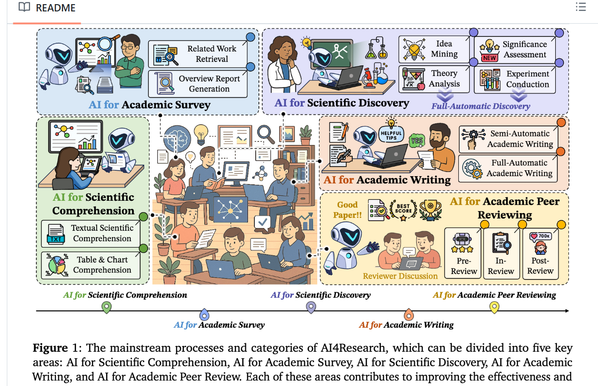
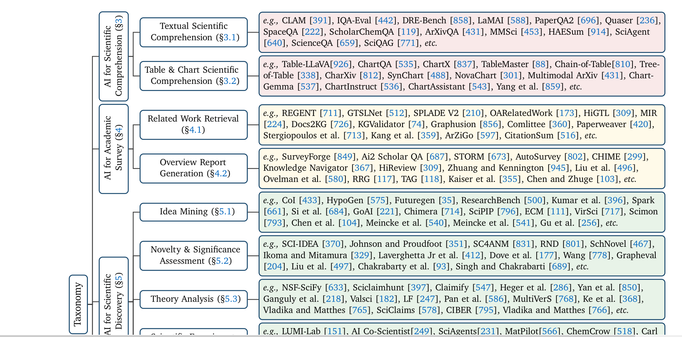
"AI4Research: A Survey of Artificial Intelligence for Scientific Research"

This is by far the best survey paper I have seen analyzing how various AI tools support various aspects of scientific research. This work analyzed a vast amount of information compiled in 950 references that were listed in the paper.

https://arxiv.org/abs/2507.01903

They provide an extensive paper list Github repo;
https://ai-4-research.github.io/
and see:
https://github.com/LightChen233/Awesome-AI4Research

#research #AItools #science #chemistry #Elicit

All sizzle, no steak: AI tools are not able to act as credible knowledge brokers by
summarising evidence in mathematics education

https://bsrlm.org.uk/wp-content/uploads/2025/05/BSRLM-CP-45-1-10.pdf

from https://bsky.app/profile/honeypisquared.bsky.social/post/3lraakawvqc2a

"We found that AI tools - both general like #ChatGPT and research-specific like #Elicit - lack the reliability, relevancy and accuracy to summarise research for teachers. This is important because we have been sold the idea that AI will make research more accessible."

How we evaluated Elicit Reports

We recently announced Elicit Reports: fully-automated research overviews for actual researchers, inspired by systematic reviews. Through external evaluation by researcher specialists, we find that Elicit Reports produce higher quality research overviews and save more time than the other “deep research” tools, including well-known ones like ChatGPT Deep Research, Perplexity Deep

The Elicit Blog
How we evaluated Elicit Reports

We recently announced Elicit Reports: fully-automated research overviews for actual researchers, inspired by systematic reviews. Through external evaluation by researcher specialists, we find that Elicit Reports produce higher quality research overviews and save more time than the other “deep research” tools, including well-known ones like ChatGPT Deep Research, Perplexity Deep

The Elicit Blog

"Artificial intelligence versus human researcher performance for systematic literature searches: a study focusing on the surgical management of base of thumb arthritis"

Interesting very recent paper comparing a manual systematic literature search to searches done with Elicit, Consensus, and ChatGPT tools.

https://www.oaepublish.com/articles/2347-9264.2024.99

#research #medicine #Elicit #Consensus #medlib

Artificial intelligence versus human researcher performance for systematic literature searches: a study focusing on the surgical management of base of thumb arthritis

Aim: In the digital age, artificial intelligence (AI) platforms have gradually replaced traditional manual techniques for information retrieval. However, their effectiveness in conducting academic literature searches remains unclear, necessitating a comparative assessment. This study examined the efficacy of AI search engines (Elicit, Consensus, ChatGPT) vs. manual search for literature retrieval, focusing on the surgical management of trapeziometacarpal osteoarthritis.Methods: The study was executed per the Cochrane Handbook for Systematic Reviews and PRISMA guidelines. AI platforms were given relevant keywords and prompts, while manual searches used PubMed, Cochrane CENTRAL, Web of Science, and Scopus databases from January 1901 to April 2024. The study focused on English-language randomized controlled trials (RCTs) comparing surgical management of trapeziometacarpal osteoarthritis (TMCJ OA). Two independent evaluators screened and extracted data from the studies. Primary outcomes involved the quality and relevancy of studies chosen by both search methods, evaluated by false positive rates and number of studies, including outcomes of interest.Results: The manual search yielded the most results (6,018), followed by Elicit (4,980), Consensus (3,436), and ChatGPT (6). Elicit identified the highest number of RCTs (205) but also had the greatest false positive rate (94%). Ultimately, the manual search identified 23 suitable studies, Elicit found 10, Consensus found 9, and ChatGPT identified only 1. No additional studies were found by AI search engines that were not discovered in the manual search.Conclusion: The findings highlight the potential advantages and drawbacks of AI search engines for literature searches. While Elicit was prone to error, Consensus and ChatGPT were less comprehensive. Significant enhancements in the precision and thoroughness of AI search engines are required before they can be effectively utilized in academia.

Plastic and Aesthetic Research