📲Accessing electronic evidence across borders can be complex.

🤝Co-implemented by Eurojust & @Europol, the #SIRIUS project provides guidelines, trainings & tools to support authorities accessing electronic evidence held by service providers.
👉https://www.eurojust.europa.eu/sirius
#eEvidence
---
https://nitter.net/Eurojust/status/2062110853512474746#m

SIRIUS

More than half of all criminal investigations today include a cross-border request to access electronic evidence held by Service Providers (SPs). This may include the contents of texts, emails or messaging apps, or data identifying the particular user of a service and his or her location. In a rapidly changing online environment, investigators and prosecutors need support to cope with the complexity and volume of information and to develop their knowledge when obtaining electronic data from SPs based in other jurisdictions.The SIRIUS project, co-implemented by Eurojust and Europol, is a central reference point in the EU for knowledge sharing on cross-border access to electronic evidence. It offers a variety of services, such as guidelines, trainings and tools, to help with accessing data held by SPs. These services are available to law enforcement and judicial authorities via a platform and an application. To this day, SIRIUS serves a community of competent authorities from 47 countries, representing all EU Member States and a growing number of third countries, as well as the European Public Prosecutor’s Office (EPPO).The SIRIUS Project has received funding from the European Commission's Service for Foreign Policy Instruments (FPI) under contribution agreement No PI/2020/417-500.

Eurojust

📲 The EU e-Evidence package will apply from August 2026.

⚖️ As implementation approaches, authorities, service providers and other stakeholders are preparing for the new framework for cross-border access to electronic evidence.

👉 https://www.eurojust.europa.eu/judicial-cooperation/instruments/electronic-evidence
#eEvidence

📲 The EU e-Evidence package will apply from August 2026.

⚖️ As implementation approaches, authorities, service providers and other stakeholders are preparing for the new framework for cross-border access to electronic evidence.

👉 eurojust.europa.eu/judicial-…
#eEvidence
---
https://nitter.net/Eurojust/status/2061389707536179277#m

Electronic evidence

Over half of all criminal investigations today include a request for cross-border access to electronic evidence such as texts, e-mails or messages in apps. However, gaining access to electronic evidence presents significant legal and technical challenges. For instance, evidence may be stored in an unknown location, servers can be spread across different countries, and there are no harmonised deadlines for how long service providers have to preserve data or reply to legal requests. In this context, gaining access becomes a cumbersome process delaying justice. New EU LegislationIn August 2026, new rules are coming into effect in the EU that will change the way judicial authorities can access electronic evidence. Known as the EU e-evidence package, the new legislation makes is much easier and faster for law enforcement and judicial authorities to obtain the electronic evidence they need to investigate and eventually prosecute criminals.Two new judicial cooperation instruments are introduced: European Production Order: Enables judicial authorities in one Member State to directly compel a service provider in another Member State – via its designated contact point (“addressee”) – to produce electronic evidence within 10 days or 8 hours in emergency cases.European Preservation Order: Enables judicial authorities to request preservation of electronic evidence for 60 days to ensure it remains available for later access.The new rules include strong safeguards, guaranteeing the protection of fundamental rights, including for protection of personal data. The persons whose data is being sought are also entitled to legal remedies. Eurojust SupportEurojust will support national authorities in using European Production and Preservation Orders, including:Advise on the applicable legal framework and the feasibility of requestsCoordinate simultaneous judicial cooperation requests, avoiding conflicts of jurisdictionFacilitate the issuance, transmission, execution and enforcement of ordersAssist with drafting and wording of certificatesFacilitate discussions between issuing and enforcing authoritiesAdvise on privileges and immunities / freedom of the press and freedom of expressionSIRIUS Project The SIRIUS project, launched in October 2017 is a project co-implemented by Eurojust and Europol and funded by the European Commission’s Service for Foreign Policy Instruments. Working closely with service providers, SIRIUS provides knowledge products and expertise to help investigators and prosecutors access cross-border electronic evidence.

Eurojust

🤝 Service providers are at the heart of the new EU e-Evidence framework.

⚖️ From August 2026, European Production and Preservation Orders will create a new system for cross-border access to electronic evidence.

👉 https://www.eurojust.europa.eu/judicial-cooperation/instruments/electronic-evidence
#eEvidence

🤝 Service providers are at the heart of the new EU e-Evidence framework.

⚖️ From August 2026, European Production and Preservation Orders will create a new system for cross-border access to electronic evidence.

👉 eurojust.europa.eu/judicial-…
#eEvidence
---
https://nitter.net/Eurojust/status/2060326084336374111#m

Electronic evidence

Over half of all criminal investigations today include a request for cross-border access to electronic evidence such as texts, e-mails or messages in apps. However, gaining access to electronic evidence presents significant legal and technical challenges. For instance, evidence may be stored in an unknown location, servers can be spread across different countries, and there are no harmonised deadlines for how long service providers have to preserve data or reply to legal requests. In this context, gaining access becomes a cumbersome process delaying justice. New EU LegislationIn August 2026, new rules are coming into effect in the EU that will change the way judicial authorities can access electronic evidence. Known as the EU e-evidence package, the new legislation makes is much easier and faster for law enforcement and judicial authorities to obtain the electronic evidence they need to investigate and eventually prosecute criminals.Two new judicial cooperation instruments are introduced: European Production Order: Enables judicial authorities in one Member State to directly compel a service provider in another Member State – via its designated contact point (“addressee”) – to produce electronic evidence within 10 days or 8 hours in emergency cases.European Preservation Order: Enables judicial authorities to request preservation of electronic evidence for 60 days to ensure it remains available for later access.The new rules include strong safeguards, guaranteeing the protection of fundamental rights, including for protection of personal data. The persons whose data is being sought are also entitled to legal remedies. Eurojust SupportEurojust will support national authorities in using European Production and Preservation Orders, including:Advise on the applicable legal framework and the feasibility of requestsCoordinate simultaneous judicial cooperation requests, avoiding conflicts of jurisdictionFacilitate the issuance, transmission, execution and enforcement of ordersAssist with drafting and wording of certificatesFacilitate discussions between issuing and enforcing authoritiesAdvise on privileges and immunities / freedom of the press and freedom of expressionSIRIUS Project The SIRIUS project, launched in October 2017 is a project co-implemented by Eurojust and Europol and funded by the European Commission’s Service for Foreign Policy Instruments. Working closely with service providers, SIRIUS provides knowledge products and expertise to help investigators and prosecutors access cross-border electronic evidence.

Eurojust
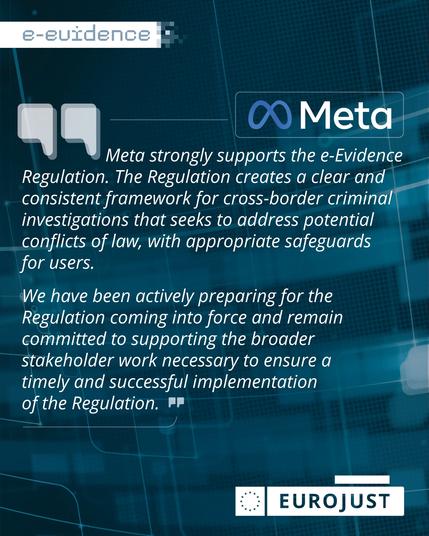
À quel moment le fort et actif soutien de Meta est un argument légitime et rassurant en faveur de la régulation #eEvidence ⁉️ 🇬🇧 Meta support = watch out 🤨 IMO this post belongs only on Facebook... [Added alt text] #DigitalSovereignty

RE: https://bsky.app/profile/did:plc:nr6o53jpaiqb3hxzcneupysa/post/3mmyhh57tw22b

🔎 More than half of criminal investigations today involve a request for cross-border access to electronic evidence.

⚖️ New EU rules will help judicial authorities obtain #eEvidence faster and more efficiently, with strong safeguards in place.

👉More: https://www.eurojust.europa.eu/judicial-cooperation/instruments/electronic-evidence

🔎 More than half of criminal investigations today involve a request for cross-border access to electronic evidence.

⚖️ New EU rules will help judicial authorities obtain #eEvidence faster and more efficiently, with strong safeguards in place.

👉More: eurojust.europa.eu/judicial-…

Video
---
https://nitter.net/Eurojust/status/2059562720077156838#m

Electronic evidence

Over half of all criminal investigations today include a request for cross-border access to electronic evidence such as texts, e-mails or messages in apps. However, gaining access to electronic evidence presents significant legal and technical challenges. For instance, evidence may be stored in an unknown location, servers can be spread across different countries, and there are no harmonised deadlines for how long service providers have to preserve data or reply to legal requests. In this context, gaining access becomes a cumbersome process delaying justice. New EU LegislationIn August 2026, new rules are coming into effect in the EU that will change the way judicial authorities can access electronic evidence. Known as the EU e-evidence package, the new legislation makes is much easier and faster for law enforcement and judicial authorities to obtain the electronic evidence they need to investigate and eventually prosecute criminals.Two new judicial cooperation instruments are introduced: European Production Order: Enables judicial authorities in one Member State to directly compel a service provider in another Member State – via its designated contact point (“addressee”) – to produce electronic evidence within 10 days or 8 hours in emergency cases.European Preservation Order: Enables judicial authorities to request preservation of electronic evidence for 60 days to ensure it remains available for later access.The new rules include strong safeguards, guaranteeing the protection of fundamental rights, including for protection of personal data. The persons whose data is being sought are also entitled to legal remedies. Eurojust SupportEurojust will support national authorities in using European Production and Preservation Orders, including:Advise on the applicable legal framework and the feasibility of requestsCoordinate simultaneous judicial cooperation requests, avoiding conflicts of jurisdictionFacilitate the issuance, transmission, execution and enforcement of ordersAssist with drafting and wording of certificatesFacilitate discussions between issuing and enforcing authoritiesAdvise on privileges and immunities / freedom of the press and freedom of expressionSIRIUS Project The SIRIUS project, launched in October 2017 is a project co-implemented by Eurojust and Europol and funded by the European Commission’s Service for Foreign Policy Instruments. Working closely with service providers, SIRIUS provides knowledge products and expertise to help investigators and prosecutors access cross-border electronic evidence.

Eurojust
📬 EU-Überwachungsgesetz E-Evidence: Neuer Datenzugriff für Ermittler – Kritik an schwachem Rechtsschutz
#Datenschutz #Rechtssachen #CloudDaten #eEvidence #EUÜberwachung #Grundrechte #MessengerÜberwachung #Rechtsschutz #Strafverfolgung https://sc.tarnkappe.info/aec0a7
EU-Überwachungsgesetz E-Evidence: Neuer Datenzugriff für Ermittler – Kritik an schwachem Rechtsschutz

Ermittler erhalten mit dem E-Evidence-Paket direkten Zugriff auf Cloud- und Kommunikationsdaten. Kritik am schwachen Rechtsschutz wächst.

TARNKAPPE.INFO

Folge: #Verschlüsselung 🔒 / #encryption 🔒 der eigenen Daten in der Cloud wird zwingend

E-Evidence: #Bundestag ( @bundestag ) erleichtert internationalen Zugriff auf Daten in der #Cloud | heise online https://www.heise.de/news/E-Evidence-Bundestag-erleichtert-internationalen-Zugriff-auf-Daten-in-der-Cloud-11161014.html #Datenschutz #privacy #eEvidence

E-Evidence: Bundestag erleichtert internationalen Zugriff auf Daten in der Cloud

Die Umsetzung der EU-Vorgaben zu E-Evidence soll Ermittlern helfen, stößt wegen Lücken beim Rechtsschutz und Missbrauchsrisiken aber auf scharfe Kritik.

heise online
Verbände warnen vor EU‑Zugriff auf Daten in der elektronischen Patientenakte

Vor dem Hintergrund der E-Evidenzverordnung fordern Psychologen und Psychotherapeuten den Schutz der Schweigepflicht bei EU-weitem Zugriff auf ePA-Daten.

heise online
My article on the #dataretention wish list by member states, including find-my-citizen necessity, #OTT and #eevidence published by @[email protected] yesterday has been translated into English. www.heise.de/en/news/Data...

Data Retention: Commission to ...
Data Retention: Commission to present proposal by mid-2026

Data retention is coming back, at least as a topic of discussion. What the EU states wish for is revealed by a pre-Christmas wish list.

heise online
E-Evidence: Grenzüberschreitende Strafverfolgung im digitalen Zeitalter: Neues Gesetz soll Zugriff auf digitale Beweismittel in der EU erleichtern

Das Bundesministerium der Justiz und für Verbraucherschutz hat heute einen Gesetzentwurf vorgelegt, der Ermittlungsbehörden in Europa den Zugang zu digitalen Beweismitteln erleichtern soll. Der Ges…

Innere und äußere Sicherheit - Deutschland und Europa