@YoMosEco
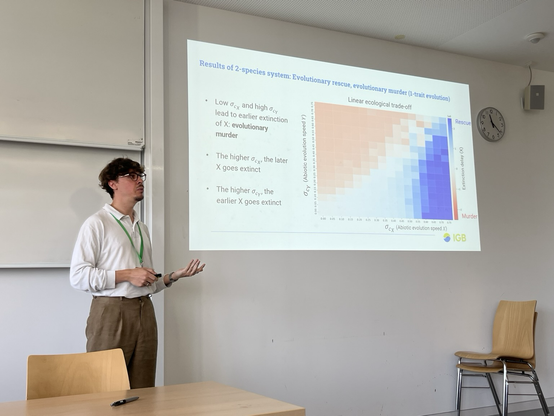
PS, I'll present recent work from Felix Jäger, PhD student in my group. The talk is entitled "Between Friends and Foes - Evolutionary #Diversification in Mutualistic-Antagonistic Networks" and based on our joint #preprint.
https://www.biorxiv.org/content/10.64898/2026.03.16.712075v1
#ecoevo #mutualism #antagonism #EcologicalNetworks #AdaptiveDynamics #EcologicalModelling #theoreticalEcology

Between Friends and Foes: Evolutionary Diversification in Mutualistic-Antagonistic Networks
Biotic interactions can drive evolutionary diversification, but the underlying mechanisms differ depending on the type of interaction. For instance, Ehrlich and Raven's escape-and-radiate coevolution provides a pathway of diversification in antagonistic interactions, whereas in mutualistic networks, coevolution is hypothesized to result in trait convergence rather than diversification. The combined effect of mutualism and antagonism on diversification remains unclear, even though organisms naturally engage in multiple types of interactions simultaneously. Using an eco-evolutionary simulation model, we investigate diversification in tripartite ecological networks such as plant-pollinator-herbivore networks. We find that diversification patterns vary according to the way mutualism and antagonism are connected on the trait level. If the two interactions are governed by uncorrelated plant traits, we observe little diversification in the mutualistic and substantial diversification in the antagonistic subnetwork. By contrast, if the same plant trait mediates both mutualism and antagonism (an example of 'ecological pleiotropy'), diversification rates in all guilds become interdependent. In this case, even the mutualistic guild diversifies considerably when antagonism is strong, while strong mutualism restricts diversification also in the antagonistic guild. Our study underlines that the inclusion of multiple interaction types is necessary to advance our understanding of evolutionary dynamics in ecological networks.
### Competing Interest Statement
The authors have declared no competing interest.
Deutsche Forschungsgemeinschaft, https://ror.org/018mejw64, AL 2563/3‑1
German National Academic Foundation
🚨 new #preprint 🚨
The evolutionary emergence of #EcologicalNetworks has been studied for decades but usually focussing on one type of interaction at a time, even though organisms naturally engage in multiple interaction types simultaneously. The combined effect of different interaction types on diversification thus remains unclear - until now. 😜
I hope you enjoy reading this fascinating story about ecological #pleiotropy and how it shapes #diversification patterns!
https://www.biorxiv.org/content/10.64898/2026.03.16.712075v1
Between Friends and Foes: Evolutionary Diversification in Mutualistic-Antagonistic Networks
Biotic interactions can drive evolutionary diversification, but the underlying mechanisms differ depending on the type of interaction. For instance, Ehrlich and Raven's escape-and-radiate coevolution provides a pathway of diversification in antagonistic interactions, whereas in mutualistic networks, coevolution is hypothesized to result in trait convergence rather than diversification. The combined effect of mutualism and antagonism on diversification remains unclear, even though organisms naturally engage in multiple types of interactions simultaneously. Using an eco-evolutionary simulation model, we investigate diversification in tripartite ecological networks such as plant-pollinator-herbivore networks. We find that diversification patterns vary according to the way mutualism and antagonism are connected on the trait level. If the two interactions are governed by uncorrelated plant traits, we observe little diversification in the mutualistic and substantial diversification in the antagonistic subnetwork. By contrast, if the same plant trait mediates both mutualism and antagonism (an example of 'ecological pleiotropy'), diversification rates in all guilds become interdependent. In this case, even the mutualistic guild diversifies considerably when antagonism is strong, while strong mutualism restricts diversification also in the antagonistic guild. Our study underlines that the inclusion of multiple interaction types is necessary to advance our understanding of evolutionary dynamics in ecological networks.
### Competing Interest Statement
The authors have declared no competing interest.
Deutsche Forschungsgemeinschaft, https://ror.org/018mejw64, AL 2563/3‑1
German National Academic Foundation
...and another quick reminder that all models are wrong, but some are delicious! 😋
Our next #LunchBoxModels #seminar is scheduled for Wednesday (Jan 28) at 12 CET. Elisa Thebault (Sorbonne Université de Paris) will talk about species diversity, food web structure and ecosystem stability. Don't think twice, join us! 😊
More info here:
https://www.yomos.org/lunchbox-models-seminar-series
#TheoreticalEcology, #ComputationalEcology, #EcologicalModelling, #ecology, #FoodWebs #EcologicalNetworks
@YoMosEco @Louzula
🚨new paper published! 🚨
„Many weak and few strong links“ seems to be a common pattern in many ecological networks. 1st author Franziska Koch shows that this pattern can enable stabilising effects of network structure, using competitive hierarchies as a case study. We argue that skewed link strength distributions should hence receive more attention, especially in studies based on #RandomMatrixTheory.
https://link.springer.com/article/10.1007/s12080-025-00626-7
#TheoreticalEcology
#EcologicalModelling
#EcologicalNetworks

Many weak and few strong links: the importance of link strength distributions for stabilising patterns in competition networks - Theoretical Ecology
Ecological networks tend to contain many weak and only a few strong links. Furthermore, link strengths are often patterned within a network in ways that enhance system stability considerably, increasing the ability of the system to return to equilibrium after a perturbation. However, little attention has been given to the relation between the skewed “many weak and few strong links” distribution and the stabilising effect of patterning. Here, we focus on the stabilising effect of a hierarchical patterning in bryozoan competition networks and demonstrate that this stabilising effect critically depends on a skewed distribution of link strengths. We first show that, in line with many other ecological networks, the empirically derived link strengths in these competition networks were characterised by a high level of skewness, with many weak and few strong links. Then, we analysed the relationship between the link strength distributions, hierarchy and stability by comparing theoretical competition matrices with different distributions of link strengths. We found that the full stabilising effect of hierarchy only appeared when we used skewed link strengths produced by a gamma distribution, but not in matrices built with uniform or half-normal distributions. This has important methodological implications, since theoretical studies often assume normal or uniform distributions to investigate ecological stability, and therefore might overlook stabilising mechanisms. These implications are relevant for theory on the relation between structure and stability of ecological networks in general, since skewed link strengths are also a common feature of food webs and mutualistic systems.
Hello dear fellow modellers, it's time to plan the next conference season! Anyone planning to attend the #MPDEE in Leicester next year? If yes, shall we propose a minisymposium together?
I was thinking about something in the direction of #EcologicalNetworks and/or #EcoEvoFeedback and/or #EvolutionaryRescue but that's still a very uncooked idea...
More info here:
https://dbearup.github.io/mpdee26/
#YoMos @YoMosEco #TheoreticalEcology
Models in Population Dynamics, Ecology and Evolution 2026
MPDEE26 Conference
Minor revisions! 🎉
...and apparently our method to derive competitive interaction strengths from empirical observation is considered "extremely elegant". That's a nice vacation start! 🥳
#AcademicChatter
#TheoreticalEcology
#EcologicalModelling
#PeerReview
#EcologicalNetworks
#preprint available here:
https://doi.org/10.1101/2024.01.25.577181

The Silent Impact: How Roads Are Eroding Europe’s Food Webs | Current Conservation
Current Conservation The Silent Impact: How Roads Are Eroding Europe’s Food Webs
The Silent Impact: How Roads Are Eroding Europe’s Food Webs | Current Conservation
Current Conservation The Silent Impact: How Roads Are Eroding Europe’s Food Webs

The domino effect of roads on biodiversity: How the impacts of wildlife-vehicle collisions propagate through food webs — Transport Ecology
Our study reveals that roads and traffic not only cause direct wildlife mortality but also destabilise entire ecological networks by altering predator-prey interactions. By mapping high-risk areas for disrupted predator-prey interactions across Europe, we highlight the urgent need for tailored measu
 Dr. Korinna Allhoff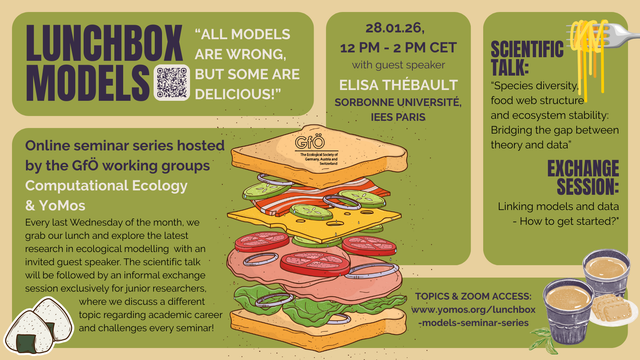
 Frederico Mestre
 Geekcologist