 Steve Dustcircle 🌹
#Hubble spots white #dwarfstar 'snacking' on chunk of #Pluto-like object

#Hubble spots white #dwarfstar 'snacking' on chunk of #Pluto-like object
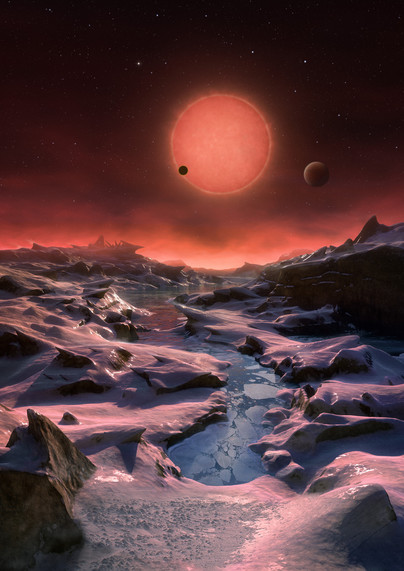
Artist’s impression of the ultracool dwarf star TRAPPIST-1 from the surface of one of its planets
Credit: ESO/M. Kornmesser
https://www.eso.org/public/images/eso1615a/
#universe #astronomy #astrophysics #astrodon #space #art #life #science #exoplanet #planet #planets #trappist1 #star #ultracool #dwarfstar #astroart #eso
The planet, which is 13 times bigger than #Earth, is orbiting a star called #LHS3154, which is nine times smaller than the #sun. The planet’s heft is unremarkable in its own right, but its pairing with an ultracool #DwarfStar, the smallest and coldest stars in the universe, has puzzled scientists.
Astronomers spot ‘overweight’ planet that appears too big for tiny host star | #Space | The Guardian
https://www.theguardian.com/science/2023/nov/30/astronomers-spot-overweight-planet-too-big-for-tiny-host-star
Orbiting the cool #DwarfStar K2-18, the exoplanet, 2.6 times the radius of #Earth, lies in what #Nasa calls the habitable zone, a region around a star where planets with liquid #water may be present.
Nasa says distant #exoplanet could have rare #WaterOcean and possible hint of life | Nasa | The Guardian
https://www.theguardian.com/science/2023/sep/11/nasa-planet-ocean-life-james-webb-telescope
Two-faced star with helium and hydrogen sides baffles astronomers: https://theguardian.com/science/2023/jul/19/two-faced-star-with-helium-and-hydrogen-sides-baffles-astronomers-janus
Credit animation : K. Miller, Caltech/IPAC
See also:
➡️ the Nature paper by Ilaria Caiazzo and co-authors: https://nature.com/articles/s41586-023-06171-9
➡️ the Keck Observatory Science News: https://keckobservatory.org/janus
#universe #astronomy #astrophysics #astrodon #dwarf #star #dwarfstar #janus #whitedwarf #stars
For the first time, astronomers have detected a radiation belt around a dwarf star outside our solar system. Radiation belts are zones of energetic particles trapped by a planet’s or star’s magnetic field. The discovery could help us understand how radiation belts form and evolve.
#RadiationBelt #DwarfStar #Astronomy
https://www.space.com/dwarf-star-radiation-belt-first-outside-solar-system

#Astronomers Have #Detected #Strange #Signals Coming From a #Star 11 Light Years Away
Could these radio signals mean there are signs of alien life out there?
 Daniel Pomarède
 Norobiik @
 Steve Dustcircle 🌹
 Hari Tulsidas
 rixty
rixty