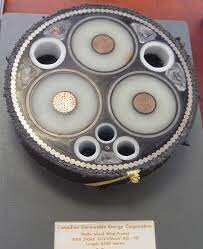
https://www.enr.com/articles/61089-feds-withdraw-49b-loan-for-grain-belt-express-power-line-as-clean-power-prospects-dim

(a deeper dive here)

#GrainBeltExpress, an 800mi, 600kV high-voltage #directcurrent line, was designed to carry up to 5 GW of wind and solar power from #Kansas through #Missouri to #Illinois and #Indiana…covering 530 miles from western Kansas to central Missouri, was expected to cost $4.4 billion, including converter stations and right-of-way acquisition…Grain Belt Express secured voluntary transmission service agreements with 39 Missouri municipal utilities—up to 25MW.

Feds Withdraw $4.9B Loan for Grain Belt Express Power Line as Clean Power Prospects Dim

<p>Despite Trump administration loan guarantee withdrawal for the estimated <span style="caret-color: rgb(0, 29, 53); font-style: normal; font-weight: 500; letter-spacing: normal; orphans: auto; text-align: start; widows: auto; word-spacing: 0px; display: inline !important; float: none;">$7-billion to $11-billion</span><span style="caret-color: rgb(0, 29, 53); font-style: normal; font-weight: 500; letter-spacing: normal; orphans: auto; text-align: start; widows: auto; word-spacing: 0px; display: inline !important; float: none;"> midwest transmission project</span>, developer said it would continue forward by securing capital through other sources.</p>

Engineering News-Record
KEPCO, Hanwha, and LG Electronics collaborate on innovative DC-based data center project, aiming for 10% energy savings and global market expansion
#YonhapInfomax #KEPCO #Hanwha #LGElectronics #DataCenter #DirectCurrent #Economics #FinancialMarkets #Banking #Securities #Bonds #StockMarket
https://en.infomaxai.com/news/articleView.html?idxno=60443
KEPCO, Hanwha, LG Electronics Sign MOU for DC-based Data Center Construction

KEPCO, Hanwha, and LG Electronics collaborate on innovative DC-based data center project, aiming for 10% energy savings and global market expansion

Yonhap Infomax
A thought - With so much #residentialsolar being installed - I wonder to what degree in the future a second #directcurrent supply will become common within the home. I know that #unitedstates homes have both #110V and #220V #alternatingcurrent circuits - but given how much #12volt stuff we have in our house I've started to consider including 12vDC feeds (Potentially wiring #cat6 #poe )
#solar

🤯🤯🤯

Sólo de pensar en las aplicaciones en la salud, me mareo

“We have discovered that hard, electrical conductors (e.g., metals or graphite) can be adhered to soft, aqueous materials (e.g., hydrogels, fruit, or animal tissue) without the use of an adhesive... This adhesion endures after the field is removed, and we term it as hard–soft electroadhesion or #EA

#ElectroAdhesion #DC #DirectCurrent

https://pubs.acs.org/doi/10.1021/acscentsci.3c01593

#TIL you can tell if somebody is being electrocuted by AC (#alternatingcurrent) or DC (#directcurrent) electricity.

If they're frozen still, it's DC. If they're spasming and convulsing, it's AC.

Either way, they're having a bad time.

#Science #randomfacts #acdc #electricity

DO 202 – Alexis Zeigler, Living Energy Farm - with Josh and Ashley

Living Energy Farm is a pioneering off-grid project in central Virginia. They have developed relatively low-cost methods for taking advantage of solar energy in the form of passive solar-thermal systems for space heating and water heating as well as DC electricity. Their “DC microgrids” systems power household appliances and computers/phones, in addition to a wide array of hand tools and shop tools. This is accomplished by efficient “daylight drive” using power from PV panels to directly run DC motors, or by using energy stored in robust nickel-iron batteries. They have also prototyped an array of low-cost homestead technologies used for biogas systems, drying seeds and foodstuffs, harvesting crops, and doing other “tractor work.” This fast-paced conversation outlines the technologies developed by LEF and contextualizes them in Alexis’ and community members’ philosophy of practical non-nonsense environmental technologies for achieving good quality of life as an antidote to typical, mainstream, middle-class, bourgeois environmentalism. Learn more about their work: livingenergyfarm.org livingenergylights.com

Doomer Optimism | Invidious
Utility Dive: "Why HVDC cables are poised to provide valuable alternatives." Moving bulk electric power over long distances is a huge part of adding renewables like wind + solar. In U.S. historically this has been performed by high-voltage alternating current (HVAC) transmission lines, though high-voltage direct current (HVDC) transmission has much more often been deployed in many other parts of the world. Over long-distances HVDC actually cost-effective, 'can transport more power farther without the dielectric or capacitive losses experienced by AC cables over very long distances,' + can be deployed underground in a much narrower right-of-way (ROW) than overhead transmission lines. "Instead of a 150- to 300-foot-wide ROW for a high-voltage overhead line, an underground HVDC cable with similar capacity can be installed in a 10-foot ROW," though with a temporary 50-foot construction easement. 'Provides a system that is highly resilient against extreme weather, vegetation interference and potential pushback from local residential and commercial landowners.' While there are higher upfront costs of underground installation, factoring in lower maintenance costs, reduced wildfire risk + pure aesthetics argues for more support for underground HVDC, especially installed parallel to railroad lines + highways. Personally, I would be much more accepting of temporary excavation for underground lines than permanent high-tower transmission pylons. #highvoltage #directcurrent #electricgrid

High Current Measurement Probe For Oscilloscopes

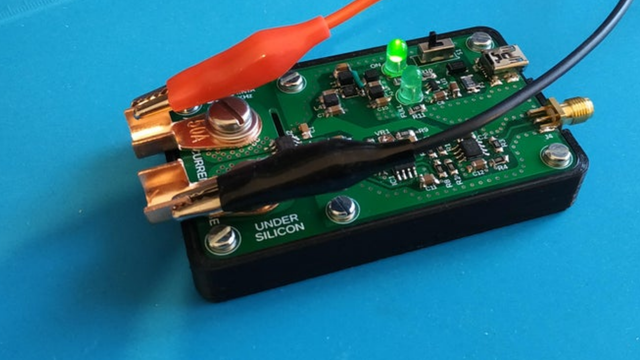
A decent current measurement sensor ought to be an essential part of every hacker's workbench. One that is capable of measuring DC, as well as low and high frequencies with reasonable accuracy. And bonus credits if it can also withstand high bus voltages - such as those found in mains utility or electric vehicle work. [Undersilicon] couldn't find one that ticked all the boxes, so he built an ACS730 based AC/DC current probe capable of measuring up to 25 A at frequencies up to 1 MHz.

Allegro Microsystems has a wide offering of current sensor IC's. The ACS730 features a -3 dB bandwidth of 1 MHz, and -1 dB bandwidth of 500 kHz. Since it is galvanically isolated, it can be used in AC mains applications up to 297 Vrms and for DC up to 420 V. And as he intended to use it as an oscilloscope accessory, the analog output suited the application nicely. A pair of precision op-amps provide the voltage output scaled to 100 mV/A. The board is powered off a 1000 mAh LiPo battery that can run the sensor for about 15 ~ 20 hours. The power supply section consists of a charge circuit for the LiPo, and a split rail dual output power supply converter for the op-amps.

The ACS730 has a 2.5 V output when measured current is zero, and is scaled for 40 mV/A. This gives an output voltage swing from -0.5 V for -50 A to +4.5 V for +50 A. This is where the AD823ARZ dual 16 MHz, Rail-to-Rail FET Input Amplifiers step in. One pair is used to obtain a 2.5 V reference from the 5 V supply, and also to buffer the analog output from the ACS730. The second pair subtracts the 2.5 V offset, and applies a gain of 2.5 to get the 100 mV/A output. Dual power supply for the op-amps comes from a TPS65133 Split-Rail Converter, ±5V, 250mA Dual Output Power Supply. Lastly, LiPo charging is handled by the MCP73831 Single Cell, Li-Ion/Li-Polymer Charge Management Controller.

Initial testing of direct currents has shown fairly accurate performance. But he's observed some noise when measuring currents below 1 A which requires some debugging to figure out the source. [Undersilicon] has provided the CAD files for both the PCB and 3D printed enclosure, giving you access to everything you need to build one yourself. If you're looking for something a bit more heavy duty, you might be interested in this +/-50 A, 1.5 MHz sensor encased in concrete.

#hardware #toolhacks #acs730 #ad823arz #alternatingcurrent #current #currentmeasurement #currentmeter #currentsensor #directcurrent #mcp73831 #tps65133

High Current Measurement Probe For Oscilloscopes

A decent current measurement sensor ought to be an essential part of every hacker’s workbench. One that is capable of measuring DC, as well as low and high frequencies with reasonable accurac…

Hackaday