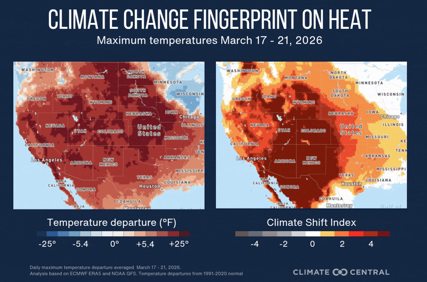
ClimateCentral: “Climate change intensifies record-breaking early-spring heatwave across the West.” It is raining up on the Mt. Baker ski areas as I write this. They have halted skiing over the next 4 days because of an ‘atmospheric river,’ + describe temperatures above freezing with “heavy rain [coupled with] heavy winds” as of Monday afternoon. The climate scientists state that “a prolonged stretch of unusually high temperatures will push highs 20°F to 30°F above normal across much of the western United States this week, with dozens of daily records expected…human-caused climate change is making this heat more likely [up to 5 times more in places such as Santa Fe, Denver, Salt Lake City +Boise] and will also accelerate snowmelt, during a year already marked by widespread snow drought across the region.”
As stated by the National Weather Service, “…many locations are likely to set both all-time high temperatures for the month of March and their earliest 100° temperature on record.” Started with an Extreme Heat Watch in effect for Southern California and parts of Arizona, where high temperatures are expected to reach between 95°F and 105°F. Parts of California’s Coachella Valley are forecast to experience temperatures ranging from 106°F to 115°F. For context, recall that the last day of winter this year is not until March 20th.
“The western U.S. is also experiencing a widespread record-breaking snow drought this year due to warm winter temperatures…final wave of unusually high temperatures will only exacerbate snowmelt ahead of April 1, which is typically the date of peak snow water equivalent—the maximum amount of water stored in the snowpack and available for spring melt.”
If this plays out as expected, it’s going to be slim pickings by April first, which is no laughing matter. Notably,Climate Central will have an update on that day.
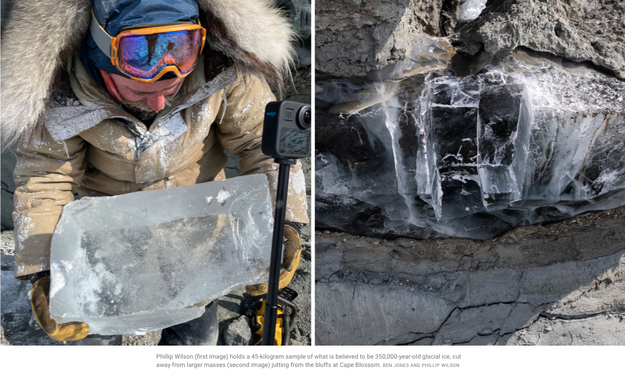
AAAS: “Frozen Witness,” Poetic beginning: “CAPE BLOSSOM, ALASKA—The tundra along Alaska’s northwestern coast sprawls gently into the distance, shimmering and waterlogged with the summer thaw. Humans once passed into North America here, before the great ice sheets retreated and seas rose, swallowing the Bering Strait land bridge.” In Antarctica, researchers have drilled deep into a time called the Pleistocene, capturing 800,000 years of continuous history, when glacial episodes within our current Plio-Pleistocene Ice Age recurred about every 100,000 years. “In Greenland, which holds the best ice records in the Northern Hemisphere, continuous cores go back as far as 123,000 years—only enough to capture the last glacial cycle.”
“But at Cape Blossom, “researchers led by Wilson and Benjamin Jones, a geographer at UAF, believe they have found a rare witness: glacial ice that has potentially survived for at least 350,000 years—defying multiple bouts of planetary warming…if true, it would be the only known ice of this age in the Northern Hemisphere.” It is likely that ‘this ice likely formed in the wake of a famously long interglacial period, or warm spell, when seas were 6 to 13 meters higher and temperatures peaked at or above today’s—an inviting, if unsettling, comparison to future warming.’
Many climate patterns are distributed unevenly. “What scientists learn from Antarctic ice can only go so far in explaining what happened in the north, which holds most of the world’s land and 90% of the world’s population.” However, “unlike the cores from Antarctica and Greenland, where ice is stacked in clean annual layers, the Alaskan ice so far appears to be a complicated snapshot, contaminated by surrounding sediments.”
About 425,000 years ago, the deep-sea record shows an unusually long warm period called Marine Isotope Stage 11, or MIS-11, based on the dating of oxygen isotopes in the shells of tiny plankton. “Verifiable records from this deep in time are scarce, and because MIS-11’s climate was so similar to today, any insight—especially how ice volumes changed as the planet warmed—carries outsize weight. Much of the investigation of these ice samples is taking place at Wood Hole Oceanographic Institute. More on that later.
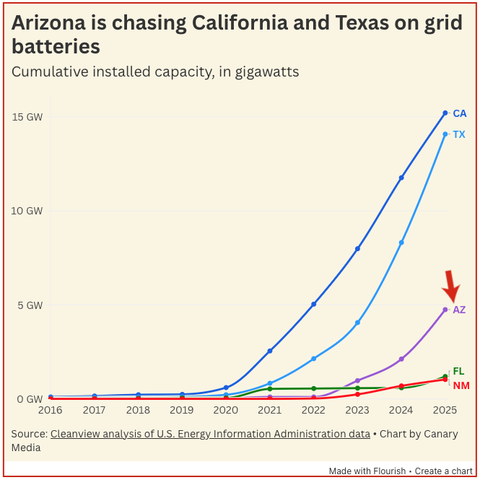
CanaryMedia: “Which states have the most grid batteries?” Competition is heating up like pancakes on a griddle. California + Texas may be far ahead of the pack when it comes to grid batteries, but hot-syrup-red Arizona is just itching to catch up. “Arizona saw blistering growth in utility-scale battery capacity last year, more than doubling its fleet to a total of 4.7 gigawatts [GW] at the end of 2025, according to U.S. Energy Information Administration data analyzed by research firm Cleanview.” The two leading states each installed far more capacity last year than Arizona did, but neither of these more mature markets grew as quickly. ” California expanded its fleet by 29%, to 15.2 GW, while Texas’ grew by 69%, pushing it to just over 14 GW of total installed capacity.”
Batteries continue to fall in price and are among the fastest ways to add capacity. “At a time when demand for electricity is skyrocketing, threatening to push already elevated utility bills even higher—cost and speed are critical factors.” In Washington, “the Republican budget bill passed last summer notably let batteries hang on to their generous tax incentives while sunsetting the same credits for solar and wind.” For perspective, “less than a decade ago, hardly any batteries were plugged into the grid, but a combination of those falling costs, surging solar, clean energy targets, and tweaks to energy market designs have opened the floodgates in certain regions.”
It makes sense that Arizona is now third on the battery leaderboard, as Arizona is “fourth in the nation in utility-scale solar, after Texas, California, and Florida.” Meanwhile, Arizona is staring down a bigger increase in electricity demand than “almost anywhere in the country,” writes Cleanview founder Michael Thomas. “Arizona is not only a hot spot for the data center boom but also the site of a massive, energy-hungry chip-manufacturing hub being built by the Taiwan Semiconductor Manufacturing Company.”
Now it’s time to go whip myself up some pancakes.
CanaryMedia: “Virginia to become second state that allows balcony solar.” Blood-orange red Utah was the first state to allow balcony solar. Now, “the Democratic-controlled Virginia House of Delegates passed a bill legalizing “balcony solar” by a unanimous, bipartisan vote…the Senate, where Democrats also have a majority, had already approved the measure with only a handful of dissents.” It will soon reach the desk of Gov. Abigail Spanberger, a Democrat, who will undoubtedly sign it. Too bad the law does not go into effect until January.
But clearly, Virginia is going “to treat solar panels like an appliance you can buy at your local big-box store and set up yourself—on your balcony, in your yard, or anywhere the sun shines on your property.” Logically, this “removes all kinds of barriers—not just cost barriers, but time and bureaucracy barriers,” said Victoria Higgins, Virginia director for the lobbying arm of Chesapeake Climate Action Network Action Fund, an advocacy nonprofit. “It makes clean energy more accessible to so many more Virginians, whether they live in apartments, or condos, or just don’t have the funding to put up a whole rooftop system.”
“The kits will be subject to safety standards and limited to a total of 1,200 watts, or about four panels, which is enough to supply between 5% and 15% of the average customer’s demand.” While a few states have deferred balcony solar bills because of safety concerns voiced by utilities, Higgins notes that Virginia’s bipartisan support helps show that red and blue states alike are eager to address energy affordability. At this point, “the estimated payback period is somewhere between two and five years.”
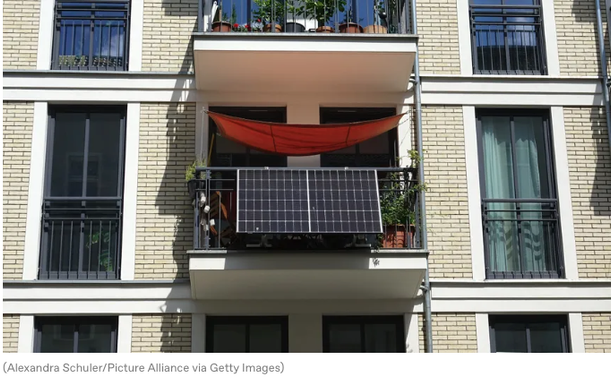
When politicians and the general public become more familiar with the technology + with economies of scale, we might see 20 states pass similar legislation this year. Watch out folks, this may prove to be an entry-level drug, aside from the fact that the first one is not free. From the photo, looks like the panels may provide a bit of shade + wind protection for the lucky owner, to take with them when they move on.
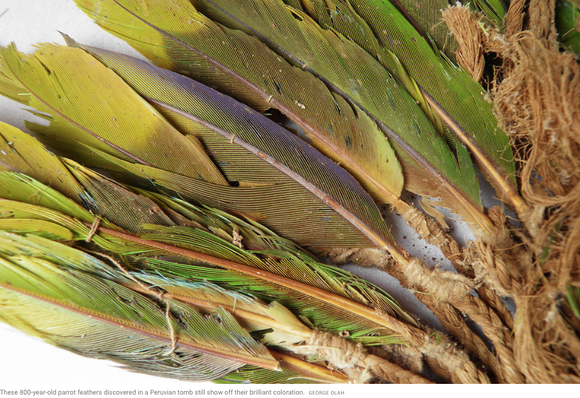
AAAS: “Ancient Peruvians transported live parrots across the Andes.” On Peru’s arid coast, some ancient elites signaled their power + standing by wearing headdresses festooned with brilliantly colored feathers from birds found in distant rainforests. ‘Study in Nature Communications reveals how they acquired these showy ornaments more than 800 years ago: from wild Amazonian parrots captured hundreds of kilometers away in the Amazon and transported—alive—high over the Andes.’ The feathers analyzed were from tombs of a pre-Inca culture called the Ychsma on the arid coast near present-day Lima.
“Archaeologist Izumi Shimada of Southern Illinois University…shipped the feather samples to Bastien Llamas, a specialist in ancient DNA at the University of Adelaide, where the detective work began.” They started with 25 samples originally, but only half contained DNA—and only about half of those had enough ancient mitochondrial DNA to perform the analysis, The 3 different samples came from 3 different scarlet macaws, with a high degree of genetic diversity, implying wild instead of captive breeding. “Carbon dating suggested the oldest dated to about 1100 C.E. to 1225 C.E.”
“Researchers also analyzed carbon and nitrogen isotopes within the feathers, which can provide clues to the birds’ diets…enriched levels of carbon-13 showed that in their final years, instead of eating a typical diet of rainforest fruits and nuts, the parrots had been fed maize.” Finally, elevated nitrogen levels suggested maize was enriched with natural fertilizers, such as dung from camelids like llamas, or guano from seabirds, an agricultural practice common in Peru’s coastal region at the time.
Another example of ancient, preindustrial humans coopting carbon + nitrogen cycles to create beautiful cultural artifacts.
AAAS: “How bumble bees survive days underwater without drowning.” In 2022, ecologist Sabrina Rondeau, while working on her Ph.D. at the University of Guelph, noted that a frosty refrigerator had dripped condensation into containers holding 4 queen bees in a state of winter hibernation, termed diapause. “After pulling them out, she was stunned to find they were still alive.” In 2023, she joined the biology department at the University of Ottawa as a postdoc, + soon learned that Charles Darveau, an evolutionary physiologist there, was also interested in insectile diapause. “If the bees held their breath—by closing the openings to the breathing tubes called ‘spiracles’ that distribute oxygen to their tissues—Darveau figured they would run out of oxygen after only a few hours.” He hypothesized they might be slowing down metabolism even more than during diapause, even be switching to anaerobic metabolism—a type of respiration used mainly by microbes but also in animal muscles for bursts of activity. “This type of metabolism doesn’t require oxygen, but builds up lactate [= lactic acid].”
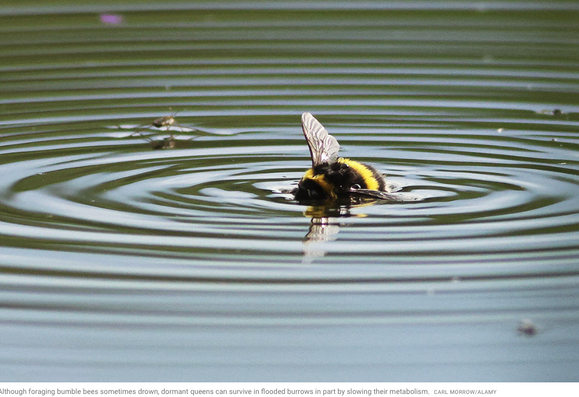
Darveau, Rondeau, and undergraduate Skyelar Rojas studied 50 bumble bees that they maintained in diapause in a refrigerator. “They took them out and put them, one at a time, in a small container filled nearly to the top with water.” Over 8 days they measured the minute amounts of CO2 released by the submerged bees. The scuba diving bees exhaled 75% less CO2 the first day, indicating they had dropped their metabolic rate by more than half. “The insects also switched partially to anaerobic metabolism, as shown by a 15-fold increase of lactate in the bees’ bodies.” The submerged bees survived due to a thin layer of air surrounding them, known as a ‘physical gill,’ allowing them to exchange O2 in + CO2 out with the surrounding liquid.
What with the increasing floods associated with climate change, perhaps humans could pick up some of these tricks. More realistically—don’t try this at home.
CanaryMedia: “Oil and gas workers find an easy segue into geothermal jobs.” In 2025, Jamie Beard, executive director of the advocacy group Project InnerSpace, hosted an event called MAGMA—short for Make American Geothermal More Abundant—last year to bring together industry leaders, policymakers, and [importantly] Energy Secretary Chris Wright to make the case for next-generation geothermal. “The Trump administration has looked favorably upon this renewable energy even as it has smothered wind and solar.” The One Big Beautiful Bill Act preserved its tax credits through 2033, and the DOE recently announced $171.5 million for next-generation geothermal field tests. “Another DOE report released in 2024 showed the domestic geothermal workforce inching up to 8,870 people,” where globally, the industry employs around 145,000 workers.
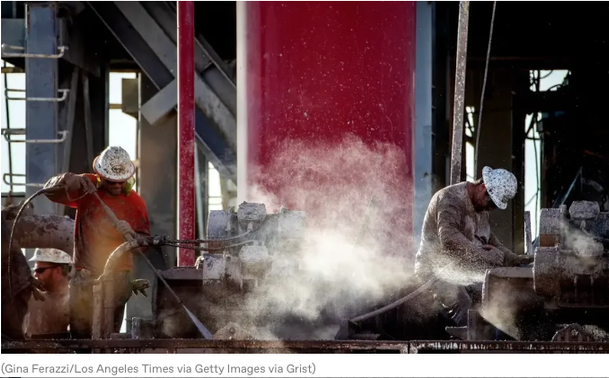
“Cindy Taff, CEO of geothermal startup Sage Geosystems, sees a broad range of fossil fuel workers, from drillers to geologists, who will fit right into the renewables sector, arguing that the same industry that evolved from simple land wells to offshore operations in water thousands of feet deep has a vast pool of technical expertise.” Apparently, major oil companies “haven’t made big investments” in this area while they wait for the technology to be proven out. “Companies boring thousands of feet into the earth, a technique called enhanced geothermal, can reach rock as hot as 750°F—hot enough to power buildings, factories, even communities.”
This creates tremendous opportunities for oil and gas workers and others with drilling experience…as many as 300,000 people already possess the required skills, according to a 2024 U.S. Department of Energy report. I have strenuously criticized the Trump administration on multitudinous issues. but I offer grudging admiration in two areas: for ramping up geothermal + for preparing to lay down the keels to build Coast Guard cutters including icebreakers, additionally ordering 4 of the world’s universally acknowledged best ice-cracking ships, made in Finland.
But I’m not going to get a MAGMA hat, I don’t care what you say.
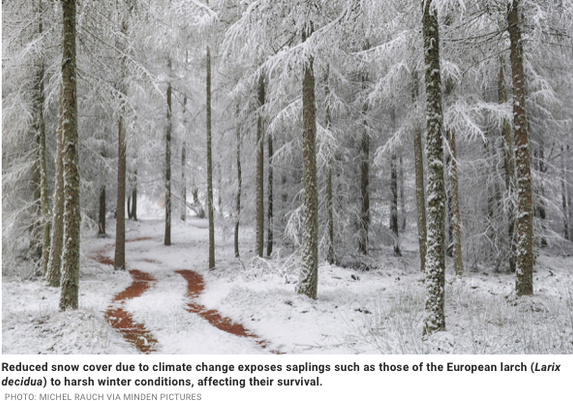
New Phytologist: “Reduced snow cover at the alpine treeline: resistance and recovery of saplings.” The phrase ‘a blanket of snow’ is not just evocative, it actually describes how small, young plants survive high-elevation winters. “Climate change is reducing snow cover duration in mountain regions, exposing young trees and shrubs to harsher winter conditions, including extreme cold, freeze-thaw cycles, and drought.”
To investigate, “A snow removal experiment was carried out at 1700 m above sea level on saplings of five different species (Acer pseudoplatanus, Juniperus communis, Larix decidua,Picea abies and Sorbus aucuparia)” [One of these is new to me: the “Rowan tree (Sorbus aucuparia), or Mountain Ash, is a hardy, small deciduous tree known for its striking compound leaves, creamy-white flowers in spring, and clusters of bright orange-red berries in autumn, rich in Vitamin C and vital for wildlife.” Good to know, + its photos are pretty to boot]. Stem diameter was continuously monitored and compared with the 5 factors of spring hydraulic conductivity (PLCspring), living cell mortality (PLDspring), nonstructural carbohydrates (NSCs), growth and survival rates.”
They “found that snow-free saplings experienced severe damage to their water-transport systems and living cells, leading to reduced growth and increased mortality the following summer.” Although some species could repair damage or regrow from roots, others struggled to recover. “These findings reveal that shorter snow cover threatens mountain forest regeneration because young plants may not survive successive harsh winters without adaptation mechanisms such as resprouting or hydraulic repair.”
Resprouting, now that sounds like something older guys wish their scalp could accomplish. Although for saplings, this is absolutely no laughing matter.
AAAS: “Many heat-stressed tropical insects are reaching their limits.” It seems intuitive that lowland tropical insects must have evolved to deal with brutal heat. “Compared with mammals, insects are more at the mercy of a hot environment because they can’t cool themselves by sweating or panting.” Their main defense strategies involve avoiding heat by finding shade or burrowing underground. “They can also synthesize ‘heat shock proteins,’ which help prevent other proteins from misfolding or breaking down when exposed to high temperatures.”
Researchers behind the new study tested the responses of 2300 species living in a range of environments + elevations in Peru and Kenya. Ecologist Kim Lea Holzmann…[in] over three field seasons in the Peruvian Andes collected thousands of insects…and put them into small tubes. “Back at camp, she added them to a portable laboratory oven and ramped up the temperature…checked in every few minutes to see which of the various species had stopped moving, which they used as marker of the limit of heat tolerance.” In Peru, flies had the lowest heat tolerance, stopping their movements at an average of 39°C = 102°F. “Beetles could cope with up to 41°C on average, whereas bees and other social insects put up with a bit more.” Grasshoppers and other members of an insect order called Orthoptera were the hardiest: They stopped kicking at 44°C = 111 °F, on average.
“In an analysis that backs up this pattern, Holzmann and colleagues looked at the thermal stability of proteins that are commonly found in major insect groups.” Working from genomic data for 677 insect species, they randomly selected 1000 proteins for each species and had a computer model estimate the temperature at which the protein structure would break down. “The overall pattern mirrored what the team observed in their field experiments: Flies were the most sensitive and orthopterans the most resilient.” In a projection of temperatures by 2100, they estimated up to half of the insects in tropical populations could suffer a ‘heat coma’ after 8 hours of exposure to typical temperatures predicted for the future.
Sobering to say the least. Scary to say the most.

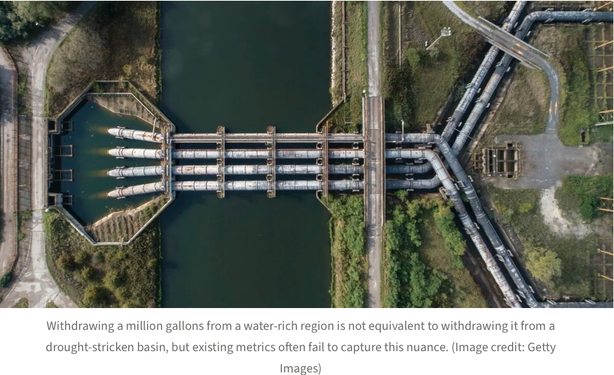
Stanford: “New metric reveals true corporate water footprints.” While carbon dioxide emissions are a global issue, water is an intensely local one. To address this, Stanford + Korea University researchers developed a scoring system that weighs where companies draw water and how it’s utilized. A new “water sustainability index” or WSI scores companies based on water source, local watershed stress, discharge quality, and reuse practices. The score also rewards water reuse technologies + penalizes companies drawing from areas of drought. Carrot + stick approach, as it were.
“Thousands of companies around the world now regularly disclose [incomplete] aspects of their water use as part of corporate commitments to environmental, social, and governance goals [ESG.]” Thus, weighting factors were devised based on the level of stress of the local watershed. “Analyzing data from the London Stock Exchange Group…[researchers] found that while 14% of major companies reported their greenhouse gas emissions, only 9% provided explicit data on total water withdrawals…more tellingly, only 1% disclosed whether their operations utilized recycled water.”
Stressed watersheds were defined as either regions where withdrawals exceed 40% of available freshwater, or alternatively, for exploitation of groundwater, which is more difficult to replenish than surface water. The new index is an easy-to-calculate, reproducible, single number ranging from 0 to 3.0. “Approximately 25 percent of the global population lives in extremely high stress watersheds, increasing [risk + responsibility] for water-intensive industries.” Notably, this new index aligns corporate reporting with United Nations Sustainable Development Goal 6.
Clearly, heat stress, drought, + agricultural failures will progress with climate weirding. Let’s make companies such as the new data centers ‘own’ their impacts on ecosystems. This is not unglamorous—it is critical. Think about this the next time you turn on your kitchen faucet.