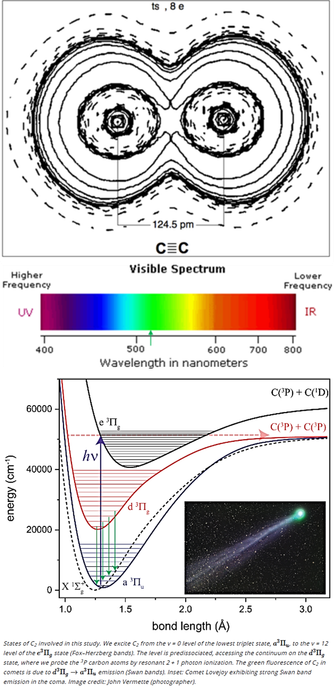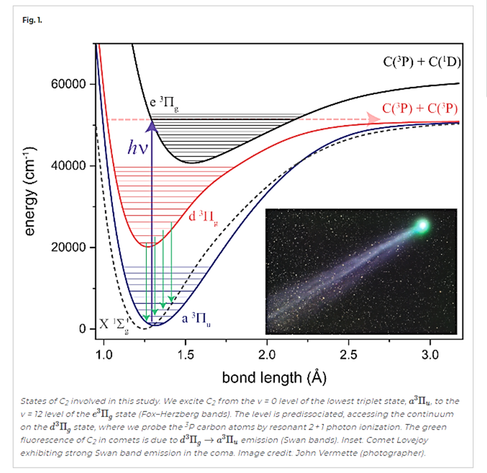
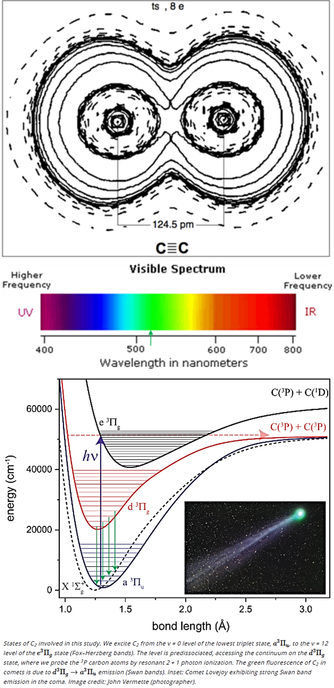

The green color seen in the coma of most comets, but not in their tails, is due to emissions from Diatomic carbon C2 (aka dicarbon) molecules.

Sunlight heats the comet’s ice and organic material to produce C2 molecules, which break apart in ~2 days before they reach the tail. C2 is excited by solar UV radiation and emits mostly in infrared but its triplet state radiates at 518 nm (d3Πg → a3Πu transition below).

https://physicstoday.scitation.org/do/10.1063/pt.6.1.20220110a/full/
https://www.pnas.org/doi/10.1073/pnas.2113315118
#dicarbon #PonsBrooks
5/n

Explosive, green 'devil comet' has hidden spiral swirling around its icy heart, photo trickery reveals

New, specially edited photos show a previously unseen swirl of light surrounding the city-size comet 12P/Pons-Brooks, which is currently racing toward the sun and will later zoom past Earth.
Live Science

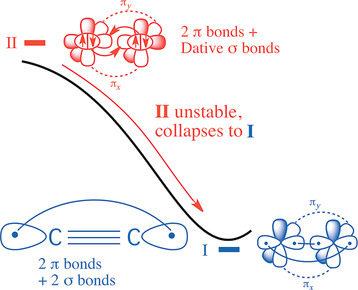
Some articles and papers on the enigmatic quadruple bond in C2 -
https://www.chemistryworld.com/news/calculations-reveal-carbon-carbon-quadruple-bond-/3000688.article
https://www.nature.com/articles/nchem.1263
https://chemistry-europe.onlinelibrary.wiley.com/doi/10.1002/chem.201600011

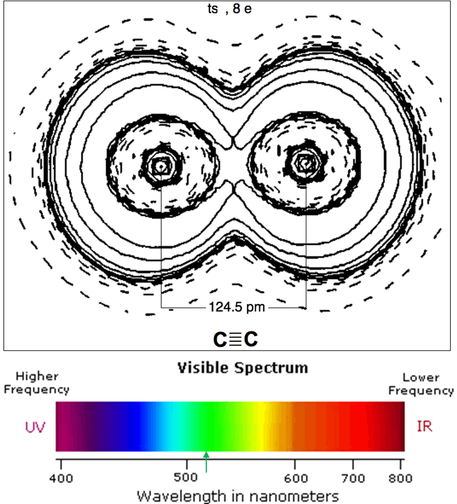
C2 exhibits a triple bond as in N2, but has been shown to have a fourth weaker bond formed by the outer electrons.

#dicarbon #C2023P1 #Nishimura
10/n

Calculations reveal carbon-carbon quadruple bond

High bonding order possible in main group and may be responsible for the ability to isolate molecular species

Chemistry World

Diatomic carbon C2 is a green, gaseous inorganic chemical. It is unstable at ambient temp. and pressure (it polymerizes).
It is found in flames, comets, stars and the interstellar medium.

From https://www.pnas.org/doi/10.1073/pnas.2113315118 -
"This work shows that, to break the quadruple bond of C2 using sunlight, the molecule must absorb two photons and undergo two “forbidden” transitions." (spin conservation and the Born–Oppenheimer approx).

Oh my!

https://en.wikipedia.org/wiki/Diatomic_carbon
#dicarbon #C2023P1 #Nishimura
9/n

The green color seen in the coma of most comets, but not in their tails, is due to emissions from quad-bond Diatomic carbon (aka dicarbon) molecules.

Sunlight heats the comet’s ice and organic material to produce C2 molecules, which break apart in ~2 days before they reach the tail. C2 is excited by solar UV radiation and emits mostly in infrared but its triplet state radiates at 518 nm.

https://physicstoday.scitation.org/do/10.1063/pt.6.1.20220110a/full/
https://www.pnas.org/doi/10.1073/pnas.2113315118
#dicarbon #C2023P1 #Nishimura
8/n

The green color seen in the coma of Comet C/2023 E1 (ATLAS) and other comets, but not in their tails, is due to emissions from quad-bond Diatomic carbon (aka dicarbon) molecules.

Sunlight heats the comet’s ice and organic material to produce C2 molecules, which break apart in ~2 days before they reach the tail. C2 is excited by solar UV radiation and emits mostly in infrared but its triplet state radiates at 518 nm.

https://physicstoday.scitation.org/do/10.1063/pt.6.1.20220110a/full/
https://www.pnas.org/doi/10.1073/pnas.2113315118
#comet #C2023E1 #dicarbon
6/n

@markmccaughrean
The green color seen in the coma of comets incl. that of Comet C/2022 E3 (ZTF) is also related to the elusive quadruple bond of the C2 molecule.

From https://www.pnas.org/doi/10.1073/pnas.2113315118 — "This work shows that, to break the quadruple bond of C2 using sunlight, the molecule must absorb two photons and undergo two 'forbidden' transitions."
Oh my!
Image source: https://www.pnas.org/doi/10.1073/pnas.2113315118
Also see https://fosstodon.org/@AkaSci/109768059428824754
#comet #dicarbon #chemistry

The green color seen in the coma of Comet C/2022 E3 (ZTF) is also related to the elusive quadruple bond of the C2 molecule.

From https://www.pnas.org/doi/10.1073/pnas.2113315118 — "This work shows that, to break the quadruple bond of C2 using sunlight, the molecule must absorb two photons and undergo two 'forbidden' transitions."
Oh my!
Image source: https://www.pnas.org/doi/10.1073/pnas.2113315118
#comet #dicarbon #chemistry
9/n

The green color seen in the coma of Comet C/2022 E3 (ZTF) and other comets, but not in their tails, is due to emissions from Diatomic carbon molecules.

Sunlight heats the comet’s ice and organic material to produce C2 molecules, which break apart in ~2 days before they reach the tail. C2 is excited by solar UV radiation and emits mostly in infrared but its triplet state radiates at 518 nm.

https://physicstoday.scitation.org/do/10.1063/pt.6.1.20220110a/full/
Image source: https://www.researchgate.net/figure/Dicarbon-moleculeThe-original-figure-is-from-4-Used-under-Creative-Commons-License_fig4_328571186
#comet #dicarbon #chemistry
8/n

How dicarbon breaks apart

<p>A laboratory study resolves the mechanism by which C<sub>2</sub> molecules dissociate in sunlight.</p>

Physics Today

@jhayden
Some articles and papers on the quadruple bond in C2 -
https://www.chemistryworld.com/news/calculations-reveal-carbon-carbon-quadruple-bond-/3000688.article
https://www.nature.com/articles/nchem.1263
https://chemistry-europe.onlinelibrary.wiley.com/doi/10.1002/chem.201600011

From https://www.pnas.org/doi/10.1073/pnas.2113315118
- "This work shows that, to break the quadruple bond of C2 using sunlight, the molecule must absorb two photons and undergo two “forbidden” transitions."
#comet #dicarbon #chemistry

Calculations reveal carbon-carbon quadruple bond

High bonding order possible in main group and may be responsible for the ability to isolate molecular species

Chemistry World