Comet C/2023 P1 (Nishimura) over Stonehenge!

More images of the comet upstream in this thread.

Posted on the Stonehenge twitter site.
Credit: Nick Bull
https://twitter.com/EH_Stonehenge/status/1701207821293846983
#C2023P1 #Nishimura
6/n

Stonehenge on X

Comet Nishimura (C/2023 P1) over Stonehenge. ☄️ Discovered last month by amateur astronomer Hideo Nishimur, the comet will reach its closest point to Earth tomorrow (12 Sept). If you’re an early riser, you may be able to catch a glimpse before sunrise. 📷: Nick Bull

X (formerly Twitter)

Here is another outstanding image of comet C/2023 P1 (Nishimura), this one taken by Sławomir Matz.

His post reads - "C/2023 P1 (Nishimura) photographed on September 7, 2023. The comet is currently popular in the media and can be visible to the naked eye. I wrote about her on Facebook! Look for the peja "Stars in the hands."

https://twitter.com/slawomir_matz/status/1700474968176226556
#C2023P1 #Nishimura
5/n

Sławomir Matz on X

C/2023 P1 (Nishimura) sfotografowana 7 września 2023 roku. Kometa jest obecnie popularna w mediach i może być widoczna gołym okiem. Rozpisałem się o niej na fb! Szukajcie peja "Gwiazdy w dłoniach" #astrophotography #astronomy #comet #Nishimura

X (formerly Twitter)

This glorious image of comet C/2023 P1 Nishimura was taken by Jeremy Perez, art director and photographer in Flagstaff, AZ.

Taken Sat. morning, Sep 9 from Cinder Hills Overlook/Sunset Crater in AZ.

He adds - "Canon 6DII + Canon EF 24-105 f/4 @ 105mm.
41 x 4 sec, f/4 @ ISO 12800 in Starry Landscape Stacker & Photoshop/Lightroom.
Tail length ~6°"

At 0.84 AU distance, the tail is ~13M km long!

https://twitter.com/jperez1690/status/1700750391812780274
Check out his website at http://www.perezmedia.net/
#C2023P1 #Nishimura
4/n

Jeremy Perez on X

C/2023 P1 (Nishimura) Saturday morning from Cinder Hills Overlook/Sunset Crater. Too early in the morning for good sense and tough to spot as it rose. Twilight really hit it hard, but the tail was still decently long—about 6 degrees in this pic.

X (formerly Twitter)

Here is another vivid image of comet C/2023 P1 (Nishimura) by "comethunter" and astro-photographer Michael Jäger.

His post adds - "Comet Nishimura C/2023 P1 2023 sep. 9 2.48 UT 10x60sec Zeiss-Milvus f-135/2.5 Nikon Z50mod ISO 400 Michael Jäger."

https://twitter.com/Komet123Jager/status/1700456978194063573
#C2023P1 #Nishimura
3/n

Michael Jäger on X

Comet Nishimura C/2023 P1 2023 sep. 8 4.48 UT 10x60sec Zeiss-Milvus f-135/2.5 Nikon Z50mod ISO 400 Michael Jäger

X (formerly Twitter)

The light curve below shows that comet C/2023 P1 (Nishimura) is brightening up nicely. Current apparent magnitude is below 4 (lower is brighter).

In theory, objects with mag 6 and lower are visible to the naked eye, but currently the comet is low on the horizon during the early morning hours, so visibility depends on local conditions. Binoculars help.

After Sep 17, it will be too close to setting sun as seen from the northern hemisphere.

Source: http://astro.vanbuitenen.nl/comet/2023P1
#C2023P1 #Nishimura
2/n

Error

Some beautiful images of comet C/2023 P1 (Nishimura) are getting posted online by amateur and professional astro-photographers, as the comet nears its closest approach to earth on Sep 12.

Let's take a look at a few.

This first one, posted on apod, was taken in eastern Slovakia by Petr Horálek / Institute of Physics in Opava.

Check out this earlier thread for some more info on the comet - https://fosstodon.org/@AkaSci/111008086190146961

Source: https://apod.nasa.gov/apod/ap230911.html
#C2023P1 #Nishimura
1/n

AkaSci 🛰️ (@[email protected])

Attached: 1 image Comet C/2023 P1 (Nishimura) is now about 0.98 AU from Earth, 0.5 AU from the Sun. Closest approach to earth is on Sep 12, perihelion is on Sep 17. It is one of the brighter comets, mag 2.7 at its brightest, sporting a nice tail, but difficult to see due to its proximity to the Sun. Visible now low near the Horizon before Sunrise. (1 AU = avg Sun-Earth distance = 150M km) Image credit: Michael Jäger https://twitter.com/Komet123Jager #C2023P1 #Nishimura 1/n

Fosstodon
Die #Kometenjagd auf #Komet #C2023P1 #Nishimura war im Grunde erfolgreich!
Viel gab es auch im 20x80 Bino nicht zu sehen, denn in Blickrichtung lag viel Dunst über dem Horizont. Gegen 5:00, als er aufgehen sollte, war unterhalb der Venus *nichts* zu sehen außer grauer Himmel. Erst ab 5:30 schälten sich 41 & 40 Leo aus dem Grau. Mit Geduld links davon gesucht, und irgendwann ein "milchiges Sternchen" gesehen, das beim Aufstieg deutlicher & etwas grünlich wurde! Mehr nicht, kein Schweif.
(1/2)
9月10日 4:30 C/2023 P1
F8 5sec ISO800
300mmよりトリミング
頑張って撮るぞ!と意気込んでいたら
テストショット1枚で曇りました😭
#西村彗星 #C2023P1
#PENTAX #K3II #東京市街地

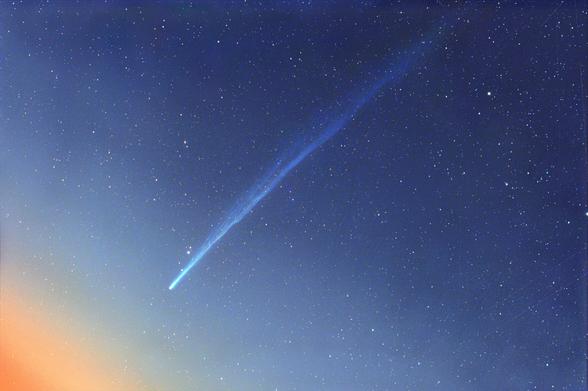
Here is another stunning image of Comet C/2023 P1 (Nishimura) captured earlier today by maestro Michael Jäger.

This one shows the two tails of the comet - the long dust tail and the shorter ion tail.

The dust tail, consisting of vaporized ejecta from the comet, points away from the sun and slightly behind the comet, while the ion tail, made of ionized gases, points along the streamlines of the solar wind.

https://twitter.com/Komet123Jager
https://en.wikipedia.org/wiki/Comet_tail
#C2023P1 #Nishimura
11/n

Michael Jäger (@Komet123Jager) / X

comethunter

X (formerly Twitter)

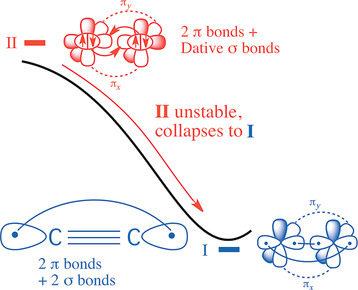
Some articles and papers on the enigmatic quadruple bond in C2 -
https://www.chemistryworld.com/news/calculations-reveal-carbon-carbon-quadruple-bond-/3000688.article
https://www.nature.com/articles/nchem.1263
https://chemistry-europe.onlinelibrary.wiley.com/doi/10.1002/chem.201600011

C2 exhibits a triple bond as in N2, but has been shown to have a fourth weaker bond formed by the outer electrons.

#dicarbon #C2023P1 #Nishimura
10/n

Calculations reveal carbon-carbon quadruple bond

High bonding order possible in main group and may be responsible for the ability to isolate molecular species

Chemistry World