Astronomers Capture the Clearest Image of a Cosmic Web Filament Connecting Galaxies

📰 Original title: First-ever direct image of the cosmic web reveals the Universe’s hidden highways

🤖 IA: It's not clickbait ✅
👥 Users: It's not clickbait ✅

View full AI summary: https://en.killbait.com/astronomers-capture-the-clearest-image-of-a-cosmic-web-filament-connecting-galaxies.html?utm_source=mastodon_world&utm_medium=social&utm_campaign=killbait.mastodon_world
#science #cosmicweb #galaxies #ast...

Astronomers Capture the Clearest Image of a Cosmic Web Filament Connecting Galaxies

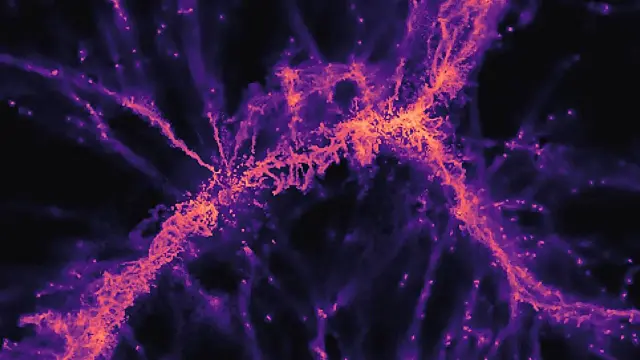
Astronomers have captured the sharpest direct image ever of a filament in the cosmic web, a massive network of matter that connects galaxies across the Universe. This glowing strand spans roughly 3 million light-years and links two galaxies that existed nearly 12 billion years ago, providing a rare glimpse into the early Universe. Using the MUSE instrument on the Very Large Telescope in Chile, researchers conducted hundreds of hours of observations to detect the faint intergalactic gas, which is normally difficult to observe due to its low brightness. By studying this filament, scientists can better understand how galaxies receive gas, which fuels star formation and galaxy growth. The observations also align well with supercomputer simulations, confirming current theories about the distribution of matter in the cosmos. The study, led by Davide Tornotti from the University of Milano-Bicocca and the Max Planck Institute for Astrophysics, marks a significant milestone in mapping the Universe’s large-scale structure and offers a new method to study intergalactic gas in detail. Researchers aim to observe more of these filaments to develop a comprehensive understanding of how matter flows through the cosmic web, ultimately enhancing knowledge of galaxy formation and evolution.

KillBait

Astronomers Capture the Clearest Image of a Cosmic Web Filament Connecting Galaxies

📰 Original title: First-ever direct image of the cosmic web reveals the Universe’s hidden highways

🤖 IA: It's not clickbait ✅
👥 Users: It's not clickbait ✅

View full AI summary: https://en.killbait.com/astronomers-capture-the-clearest-image-of-a-cosmic-web-filament-connecting-galaxies.html?utm_source=mastodon_social&utm_medium=social&utm_campaign=killbait.mastodon_social

#science #cosmicweb #galaxies #a...

Astronomers Capture the Clearest Image of a Cosmic Web Filament Connecting Galaxies

Astronomers have captured the sharpest direct image ever of a filament in the cosmic web, a massive network of matter that connects galaxies across the Universe. This glowing strand spans roughly 3 million light-years and links two galaxies that existed nearly 12 billion years ago, providing a rare glimpse into the early Universe. Using the MUSE instrument on the Very Large Telescope in Chile, researchers conducted hundreds of hours of observations to detect the faint intergalactic gas, which is normally difficult to observe due to its low brightness. By studying this filament, scientists can better understand how galaxies receive gas, which fuels star formation and galaxy growth. The observations also align well with supercomputer simulations, confirming current theories about the distribution of matter in the cosmos. The study, led by Davide Tornotti from the University of Milano-Bicocca and the Max Planck Institute for Astrophysics, marks a significant milestone in mapping the Universe’s large-scale structure and offers a new method to study intergalactic gas in detail. Researchers aim to observe more of these filaments to develop a comprehensive understanding of how matter flows through the cosmic web, ultimately enhancing knowledge of galaxy formation and evolution.

KillBait

Astronomers using NASA’s James Webb Space Telescope (JWST) have created the most detailed map ever produced of the cosmic web, the enormous structure that connects galaxies across the universe

https://scitechdaily.com/james-webb-telescope-reveals-the-universes-hidden-cosmic-web-in-stunning-detail/

#JWST #JamesWebbTelescope #cosmicWeb #darkMatter #largeScaleStructureOfTheUniverse

James Webb Telescope Reveals the Universe’s Hidden Cosmic Web in Stunning Detail

JWST has unveiled the sharpest-ever map of the universe’s hidden cosmic web, reaching back nearly to cosmic dawn.

SciTechDaily
Large-scale Structure in COSMOS-Web - Tracing Galaxy Evolution in the #CosmicWeb up to z ∼ 7 with the Largest JWST Survey: https://iopscience.iop.org/article/10.3847/1538-4357/ae5bac -> Astronomers produce most detailed map of the cosmic web: https://news.ucr.edu/articles/2026/05/11/astronomers-produce-most-detailed-map-cosmic-web
Large-scale Structure in COSMOS-Web: Tracing Galaxy Evolution in the Cosmic Web up to z ∼ 7 with the Largest JWST Survey

Large-scale Structure in COSMOS-Web: Tracing Galaxy Evolution in the Cosmic Web up to z ∼ 7 with the Largest JWST Survey, Hatamnia, Hossein, Mobasher, Bahram, Taamoli, Sina, Kartaltepe, Jeyhan S., Casey, Caitlin M., Akins, Hollis B., Brinch, Malte, Chartab, Nima, Drakos, Nicole E., Faisst, Andreas L., Finkelstein, Steven L., Franco, Maximilien, Giddings, Finn, Gozaliasl, Ghassem, Hadi, Ali, Haghjoo, Aryana, Harish, Santosh, Ilbert, Olivier, Jablonka, Pascale L., Jin, Shuowen, Khostovan, Ali Ahmad, Koekemoer, Anton M., Laishram, Ronaldo, Liu, Daizhong, Maturi, Matteo, McCracken, Henry Joy, Martin, Crystal L., Moscardini, Lauro, Scognamiglio, Diana, Shuntov, Marko, Toni, Greta, de la Vega, Alexander, Weaver, John R., Yang, Lilan

A DESI Milestone

Yesterday the Open Journal of Astrophysics published a paper by Porredon et al which will feature in the usual Saturday round-up. That paper, which is based on the First Data Release from the Dark Energy Spectroscopic Instrument (DESI) reminded me that I should mention that DESI recently reached an amazing milestone – it has now mapped the positions and redshifts of 47 million galaxies and quasars! There is a full press-release about this achievement here.

Here’s a little video showing how the survey works:

https://www.youtube.com/watch?v=6H3diAK_KIc

There are more videos and other graphics in the press release.

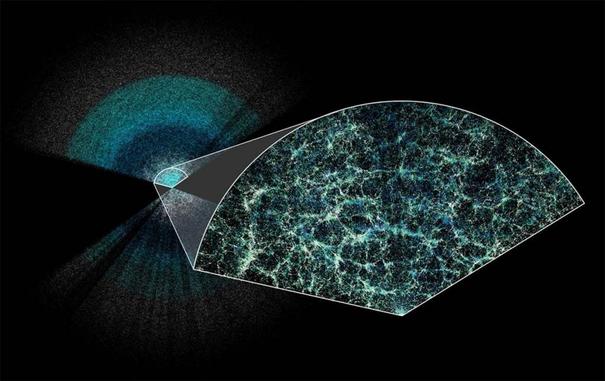
Here’s a nice picture showing a thin slice through the full survey that reveals the characteristic “cosmic web” of the large-scale structure of the Universe in all its glory:

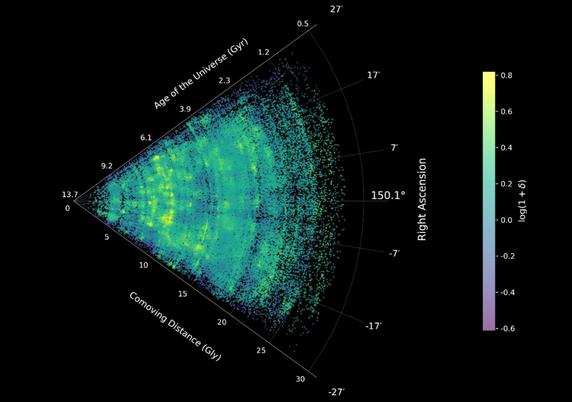
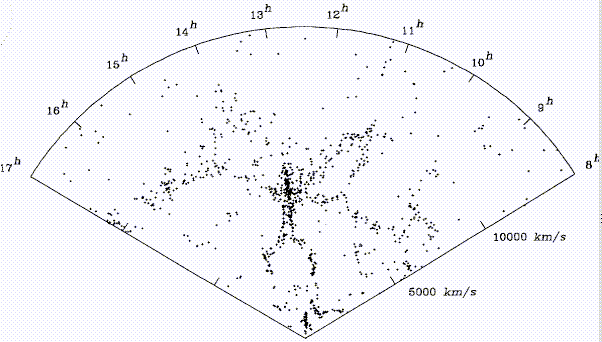
This progress is great, but it really makes me feel old. Forty years ago, in 1986, I had just started my PhD. The state-of-the-art galaxy redshift survey slice then is shown in this plot, from de Lapparent et al 1986 (ApJLett 302, L1), one of the first papers I read as a research student (I got it in 1985 as a preprint), which contains just 1,100 galaxies:

It is worth mentioning that although DESI has now covered its original target area, it will continue until 2028. You can never have too many galaxy redshifts!

#CosmicWeb #Cosmology #DarkEnergy #DarkEnergySpectroscopicInstrument #DESI #GalaxyRedshiftSurveys

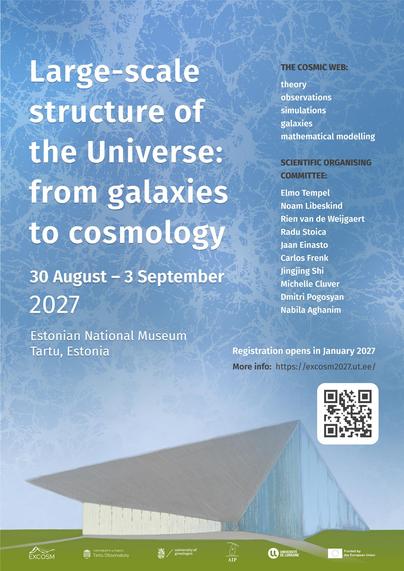
Large-scale structure of the Universe: from galaxies to cosmology

30 August - 3 September 2027, Tartu, Estonia

https://excosm2027.ut.ee/

#Universe #Cosmology #galaxies #CosmicWeb #conference #Tartu #Estonia #Astronomy #Astrophysics #Astrodon #science #news

On the cover of the new issue of Nature Astronomy: Elongated galaxies point to warm dark matter

Image: Álvaro Pozo, Donostia International Physics Center. Cover design: Bethany Vukomanovic

https://www.nature.com/natastron/volumes/10/issues/2

#Cosmology #galaxies #DarkMatter #physics #science #astrodon #nature #astronomy #news #astrophysics #simulation #cosmicweb

The #CosmicWeb is made up of large #voids delimited by long filaments of #matter at the intersection of which vast #gravitational structures are formed: #galaxies grouped into clusters.

Do their properties (mass, shape, star formation rate) preserve traces of the large-scale cosmic flows from which they originated? Find out this Thursday with Katarina Kraljic, a researcher at the @ObsStrasbourg , who studied a sample of observed and virtual galaxies : https://www.irap.omp.eu/event/the-co-evolution-of-galaxies-and-the-cosmic-web-over-cosmic-time/

Structures cosmiques : une famille de géantes

Comment Quipu, structure parmi les plus grandes, a-t-elle été identifiée ? De quoi sont composés les filaments de galaxies et de matière noire qui forment les structures de l'univers ? En quoi leur identification permet-elle de préciser notre compréhension de la cosmologie ?

France Culture