 gnd
gndNew online tool! Got tired of calculating pot bias by hand 😅
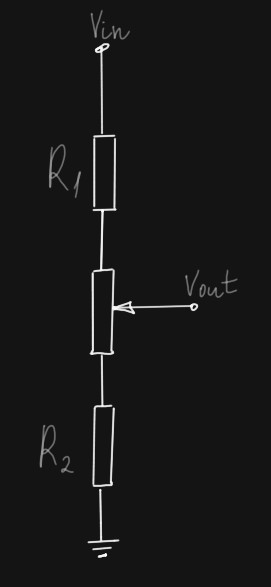
New online tool! Got tired of calculating pot bias by hand 😅
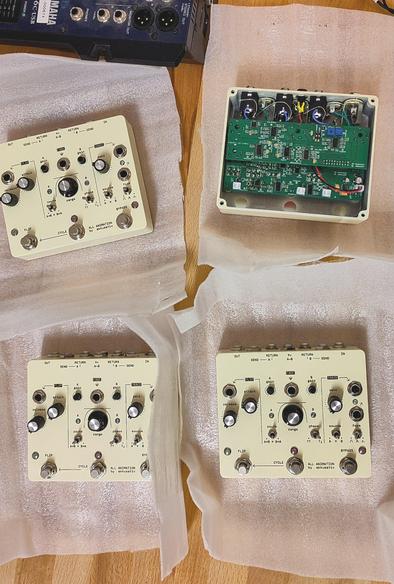
Built a few of these strange beasts.
If you are looking for a crossfader pedal that can be controlled via expression or CV, has an envelope follower and can route signals every which way, consider All Animation 🙂↕️
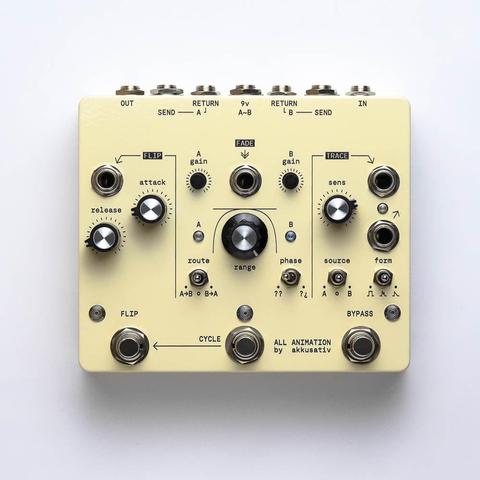
Finishing a small batch of All Animation. Love playing with that pedal, but it's an absolute pain to assemble 🥲
More info about the device: https://akkusativ.cc
When designing my Educational DIY Synth Thing I always had in mind that I might be able to hook it up to my Korg Volca Modular.
This post looks at the implications and possibilities.
Warning! I strongly recommend using old or second hand equipment for your experiments. I am not responsible for any damage to expensive instruments!
CHECK YOUR LEVELS AND SIGNALS, DECIDE FOR YOURSELF, AND PLUG THINGS INTO YOUR KORG VOLCA AT YOUR OWN RISK!?
These are the key previous posts for the main concepts used in this project:
If you are new to electronics, see the Getting Started pages.
Korg Volca Modular Signals
According to the manual that comes with the synth, there are the following internal (i.e. patchable) signals:
And of course, any of these signals as an output can be used as an input to another part of the synth.
One additional source of information comes from The Real Volca Modular Specs by Syntherjack where they have observed the following:
The 0.5V/oct comment on the pitch sequencer is interesting. That implies that the internal standard used by the Volca is half of what you’d expect in (say) a Eurorack 1V/oct common setup.
My own Synth Thing uses 1V/oct internally but only has a range of 0 to 3.3V.
So what I have learned? That the triggers and gates should be fine and compatible. That audio may be clipped as the Volca uses +/- 3.3V and I use 0-3.3V. But the Volca’s pitch CV is half that of the Synth Thing.
Volca to Synth Thing Experiments
Volca pitch CV to Synth Thing
The first experiment is to investigate that 0.5V/oct vs 1V/oct thing to see what that sounds like.
This demonstrates the basic connection from the Volca to the Synth Thing. A key point to note is that the GND must be connected together, but the only way to access that from the Volca is from the CV-In socket, which isn’t ideal.
Once the GND are linked, the Sequencer’s pitch output can be connected to the Synth Thing’s VCO1 pitch input and the pitch pot turned until the pitch matches the note played on the Volca. I tuned it to the lowest note on the keyboard and then could easily hear as it went up an octave that the Synth Thing hadn’t matched the pitch again.
As this is the pitch output for both the sequencer and the Volca’s keyboard, this allows the Volca’s sequencer to drive the Synth Thing too.
Some interesting micro-tonal effects are possible, but if I want pitch parity then I’d need to use some kind of amplifier with a gain of 2 on the output of the Volca to get it to match 1V/oct.
Volca Amplified Pitch CV to Synth Thing
There are lots of circuits around for a simple amplifier with a 2x gain, but perhaps one of the best for this type of application might be a classic non-inverting amplifier op-amp circuit.
At its simplest it is as follows:
The gain is 1 + R1/R2 so when R1 = R2 that gives a gain of 2. A MCP6002 is a “rail to rail” opamp so it can work essentially up to the power supply. In this case I’ll power it via the 5V supply from the Synth Thing.
Now there are a number of other considerations with a practical, accurate amplifier but for my purposes I’m putting on my “little knowledge is dangerous” hat and just going for it.
I’ve used two 220K resistors, but the accuracy of the resistors isn’t very good. The principle largely works, but I find that if I tune the two synths to the lower note on the Volca, I can’t quite get an accurate octave above. It may be that using variable resistors it might be possible to tune an octave.
There could easily be issues with non-linear tracking of input and output voltage and voltage drops due to impedance issues, but this is where my (limited) knowledge of electronics reaches its limits.
To be honest, I’m not entirely convinced the pitch tracking in the Synth Thing is very accurate anyway! I really ought to do some calibration tests with constant voltages vs frequency.
This is an interesting experiment and something worth exploring a little more in the future, but for now I’m leaving it here.
Volca and Synth Thing ADSR
The final audio output of the Volca can be obtained from the “Space Out” output. Pairing this with the gate from the sequencer allows me to use the Synth Thing’s ADSR envelope generator.
The key thing to watch out for is having the Volca’s release time too short. If it instantly releases then the release phase of the ADSR will seem not to be working.
The other thing to note is that the Volca sequencers gate output always has a break between notes so it isn’t a continuous gate. But playing quickly could easily overtake the release time from the ADSR.
I’m not sure if it is possible to completely bypass the built-in connection between the Volca’s modules, but it might be possible to connect the Source carrier out signal directly into the LPGs and onwards to the output. But that is pretty much bypassing most of what makes the Volca a Korg Volca Modular so I’m not sure why I’d want to do that 🙂
Synth Thing to Volca Experiments
It is probably prudent at this point to repeat the warnings:
I’m daft enough to take the consequences of toasting my Volca but I am not responsible for damage to anyone else’s!
Using the CV/Gate Input
This is by far the easiest, safest, and probably most reliable way to link into a Korg Volca Modular. I covered this before in my Korg Volca Modular Notes, but to recap:
This is how to wire up the Synth Thing LFO to the CV input of the Volca.
It uses a stereo 3.5mm TRS to 3.5mm TRS lead – essentially a headphone lead. I’m using my Sparkfun 3.5mm TRS breakout and a solderless breadboard.
The CV signal is available on the lower of the two breakout jumper headers on the Volca. In the patch above it is connected to the control input (middle) of the first LPG.
Other good candidates for patching the CV to are:
You can also get some curious effects by using the “a+bxc” utility module to combine the CV In with one of the internally generated control signals, e.g. the first LPG “+” output.
The CV In can be linked to the Source pitch input too, but there is no way that I’ve found so far of combining a pitch CV input with the keyboard, so the pitch becomes fixed by the CV input only at this point – i.e. it controls the carrier frequency, not the modulator (as far as I can see).
Synth Thing EG controlling the Volca
It is possible to trigger the Synth Thing envelope generator and use the resultant control signal back in the Volca via the CV in as shown below.
The key for this working is to use the Volca’s sequencer GATE output as the GATE and TRIGGER for the Synth Thing’s ADSR envelope generator and then feed the EG output into the Volca’s CV In. The Volca’s CV In is then connected to whatever is to be controlled by the EG – in the above case the first LPG.
Unlike the previous approach that fed the Volca’s output through the Synth Thing’s EG, this now replaces the built-in AHD attack and release EG of the Volca which leads to a much easier to understand set of controls.
Direct connections between Synth Thing and the Volca
Whilst it should be possible to connect the Synth Thing’s patch wires directly into various parts of the Volca, in the end, I decided there wasn’t anything at this point in time that couldn’t be achieved using the official CV In link.
So for the time being, I’ve not experimented further with any direct connections that bypass the official CV In.
Closing Thoughts
I’m intrigued by the 0.5V/oct thing and need to do some further testing of the Synth Thing’s response, but then I was never really happy with how the pitch and amplitude inputs for the VCOs were working. It is on my “todo” list to look into a more efficient way of sample the ESP32’s ADCs.
But I am quite impressed with the possibilities of the CV In on the Volca. Now I’ve explored and noted the basics I’ll have to see what the full “art of the possible” might be.
Kevin
https://diyelectromusic.com/2024/09/01/educational-diy-synth-thing-meets-korg-volca-modular/
#controlVoltage #cv #envelopeGenerator #korg #synthThing #vco #volca


I’ve been playing with a Korg Volca Modular recently, but it doesn’t have built-in MIDI.
There are some conversion kits available (apparently MIDI is broken out on the PCB inside – more here), but it also has a well-specified CV/Gate interface, so this is a design for a MIDI to CV converter with a Korg Volca Modular compatible CV/Gate interface out via a 3.5mm TRS socket.
It isn’t specifically just for the Volca. It should work with any CV/Gate system that is ok with a 0V-5V CV and a 0V/5V Gate.
Warning! I strongly recommend using old or second hand equipment for your experiments. I am not responsible for any damage to expensive instruments!
If you are new to microcontrollers, see the Getting Started pages.
The Circuit
The Korg Volca has the following CV/Gate input specification (via a 3.5mm stereo TRS jack socket):
MIDI to CV is a pretty straight forward job for a microcontroller provided the following is acceptable:
As the Korg will accept 0-6V, for a six octave range, I’ve opted to stick with a 5V microcontroller to give me a five octave range.
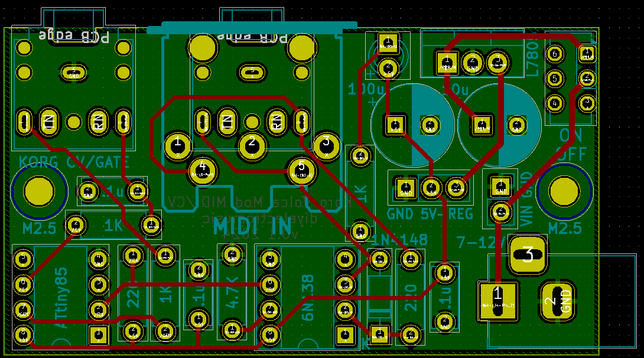
I’ve decided to use the circuit from here: ATTiny85 MIDI to CV.
I’ve not really done much with the ATTiny on this blog yet, but this is a pretty straight forward circuit and the 8-pin DIP version of the ATTiny85 is pretty easy to work with. More importantly it has a pretty small footprint and needs few additional components for a completely functional build.
I’m not bothering with a way to set the MIDI channel – it will be hardcoded in. The circuit uses PWM to generate the output CV with a filter stage for smoothing.
I’ve included a couple of options for power:
There is an option to include a PCB-mounted slider switch for on/off, but this could also be replaced with jumper headers for an external switch, or jumpered/soldered across to bypass the switch completely.
The MIDI circuit is a pretty common 5V 6N138 based MIDI IN circuit. Only serial MIDI will be supported.
PCB Design
The design is fairly straight forward. The only slight complication is around the use of jumper headers for the different power options, but I’ll explain these in detail in the build guide.
I’ve included two mounting holes, so I hope to be able to build up a simple enclosure for it.
The PCB can use PCB-mounted 5-pin DIN or TRS MIDI (type A) and includes a power indicator LED.
The output to the Korg is via a 3.5mm TRS stereo socket, so it should be possible to use a standard 3.5mm stereo jack to jack cable between this and the Volca. It should conform to the Volca’s CV/Gate interface specification.
Closing Thoughts
The ATtiny85 is a pretty capable microcontroller and fairly easy to work with, so I’m not anticipating any significant issues.
But I am taking a bit of punt going straight to a PCB with this one.
Kevin
https://diyelectromusic.com/2024/07/07/korg-volca-modular-midi-to-cv-pcb-design/
You all getting ready for #Jamuary? Don’t get caught on Jam 1st twiddly-tweaky-four unprepared to share your jams.
#Synths #MIDI #Synthesizers #EuroRack #DAWless #DAWfull #Analog #VirtualAnalog #Sequencers #ShamelesslyDigital #Modular #ControlVoltage #Hardware #Software #Softsynths

Holy shit, my fellow synth nerds! This is incredible! https://youtu.be/qSKBtEBRWi4
#synthesizers #cv #controlVoltage #prothesis #DisabilityHack

 élytres - François Dumeaux
 Brian Enigma
 Brian Enigma
 flpvsk
 Simple DIY Electronic Music Projects

 Nate
Nate Devo
Devo  🪴🌮🥃🍣
🪴🌮🥃🍣