 virtual void meow()
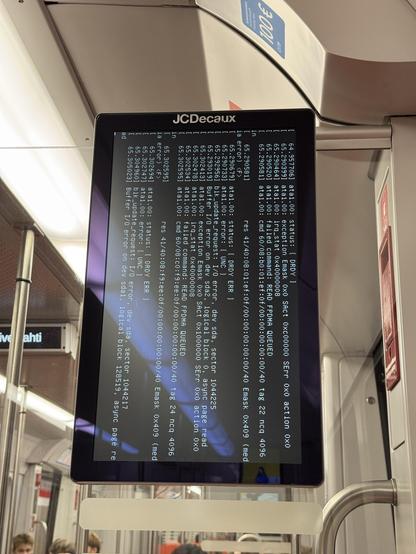
Goog night and goodbye #ComputersWereAMistake
Gravis has told me that there's some meaningful purpose to defining "compute" as a noun substantive; I don't remember the details of his explanation but it had something to do with the difficulties cropping up with older units for comparison of processing power (e.g. instructions per second).
But gawd it just looks stupid. It sounds stupid. "Gimme more compute, I said." "My dad's got more compute than your dad!" "The latest version of 'CloudClaudeGrokChat Version 17.0.137b for the Enterprise', now with 21.12% more compute!"
And if you try to look for a plain definition of what a "compute" unit is, good luck! All the Google results are for corporate marketing slop which, by its nature, is intentionally vague and sparing of technical details.
no one: …
me: so what if you gave an #LLM a training set that consisted of all #Java bytecode scraped together and then treated as though it were text, with each "word" being the opcode and subsequent operands? then it would output statistically assembled Java bytecode directly and you wouldn't need to slopcode a #programming language, you could slopcode directly for a JVM! Think of the #efficiency gains, the #productivity, and so forth.
Doesn't that make perfect sense? Quick, someone find me a slopcode enthusiast to critique my idea.
I know little about the tedious turf-wars over licensing terms which seems to be a major preoccupation of the "open software" community; I've always been dubious about such wrangling over terms because (to my naïve eyes) it has something of the same delirious and Kafkaesque quality as (say) arguing over whether it's possible to be a "sovereign citizen" with some sufficiently arcane combination of legal maneuvers that will almost certainly not survive a serious court challenge, but which isn't really intended to survive such a challenge. I suppose that the occasional open-source licensing mudfight has occasionally been argued in civil courts (i.e. the separate court system chiefly for wealthy persons' complaints against each other) so the squabbling over this versus that open-source licence isn't completely unreal. I guess. It's just about as real as anything else pertaining to civil law, i.e. it's all part of the same unending bureaucratic nightmare from which Joseph K. and the rest of us seem condemned never to wake.
That was a very long introductory paragraph, wasn't it? Suffice it to say: I don't know one open-source licence from another, but I'm sure someone who was deeply into FOSS legalisms could tell me that there's a VERY important reason why someone would want to play the elaborate trick that Dan Blanchard played with the chardet library. I'm guessing that Blanchard has some ulterior motivations involving commercial monetization of his work that he'll never be totally honest about. I will accept for the purpose of my own blithering that there's a good reason why he did what he did.
I wish only to point out the following: the premise of what he did requires his "AI tool" not to be intelligent. Blanchard did not want an exercise of intelligence. If he had, he would have simply hired someone to do a refactor, applying their intelligence to the matter of how to change things in just such a way as to anticipate the inevitable disputes about whether it was really acceptable to rewrite a code base for the sole purpose of wriggling out from under a particular set of licensing terms. But then he would have to cut this person in on the deal—that's the important thing. A genuinely intelligent henchperson would have needed to be a PEER to Blanchard, someone whose own business interests needed to be accommodated, and that is plainly not what Blanchard wanted. He simply wanted a box that he could put his codebase into, and then with some tinkering and fiddling it would transform his codebase into something unique enough to re-licence, and basically…he didn't want any troublesome thoughts and reflections about what he was doing, which is what inevitably would have happened if he'd involved another person, someone with actual intelligence.
He wanted a witless machine, to do one witless job. And gosh, doesn't that basically sound like what the entire technology sector REALLY wants from "artificial intelligence"?
~Chara of Pnictogen
Colleague currently at a trade show. Being given press kits by exhibitors which are usually a business card with a QR code (and no URL).
He is sending me photos of these cards in WhatsApp.
Reading QR codes is part of the camera app, so I can't (easily) interrogate the image directly (I'm sure there's a way).
Current workflow:
* Airdrop image to laptop
* Use phone camera to scan QR code on laptop screen
* Airdrop the resulting URL to the laptop and retrieve the press kit
Gimme a f-ing URL. Even if it's a bit.ly
🤦♂️

How many companies do you want to share your personal information with in order to quickly look up something in an ASCII table?
707? 850? More?
Top two hits on @kagihq want to sell your soul to look at some tables at least.
But "money is made", "curve goes up" and billionaires get $1 trillion payouts, so I guess this is "a good thing"?
All the better to monetize you with, my dear.


My car is "It's ok that the check engine light is on, you can still pass state inspection" years old.
However, "the computer" won't pass it. My mechanic thinks it's because my car was built in Oct. and is 15 and 362 days old. Cars must be "over 15" to pass w/ a check engine light on (just an EVAP code, not a safety issue).
I think some programmer made the computer look for a number that was 16 or over in the "car age" slot. Got a new appointment on Monday. Wish me luck! #ComputersWereAMistake
 Mx. Chara Aznable (they/them) of Pnictogen
 Mx. Chara Aznable (they/them) of the Pnictogen Wing
 richh
richh
 Karl Fredrik 🦊
 Jessamyn