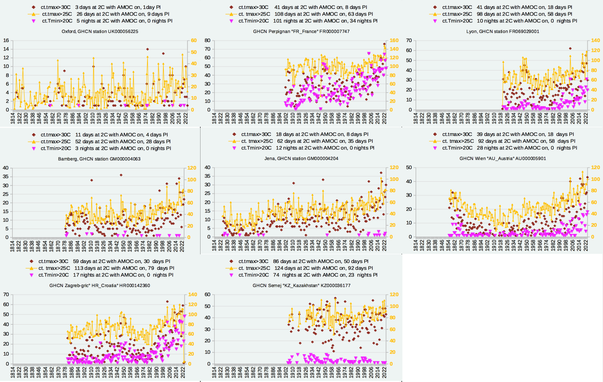
Ich hab jetzt noch mal ein paar mehr Stationen geplottet als nur Bamberg und Oxford, und die modellierten Werte für 2C bei AMOC on in die Legenden geschrieben.
Heiße Tage >=30C, Sommertage >=25C und Tropennacht >=20C.
Stationsauswahl random, Hauptsache ne lange Zeitreihe mit guter Qualität.
Die Stationen sind seit der vergangenen Dekade fast alle beim 2C-Wert, teils 3fach über dem 2C-Wert. Nur die ganz östliche Station in Kazachstan, das Chart unten rechts, hat noch eine Weile Zeit.
Quelle GHCN.
Ab 1814 bis 2024.
Daran sieht man, was für einen Unterschied die grobe Auflösung macht, die van Westens AMOC paper zugrunde liegt. Der verwendet ja extra die CMIP6 um zu zeigen, dass auch in den sturen 😁 Modellen die AMOC kippen kann.
Brunner et al 2025 schreiben auch, dass es schon in 2050 einen enormen Unterschied bei Temperaturextremen macht, ob man 100x100km CMIP6 oder 9x9km Auflösung hat. 🖖🏽
Way back in 2022, as the world tried to readjust back to "normal" following COVID - I helped to co-organise a bootcamp with sponsorhop from the @wcrp_climate IASC, @esaclimate and a generous dollop of help from @PolarRES and @dmidk colleagues.
We gathered 10 senior scientist mentors and 22 students in an old torpedo research station (now used by Roskilde University) for 10 days. It was an extremely intense period but the 4th paper produced by this talented group has just come out.
I consider facilitating #EarlyCareerScientists to work on important science problems an extremely rewarding part of my job, and I'm looking forward to the next one already as part of our PISCO project.
In the mean time, go and read this extremely cool work, collecting together a huge number of radiosonde observations going back to the 1950s over the Arctic Ocean and using them to assess how well CMIP6 models represent lower atmosphere.
#CMIP6 #ClimateModels #Arctic #ArcticClimate #SeaIce
https://agupubs.onlinelibrary.wiley.com/doi/10.1029/2024JD041412
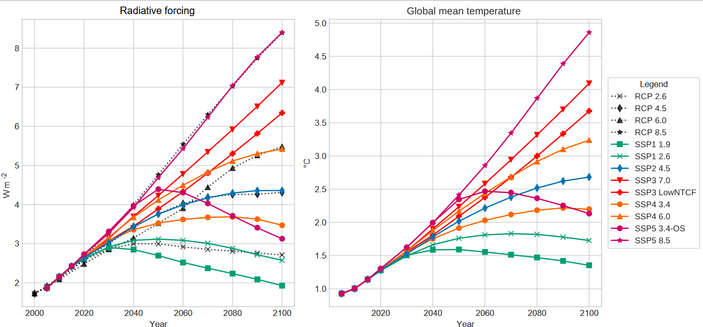
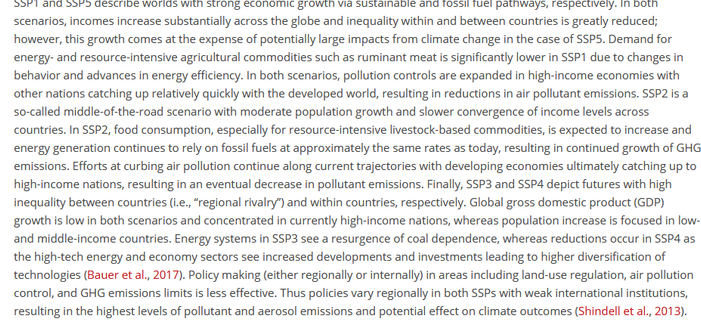
Looking up the old #CMIP6 emissions pathways for a thing - and while I wish I lived in SSP1, it feels a lot more like SSP3 or 5 right now.
Beats me why they call #Economics the Dismal Science...🫠
Full link to paper: https://gmd.copernicus.org/articles/12/1443/2019/
Abstract. We present a suite of nine scenarios of future emissions trajectories of anthropogenic sources, a key deliverable of the ScenarioMIP experiment within CMIP6. Integrated assessment model results for 14 different emissions species and 13 emissions sectors are provided for each scenario with consistent transitions from the historical data used in CMIP6 to future trajectories using automated harmonization before being downscaled to provide higher emissions source spatial detail. We find that the scenarios span a wide range of end-of-century radiative forcing values, thus making this set of scenarios ideal for exploring a variety of warming pathways. The set of scenarios is bounded on the low end by a 1.9 W m−2 scenario, ideal for analyzing a world with end-of-century temperatures well below 2 ∘C, and on the high end by a 8.5 W m−2 scenario, resulting in an increase in warming of nearly 5 ∘C over pre-industrial levels. Between these two extremes, scenarios are provided such that differences between forcing outcomes provide statistically significant regional temperature outcomes to maximize their usefulness for downstream experiments within CMIP6. A wide range of scenario data products are provided for the CMIP6 scientific community including global, regional, and gridded emissions datasets.
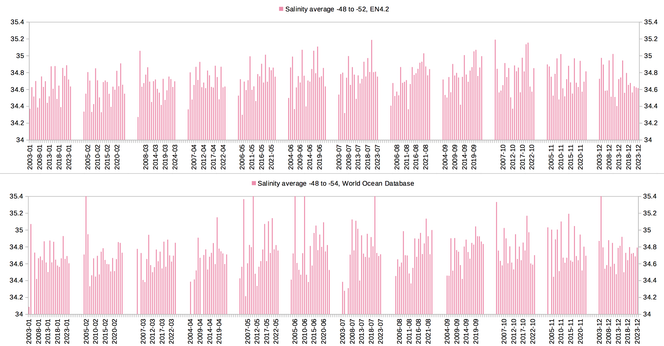
The promised plots.
I'll show data since 2003 only because only then did real measurements really kick off. Before that, measurements were so spotty with 1 in January in one year, then 3 years nothing, then 5 measurements in for example August and so on.
Data source for measurements is #NOAA https://www.ncei.noaa.gov/access/world-ocean-database-select/dbsearch.html
The other plot is from a #ReAnalysis called EN4.2 https://www.metoffice.gov.uk/hadobs/en4/download-en4-2-2.html#c14_analyses
It is based on the same NOAA data, and goes back to 1900. EN4.2 has better quality assurance than my download. And EN4.2 is able to calculate the likely values in adjacent coordinates and adjacent months.
Among other Reanalyses, EN4.2 has also been used in the newest preprint by the Dutch team around #vanWesten. It sees AMOC tip in 2065 in RCP8.5 and in 2085 in RCP4.5. But it is based on biased Reanalyses and known-to-be too stable #CMIP6: https://arxiv.org/pdf/2407.19909
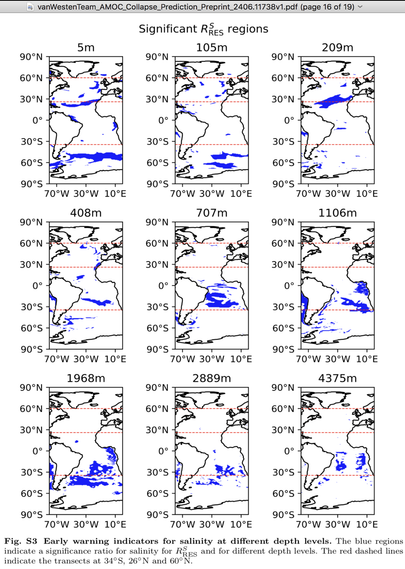
Whereas the first new preprint by van Westen's team, which tips AMOC 2037-2064, uses only real measurements of the 3 dedicated monitoring arrays in the North, tropical and South #Atlantic. https://arxiv.org/pdf/2406.11738
Here, the caveat is: very short data series.
With measurements being so spotty, I only show monthly salinity 2003ff in down to 10m depth. And only from the area in the South Atlantic. Averaged on a 2 by 2 degree grid from Argentina's coast to longitude -48, and latitudes 40-48 South.
Sorry, not sorry: neither dataset shows a smoking gun. 😁
#FridaysForFuture #ChartsForFuture
"
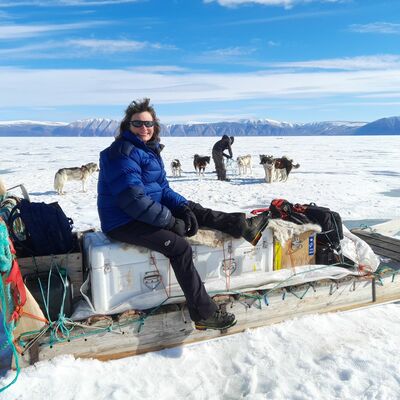
Verschiebung von Wolken vom Tag zur Nacht verstärkt die globale Erwärmung
In einem wärmer werdenden Klima verändern sich die Wolkenmuster so, dass sie die globale Erwärmung noch verstärken. Eine Pressemitteilung der Universität Leipzig.
"
https://www.raumfahrer.net/verschiebung-von-wolken-vom-tag-zur-nacht-verstaerkt-die-globale-erwaermung/
20.6.2024
#Albedo #CMIP6 #Erderwärmung #Klima #Klimakrise #Klimamodellierung #Klimawandel #Leipzig #Raumfahrt #Satellitendaten #Treibhausgas #Wetter #Wolken
In einem wärmer werdenden Klima verändern sich die Wolkenmuster so, dass sie die globale Erwärmung noch verstärken. Eine Pressemitteilung der Universität Leipzig. Quelle: Universität Leipzig 20. Juni 2024. 20. Juni 2024 – Eine Forschergruppe um Prof. Dr. Johannes Quaas von der Universität Leipzig sowie Hao Luo und Prof. Yong Han von der Sun-Yat-sen Universität in […]
YES! Found the issue. The pipeline was processing #CMIP6 models and it turned out I had downloaded multiple versions of the same model. Filtering to keep only one version solved the issue!
I hate CMIP6.