 SpaceMacSpiff
Word of the day: Chemosynthesis
https://en.wikipedia.org/wiki/Chemosynthesis
To think that this process may be enabling life on other worlds is inspiring.
Word of the day: Chemosynthesis
https://en.wikipedia.org/wiki/Chemosynthesis
To think that this process may be enabling life on other worlds is inspiring.
#KnowledgeByte: #Chemosynthesis is a process by which certain organisms, primarily bacteria, use chemical energy to produce organic matter from inorganic substances.
Unlike #Photosynthesis, which uses sunlight as an energy source, chemosynthesis relies on the oxidation of inorganic compounds, such as hydrogen sulfide, methane, or ammonia, to generate energy.
https://knowledgezone.co.in/posts/What-Is-Chemosynthesis-672f819017920b14062a35b5
Fields of #worms and snowy microbial mats: #DeepSea submersible discovers flourishing ecosystem https://www.nbcnews.com/science/science-news/deep-sea-creatures-discovery-hadal-trench-submersible-rcna222158
"There were dense beds of #clams, each up to 9 inches long, and snow-like #MicrobialMats creating an ethereal undersea dusting, dozens of feet wide. This is the first time #chemosynthesis-based communities directly observed at extreme depths... Long-standing theories suggest that chemosynthesis-based communities are widespread in hadal trenches, but few have been discovered"
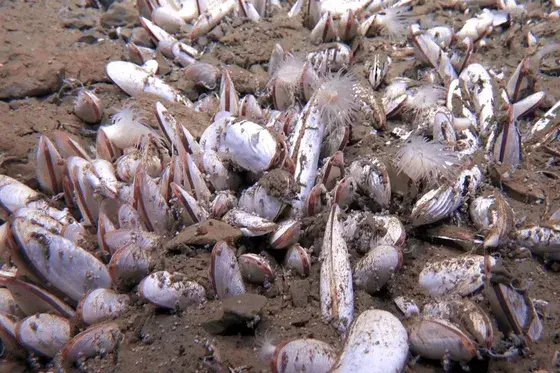
#KnowledgeByte: #Chemosynthesis is a process by which certain organisms, primarily bacteria, use chemical energy to produce organic matter from inorganic substances.
Unlike #Photosynthesis, which uses sunlight as an energy source, chemosynthesis relies on the oxidation of inorganic compounds, such as hydrogen sulfide, methane, or ammonia, to generate energy.
https://knowledgezone.co.in/posts/What-Is-Chemosynthesis-672f819017920b14062a35b5
The Earth's deepest living organisms may hold clues to alien life on Mars
> To understand the life that might survive deep below Mars' surface, we can look to some of the deepest, and oldest, forms of living organism on our own planet.


Investigating newly discovered #HydrothermalVents at depths of 3,000 meters off #Svalbard
https://phys.org/news/2024-06-newly-hydrothermal-vents-depths-meters.html paper: https://www.nature.com/articles/s41598-024-60802-3
"At depths greater than 3000m, the remote-controlled #submersible vehicle MARUM-QUEST took samples from the newly discovered #hydrothermal field... hydrothermal fluids form the basis for #chemosynthesis, which is employed by organisms in #symbiosis with #bacteria."
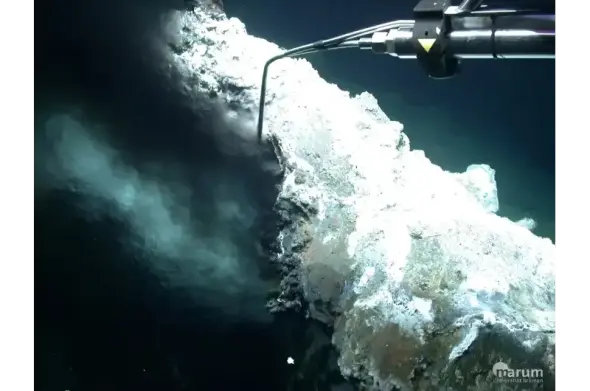

Hydrothermal vents can be found around the world at the junctions of drifting tectonic plates. But there are many hydrothermal fields still to be discovered. During a 2022 expedition of the MARIA S. MERIAN, the first field of hydrothermal vents on the 500-kilometer-long Knipovich Ridge off the coast of Svalbard was discovered.
Deep-sea #hydrothermal vents are hot springs on the #ocean floor.
Around these vents, far from any sunlight, vibrant biological communities are found.
Here, #microbes play the role of primary producers through #chemosynthesis—similar to the role that plants play on land through photosynthesis.
Now, a newly discovered bacterial species from a hydrothermal vent throws light on microbial #evolution.
https://phys.org/news/2023-11-bacterial-species-hydrothermal-vent-microbial.html
Paper by Mino et al. (2023):
https://www.microbiologyresearch.org/content/journal/ijsem/10.1099/ijsem.0.006132

Deep-sea hydrothermal vents are hot springs on the ocean floor. Sea water penetrates into the ocean crust, becomes heated, and rises to the seafloor surface carrying dissolved nutrients. Around these vents, far from any sunlight, vibrant biological communities are found. Here, microbes play the role of primary producers through chemosynthesis—similar to the role that plants play on land through photosynthesis.
Bacteria use life's original energy source to thrive in the ocean's lightless depths
https://theconversation.com/bacteria-use-lifes-original-energy-source-to-thrive-in-the-oceans-lightless-depths-199177 by @Zahra_F_Islam
Molecular hydrogen in seawater supports growth of diverse marine bacteria https://www.nature.com/articles/s41564-023-01322-0
"Eight distantly related groups, or phyla, of #bacteria made the #enzymes to use #hydrogen and #CarbonMonoxide. Clearly #chemosynthesis is a far more widespread strategy in the oceans than previously thought!"


 Knowledge Zone
 Lukas VFN 🇪🇺
 Dr. Or M. Bialik
 David W. Jones
 💧🌏 Greg Cocks
 Mikko Tuomi