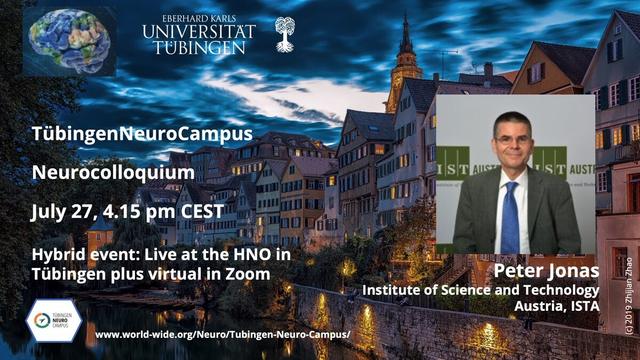
There will be a talk by Peter Jonas (ISTAustria) on "#Synaptic mechanisms of #patterncompletion in the #hippocampal #CA3 region":
⏰ Thu July 27 at 4.15pm CEST
🌎 https://t.co/tlk4CorzwE
📍 University of #Tübingen, Hertie-Institut für klinische Hirnforschung (HIH), Host: Ulrike Hedrich
The Neurocolloquium of the TübingenNeuroCampus will be happening hybrid, live in the Lecture Hall of the HNO in Tübingen and in Zoom: The next talk will be on Thursday, December 7, 2023 at 4.15 pm CET Speaker: Prof. Uri Hasson (Princeton) Title: "Deep language models as a cognitive model for natural language processing in the human brain" To receive the zoom details, please insert your email adress below.
An article "A Hippocampal Cognitive Prosthesis: Multi-Input, Multi-Output Nonlinear Modeling and VLSI Implementation" by Theodore W. Berger, et al.
(https://www.ncbi.nlm.nih.gov/pmc/articles/PMC3395724/) tells about a brain implant with 16 analog-to-digital converters and 32 channels of output.
I've been discussing it with Prozion (https://github.com/prozion) before and he has a very good question.
"How does the implant function at all with that amount of channels?"
The previous explanation from "Computational Cognitive Neuroscience" about memory de-indexing sheds some light on that: the article is about the same brain regions: CA1, CA3 and DG.
This paper describes the development of a cognitive prosthesis designed to restore the ability to form new long-term memories typically lost after damage to the hippocampus. The animal model used is delayed nonmatch-to-sample (DNMS) behavior in the rat, ...