 WPS News
What Hunger Does to Morality
The American Civil War: Civic Life Series (Part 6 of 18)
By Cliff Potts, CSO, and Editor-in-Chief of WPS News
Baybay City, Leyte, Philippines
June 16, 2026
Hunger arrived quietly. Then it stayed.
Unlike battle, hunger did not announce itself with noise or spectacle. It crept into households through empty cupboards, shrinking portions, and meals designed to deceive the stomach rather than nourish it. By the middle years of the Civil War, scarcity had become a defining feature of civilian life—especially, but not exclusively, in the South.
Hunger did not simply weaken bodies. It altered judgment.
From Shortage to Strategy
At first, shortages were treated as temporary inconveniences. Families substituted ingredients, stretched meals, and relied on neighbors. Governments issued reassurances. Merchants promised resupply. Most people assumed relief was coming.
But as disruptions persisted, scarcity became structural. Transportation failures, inflation, hoarding, and prioritization of military supply chains meant civilians were no longer competing with one another alone—they were competing with the war itself.
At that point, hunger ceased to be accidental. It became something to manage.
The Moral Line Moves
When food is scarce, ethics change shape.
Acts once considered unacceptable—hoarding, price gouging, theft—began to acquire context. A woman who hid flour was no longer seen as selfish if her children were thin. A merchant who charged exorbitant prices was condemned in public and patronized in private. Survival blurred the boundary between wrongdoing and necessity.
This was not hypocrisy. It was adaptation.
People did not abandon morality altogether; they recalibrated it around survival. Right and wrong were no longer fixed points. They were weighed against hunger.
Bread Riots and Public Anger
Nowhere was this shift more visible than in the bread riots that erupted in several Confederate cities. Women, pushed beyond endurance, demanded food at prices they could afford. When appeals failed, force followed.
These riots were not revolutionary in intent. They were transactional. People wanted bread, not regime change. But they revealed something dangerous: when hunger becomes widespread, patience evaporates. Deference dissolves. Authority weakens.
Governments responded with a mix of relief, repression, and rhetoric. None of it solved the underlying problem.
Community Strain and Social Fracture
Scarcity strained relationships. Mutual aid gave way to suspicion. Neighbors watched one another’s stores. Rumors of hoarding spread quickly. Trust, already weakened by political division, eroded further under material pressure.
Charity became selective. Aid flowed first to kin, then to friends, then—if anything remained—to strangers. This narrowing of concern was not cruelty; it was triage.
Hunger forces prioritization. Someone always comes last.
Children and the Arithmetic of Hunger
Children bore hunger differently. Growth slowed. Illness lingered. Hunger shaped memory. Adults remembered the war as fear and loss; children remembered it as emptiness.
Families made quiet calculations: who needed food most, who could endure less. These decisions were rarely spoken aloud, but they were made daily. Hunger transformed care into arithmetic.
The Long Shadow
The moral adjustments made during hunger did not vanish when food returned. Postwar communities carried scars of mistrust and resentment. Accusations lingered. Reputations hardened. People remembered who helped—and who did not.
Hunger teaches lessons quickly and erases them slowly.
Looking Back
The Civil War did not only kill through violence. It killed through deprivation. And in doing so, it forced civilians to renegotiate the moral rules of everyday life.
This is the sixth truth of civic breakdown: when institutions fail to provide, morality does not disappear—but it bends. Survival reshapes ethics long before it reshapes politics.
Hunger did not make people worse.
It made them honest about what survival costs.
McPherson, J. M. (1988). Battle cry of freedom: The Civil War era. Oxford University Press.
Faust, D. G. (2008). This republic of suffering: Death and the American Civil War. Alfred A. Knopf.
McCurry, S. (2010). Confederate reckoning: Power and politics in the Civil War South. Harvard University Press.
Rable, G. C. (2010). Damn Yankees! Demonization and defiance in the Confederate South. Louisiana State University Press.
Library of Congress. (n.d.). Civil War diaries and letters. Manuscript Division. https://www.loc.gov/collections/civil-war
Library of Congress. (n.d.). Chronicling America: Historic American newspapers. https://chroniclingamerica.loc.gov
#AmericanCivilWar #breadRiots #civicBreakdown #civilianMorality #foodShortages #homeFront #hungerAndScarcity #socialHistory #wartimeEthics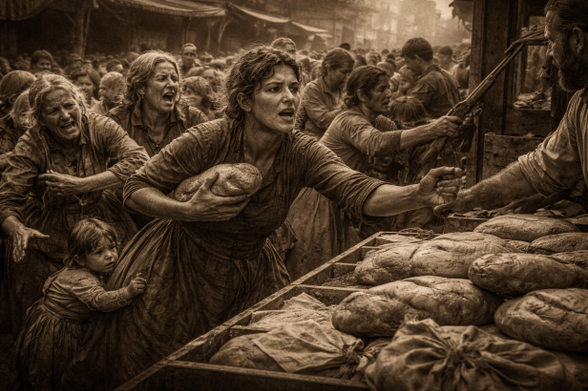
 Liam O'Mara IV, PhD
 John Autry
 Ramesh Gupta