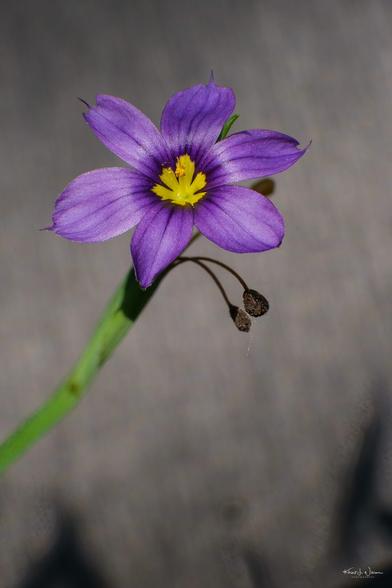
New flower! It’ll look better when there’s a big clump all flowering at once, but teased open the first Sisyrinchium angustifolium bloom!
Common named Narrowleaf Blue-eyed Grass, this isn’t a grass at all but a wet meadow-loving Iris relative. With thin Iris like leaves the relationship is obvious, and one plant in typically mid spring once put outside in appropriate seasons will send up several stalks each supporting several inch-wide, metallic indigo blooms with yellow centers. En masse, they are breathtaking. There are many species in this genus, some of which even have white or all-yellow flowers, and I used to have a second species from the Atlantic coastal plain but sadly it crashed outside and new seeds refused to sprout…but this one is doing well, so well that there are even flower stalks forming on a few of the ones in the for-sale pot (yes, these are currently available in the website Shop!).

#sisyrinchium #flowers #plants #botany #horticulture #blueeyedgrass #gardening #educational

Blue eyed grass, Sisyrinchium angustifolium a clumping flowering perennial grass with blue and yellow flowers. Sometimes the flowers can be purple as well. As a medicinal plant a tea from the entire plant can treat stomach aches, tea from just the roots can be used to treat diarrhea especially in children.

#hobonichitecho #hobonichi #ink #micron #doodle #blue #blueeyedgrass #flowers #watercolor #drawing #sketchoftheday #sotd #botanicalillustration #MastoArt

Since I had "rediscovered" my MCEX-16 macro extension tube and had just completed photographing the lepanthes telipogoniflora in my wabi-kusa forest terrarium, I turned my attention to the small purple flowers growing in my container garden of native plants.

The Blue-eyed Grass, a perennial flowering plant native to New Jersey, tends to be overlooked in some gardening circles. The online descriptions and photos feature a plant with petite blue flowers and yellow centres blooming on stalks above grass-like leaves. But the flowers on my blue-eyed grass plant appear more purple than blue. This is not a trick of the light or an incorrect white balance on my camera sensor. To my eyes, the flowers appear to be a deep shade of purple.

Blue-eyed grass blooms from late spring to early summer. The plant forms small clumps of grass-like leaves that can slowly spread, serving as a ground cover and helping to retain moisture in the soil.

Blue-eyed Grass thrives in consistently moist soil but can tolerate some drought once established. My patio planters have a basin at the bottom that catches and retains rainwater. There is also a layer of moss growing in the planter. Both of these things help retain moisture and keep the container soil moist.

Blue-eyed grass is not grass. Blue-eyed Grass belongs to the Iris Family and attracts bees, butterflies, and other pollinators. This was one of my main goals in planting Blue-eyed Grass. While having bees on my patio could be annoying, I wanted to attract butterflies. With any luck, I may attract some interesting photography subjects.

Blue-eyed grass plant can be found in all regions of New Jersey and thrives in specific ecoregions like the coast and Pinelands. Princeton is far from the coast or the Pinelands area of New Jersey.

Forty-two images were captured and stacked using the DMap method in Zerene Stacker.

https://islandinthenet.com/blue-eyed-grass/

#BlueEyedGrass #ContainerGarden #LensArtists #MacroPhotography #NativeWildflower #Photography #SisyrinchiumAngustifolium #ZereneStacker

It's that time of the year again (May) - the sun is shining, birds are singing, and the "container garden meadow" on my patio is bursting with life like a group of enthusiastic skydivers jumping off a plane!

I live in a townhome community where the garden soils are rockier1 than in a Stallone movie, and native plants are about as rare as a unicorn. And don't even get me started on the landscaping crew, who seem to have a feud against anything not purchased at a Home Depot Garden Center or the ever-hungry deer who treat my lovely little garden like I'm running a free salad bar.

But I refused to be defeated! Sometimes inspiration strikes in the oddest of places. I stumbled upon an article called "Container Gardening with Native Plants" on the Missouri Botanical Garden website, and a lightbulb went off in my head. With creativity and the simplicity of container gardening, I planted a thriving meadow outside my patio door.

Sisyrinchium angustifolium, or blue-eyed grass as it's commonly known, is a New Jersey native. Its grass-like foliage (for which it's named) may fool some, but it's actually a member of the iris family. This simple clump-forming perennial produces stunning violet-blue flowers with yellow eyes in the spring, which grow on flattened, branched stems. S. angustifolium used to go by the name S. bermudianum. The plant is indigenous to the British Overseas Territory of Bermuda hence the bermudianum in the former name.

I excitedly showed Bhavna my latest gardening triumph. It's taken some time and effort, but she agrees that my gardening skills are on point.

  • Believe it or not, the neighbouring borough is called Rocky Hill! ?
  • https://islandinthenet.com/blue-eyed-native/

    #BlueEyedGrass #ContainerGarden #Gardening #LensArtists #Meadows #NativePlant #SisyrinchiumAngustifolium #Spring

    Container Gardening with Native Plants