RE: https://mastodon.green/@plazi_species/116103658450230777

An interesting scientific paper on #Gilliesieae (#Amaryllidaceae), which have a limited distribution in #Chile, Argentina, Bolivia, and Peru. The authors N. García and Miersia (2026) describe four #newspecies of genera #Gilliesia and #Miersia. All species are found only in specific regions of Chile and are therefore #endemic. The authors also amplified and sequenced #DNA sequences to reconstruct the #phylogenetic positions of the new species. #Biodiversityresearch
© this text #StefanFWirth 2026

RE: https://mastodon.green/@plazi_species/116022519007902519

Beetles of the genus #Cheironitis (#Scarabaeinae) are characterized by a strikingly #robust #morphology in the #adults, while the larvae usually resemble cockchafer grubs. These are #dungbeetles that exhibit #broodcare. They are widespread in #arid regions of the #Palearctic and #Afrotropical regions. YuHeng Wang et al. (2025) described, i.a., the new species C. #aiweiae from #ShirenGou (Xinjiang Uygur). #Biodiversityresearch © this text #StefanFWirth

RE: https://flipboard.com/@bbcwildlife/bbc-wildlife-magazine-7k5eiel4z/-/a-2rFMDww0RQ20twgmp99IEw%3Aa%3A2902041756-%2F0

In Southern #Ethiopia a small #shrew was found in the bottom of a pitfall trap. The tiny #mammal was analyzed being new to science and representing a #newspecies. It indicates that the #biodiversity is far away from being well explored and that not only microscopic invertebrates, but even very small mammals are still to discover. #Biodiversityresearch is important for an understanding of our environments in times of #globalwarming.
© Text © #StefanFWirth 2026

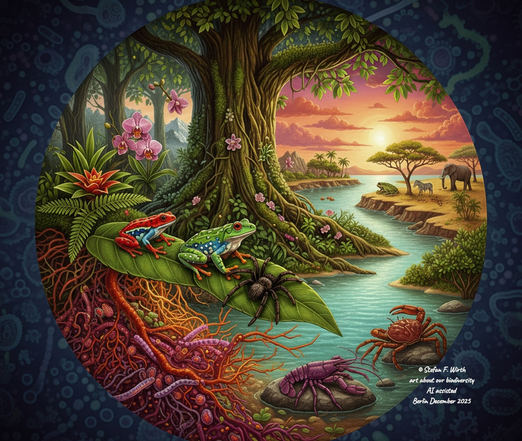
In the context of human-induced #globalwarming, the crucial #importance of our #ecosystems, which depend on the #biodiversity they contain, has been repeatedly emphasized. Is there enough #biodiversityresearch? Xin Li et al. (2025) point to an #increase in #speciesdescriptions since 2000 and predict the discovery of new species especially in plants, fungi, arachnids, malacostracan crustaceans or amphibians.
©#StefanFWirth Berlin Dec. 2025

Ref
https://doi.org/10.1126/sciadv.adz3071

Pic
©S F.Wirth,AI assisted

🌱🔍 Unlocking the Power of Data Citation in Biodiversity Research

Join us to learn about best practices for standardized dataset citation and master the essential techniques for recognizing and attributing GBIF datasets to ensure reproducibility and proper credit for data publishers.

This BioDT event is organized jointly by GBIF, LifeWatch, DISSCO, and eLTER.

📆 Date: November 6, 2023
⏰ Time: 3 PM CET
🔗 Register: https://biodt.eu/events/mastering-data-citation-insights-gbif

#DataCitation #BiodiversityResearch #Webinar

Mastering Data Citation: Insights from GBIF

Learn the importance of data citation in biodiversity research, recognising contributors, and enhancing data accessibility. Join our webinar with GBIF on 6 November 2023, for expert insights on effective biodiversity data citation practices.

BIODT