SK Livio, backed by SKC, has secured a $40 million investment from the World Bank Group’s IFC to complete its Vietnam biodegradable materials plant, boosting global sustainable materials supply and targeting commercial production of 70,000 tons of PBAT annually.
#YonhapInfomax #SKLivio #IFC #BiodegradableMaterials #VietnamPlant #Investment55BillionWon #Economics #FinancialMarkets #Banking #Securities #Bonds #StockMarket
https://en.infomaxai.com/news/articleView.html?idxno=75946
SK Livio Secures 55 Billion Won Investment from World Bank Group

SK Livio, backed by SKC, has secured a $40 million investment from the World Bank Group’s IFC to complete its Vietnam biodegradable materials plant, boosting global sustainable materials supply and targeting commercial production of 70,000 tons of PBAT annually.

Yonhap Infomax

The Revolutionary World of Bioresorbable Implants: Transforming Modern Medical Treatment Strategies

Bioresorbable implants represent a groundbreaking technological advancement in medical science that has been transforming healthcare approaches across multiple disciplines. https://prateikcmi.hashnode.dev/bioresorbable-implants-revolutionizing-medical-treatment-with-cutting-edge-technology
#BioresorbableImplants #MedicalTechnology #BiodegradableMaterials #Nanotechnology #CoherentMarketInsights

https://www.maximizemarketresearch.com/market-report/biopolymer-coatings-market/13310/

Biopolymer Coatings Market: Sustainable Solutions for a Future

The Biopolymer Coatings Market is gaining momentum as industries shift toward eco-friendly and biodegradable solutions. Used in packaging, food & beverage, pharmaceuticals, automotive applications, biopolymer coatings offer excellent barrier properties while reducing environmental impact.

#BiopolymerCoatings #SustainablePackaging #EcoFriendly #BiodegradableMaterials #GreenTechnology #FoodPackaging

Biopolymer Coatings Market - Global Industry Analysis and Forecast (2025-2032) – by Product and Region

The Biopolymer Coatings Market size was valued at USD 372.90 Million in 2024 and the total revenue is expected to grow at a CAGR of 6.58%

MAXIMIZE MARKET RESEARCH

In situ bioremediation (Microbiology 🦠)

Bioremediation is the process of decontaminating polluted sites through the usage of either endogenous or external microorganism. In situ is a term utilized within a variety of fields meaning "on site" and refers to the location of an event. Within the context of bioremediation, in situ indica...

https://en.wikipedia.org/wiki/In_situ_bioremediation

#InSituBioremediation #Microbiology #Biotechnology #Biodegradation #Bioremediation #BiodegradableMaterials

In situ bioremediation - Wikipedia

"The Philippines is the second-largest producer of coconuts in the world. An estimated 9 billion husks are burned or left to rot here every year. Fortuna Cools makes coolers out of that waste, instead of the commonly used expanded polystyrene foam, often incorrectly called "styrofoam." We make more than 14 million tons of this hard-to-recycle plastic every year."

https://m.youtube.com/watch?v=lHgBJT1_x9A

#recycling #biodegradable #biodegradablematerials

How Biodegradable Coolers Are Made Out Of Coconut Waste | World Wide Waste | Business Insider

YouTube

In situ bioremediation (Microbiology 🦠)

Bioremediation is the process of decontaminating polluted sites through the usage of either endogenous or external microorganism. In situ is a term utilized within a variety of fields meaning "on site" and refers to the location of an event. Within the context of bioremediation, in situ indica...

https://en.wikipedia.org/wiki/In_situ_bioremediation

#InSituBioremediation #Microbiology #Biotechnology #Biodegradation #Bioremediation #BiodegradableMaterials

In situ bioremediation - Wikipedia

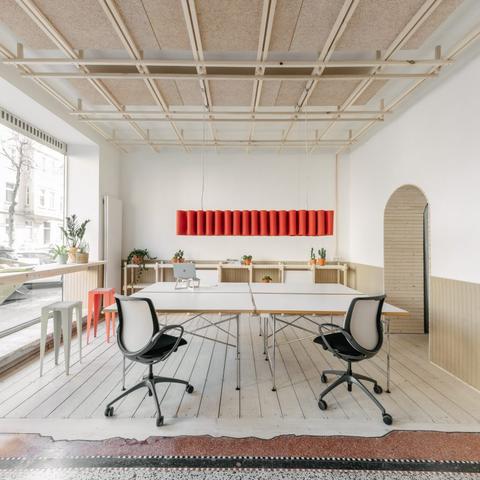
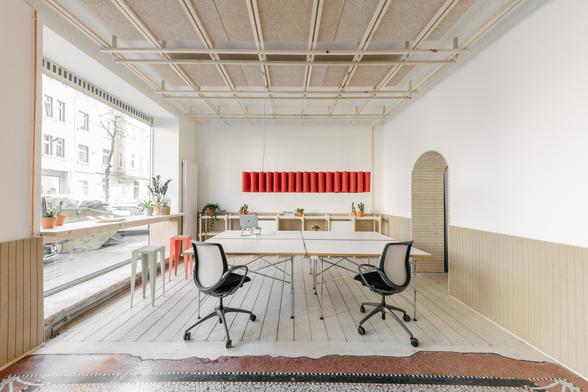
Urselmann Interior renovates own office using recycled and biodegradable materials

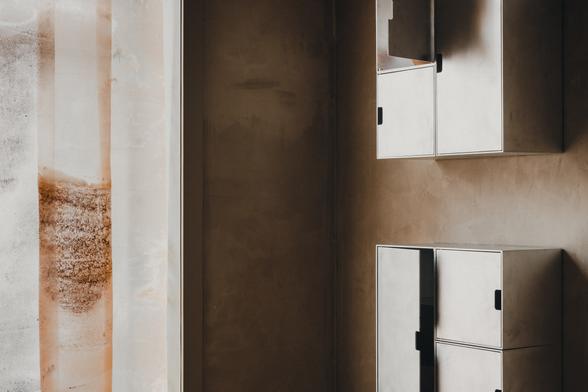
Düsseldorf studio Urselmann Interior has renovated its own office interior using biodegradable, recycled or upcycled materials, including glueless joinery and a cellulose-based wall cladding.

The interior design studio said that it renovated its self-described "circular" office in the German city to only feature materials that are either recycled, upcycled or biodegradable.

Urselmann Interior's office is in Düsseldorf

These include existing wooden and terrazzo flooring that was salvaged during the renovation, as well as heaters obtained from resource-efficient building material platform Concular.

Spread over one main workspace, a kitchen and a meeting room, the single-level office features clay paint walls and is designed to be used as both a co-working space and a showroom.

The renovation includes a kitchen

"The office also serves us as a laboratory in that we can [use it to] test new qualities, materials and construction methods," project manager Liz Theißen told Dezeen.

A solid wooden frame was used to create simple kitchen cabinets, which were constructed without glue so that the structure is fully demountable.

Joinery was created without glue in much of the project

The frame was fitted with panels formed from recycled strips of fabric supplied by textile brand Kvadrat from its Really collection.

For its walls, the studio used Honext wall cladding – a cellulose-based material that is produced using paper sludge and cardboard waste.

[

Read:

Honext develops recyclable construction material made of cellulose fibres from waste paper

](https://www.dezeen.com/2020/11/26/honext-recyclable-construction-material-cellulose-paper/)

Poplar wood from a tree felled in the nearby city of Krefeld was chosen for the ceiling, which was also assembled without glue.

Throughout the office, neutral and minimal colour and material palettes were applied to the interior design, which also includes clusters of carefully arranged potted plants and books.

Second-hand lighting encased in wiggly orange felt from Hey-Sign adds a splash of colour to the otherwise sandy-hued atmosphere.

Wiggly orange lighting adds a splash of colour

Theißen explained that all of the components that Urselmann Interior used for the renovation have been listed in a published "material passport" that can be referred to for future projects.

"We want to develop a new design language for ourselves, in which we smartly combine high-quality materials such as solid wood with ecological building materials as well as reusable components [to achieve] a positive footprint in the construction industry," she concluded.

Honext panels line the clay paint walls

Urselmann Interior is a Düsseldorf-based interiors studio founded by Sven Urselmann.

Similar projects to the studio's office renovation include a Madrid restaurant by Lucas Muñoz with furniture formed from site construction waste and a bar made out of recycled stereos, bottle crates and fridges by Michael Marriott.

_The photography is byMagdalena Gruber. _

Project credits:

Design and build: Urselmann Interior
Founder and designer: Sven Urselmann
Designer: Petra Jablonická
Project manager: Liz Theißen

The post Urselmann Interior renovates own office using recycled and biodegradable materials appeared first on Dezeen.

#all #interiors #sustainabledesign #germany #renovations #düsseldorf #reclaimedmaterials #upcycling #circulareconomy #recycling #officeinteriors #biodegradablematerials #honext

Natural Material Studio and Frama showcase algae and terracotta fabrics

Danish designer Bonnie Hvillum's Natural Material Studio has collaborated with multidisciplinary studio Frama on a collection of biodegradable materials made from algae, clay and foam.

The collection comprises three different fabrics that were turned into clothes, curtains and drapes, and showcased at Frama's Copenhagen showroom as part of last year's 3 Days of Design festival.

Above: Natural Material Studio unveiled new materials with Frama. Top image: the exhibition showed biodegradable clothes. Photo is by Natural Material Studio

The collaboration was the result of Natural Material Studio's long-running research into different types of natural materials.

"Some of the used materials were already in development when Frama's creative director Niels Strøyer Christophersen and I started having our meetings and talks about materials and our relations with them," Hvillum told Dezeen.

Door hangings were made from B-Foam. Photo is by Natural Material Studio

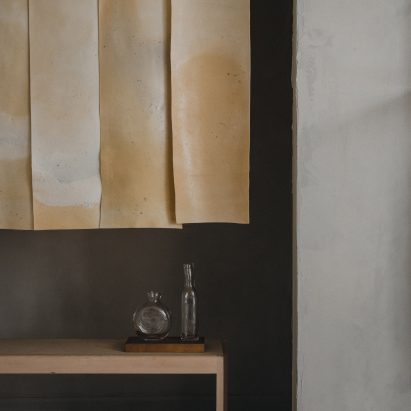
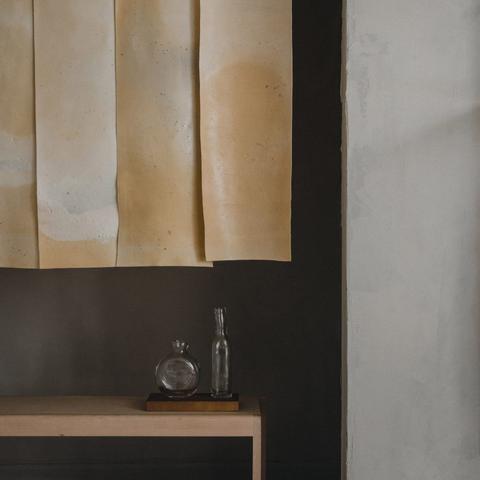
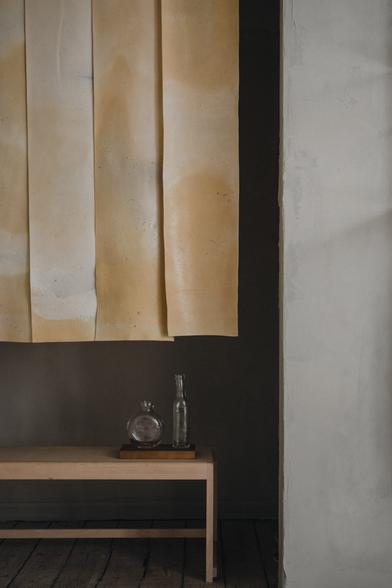
The fabrics that were shown at Frama's Copenhagen showroom were Alger, a seaweed fabric made from seaweed extract and softener, which is dyed with spirulina algae; and Terracotta, a clay-pigmented biofabric formed using a protein-based binder extracted from collagen and a natural softener.

Also on display were fabrics made from B-Foam, a foam material made from charcoal that Natural Material Studio has been developing since 2019. This was showcased at an earlier 3 Days of Design event, as part of design show Ukurant.

The three materials on display in the store are all biodegradable

"The seaweed textiles started during my research with Noma, but the terracotta bio fabric came up as a very impulsive idea we tried out, when we browsed for pigments we could use from Frama themselves," Hvillum explained.

"The B-Foam has been an ongoing research project for years and is used now in many different contexts, including fashion and furnitures."

Clothes were made from fabrics created from algae. Photo is by Natural Material Studio

The designer hand-casts the fabrics in wooden frames, in which they hang to dry for "a few days" before being cut out of the frames. All three fabrics are biodegradable.

"They are all based on a protein bio-polymer derived from waste," Hvillum said. "[The fabrics] are circular and bio-degrade within three months when exposed to soil and live bacterias."

Spores create patterns on clothes

As well as being made from natural materials, the fabrics have an organic look, with the algae ones featuring spores that give them a mould-like feel.

"The seaweed textiles contains live algae, which was used for pigmentations and colouring," Hvillum said.

[

Read:

Natural Material Studio develops Shellware ceramics from leftover seashells

](https://www.dezeen.com/2021/07/15/natural-material-studio-shellware-ceramics-noma/)

"They are alive and breathe the air," she added. "We didn't know exactly how the algae pigmentation would end up looking, and all the curtain and clothing pieces all turned out very individual and bespoke."

Eventually, Hvillum hopes the materials will come into everyday use, but she believes there still needs to be more research into these kinds of fabrics before commercialised standards can be set for them.

Pieces turned out "very individual and bespoke." Photo is by Natural Material Studio

"These are early-stage versions – beta versions, pilot versions, whatever we call them in other industries!" she said.

"They do not live up to quality standards for fabrics yet, but hopefully they will do one day with more research, testing and application trials continues," she added.

"This is a very important point because there is such a long step from early-stage research to commercial standardisation of all these new-age materials we see more and more of."

Terracotta clay was used to dye some of the fabrics

In order to make them commercially available, Hvillum believes more companies need to "be courageous" like Frama and focus on these kinds of natural materials.

"They will come into use gradually with smaller companies and brands that dare to be front movers, and are okay with not everything being fully standardized," Hvillum said. "This is nature we're talking about."

Hvillum's studio has previously launched projects such as the Shellware collection of ceramics made from discarded seashells from the Noma restaurant, while Frama is known for its minimalist design as seen in this interior for a Copenhagen bakery.

The photography is by Paolo Galgani unless otherwise stated.

3 Days of Design took place in Copenhagen on 16 to 18 September 2021. SeeDezeen Events Guide for up-to-date details of architecture and design events around the world.

The post Natural Material Studio and Frama showcase algae and terracotta fabrics appeared first on Dezeen.

#fashion #materials #products #all #design #sustainabledesign #copenhagen #denmark #algae #3daysofdesign #frama #biodegradablematerials #naturalmaterialstudio

Natural Material Studio and Frama showcasealgae and terracotta fabrics

Natural Material Studio has collaborated with multidisciplinary studio Frama on a collection of biodegradable materials made from algae, clay and foam.

Dezeen

Notpla is a biodegradable material designed "to make packaging disappear"

Sustainable startup Notpla has created an edible, biodegradable packaging made from seaweed and plants that was designed to replace plastic.

Notpla's eponymous packaging has been shortlisted for this year's Dezeen Awards in the sustainable design category.

Notpla has been designed as an alternative to plastic

Its name is a shortening of "not plastic," referring to the fact that while it looks plastic, the product is actually made from seaweed and plants.

Branding agency Superunion coined Notpla's name as well as a visual identity for the startup. This includes an animated logo that resembles a vessel filling up with water that is only visible when "filled" – as is the case with clear packaging.

Superunion created a visual identity for the startup

"Notpla is a seaweed-based, sustainable packaging startup on a mission to make packaging as we know it disappear naturally," Superunion senior creative director Mark Wood told Dezeen.

"Every year, 8 million tonnes of plastic are dumped in the oceans. The world’s behaviours need to change when it comes to single-use plastic," he explained.

The material can be used to hold condiments

According to Notpla's designers, the material is entirely biodegradable and edible and can be composted at home in four to six weeks.

So far, the packaging has been used to create thin films and coating for cardboard takeaway boxes, as well sachets for condiments.

[

Read:

Holly Grounds develops dissolvable ramen packaging that turns into sauce

](https://www.dezeen.com/2020/07/13/holly-grounds-dissolvable-noodle-packaging-design/)

Notpla says seaweed is a sustainable material from which to create packaging because the underwater plant does not need to compete with food crops for land, and also sequesters carbon dioxide – the process of removing it from the atmosphere.

The startup is also behind Ooho, which are sachets made from Notpla designed to be consumed by runners during sporting events.

In 2019, Ooho was trialled at the London Marathon where runners were offered the sachets, which were filled with Lucozade sports drink, while they ran.

Ooho, which is made from Notpla, has been trialled at sporting events

The Notpla designers have also created smaller-scale versions of Ohoo that are intended to hold liquids such as toothpaste, coffee and suncream.

"The ultimate aim is to stop billions of single-use plastic packaging from ever being made by providing a positive alternative," Wood said. "We believe Notpla has the potential to turn the tide on plastic waste."

The packaging is clear in colour

Formerly known as Skipping Rock Lab before Superunion rebranded it, Notpla was founded by Rodrigo Garcia Gonzalez and Pierre Paslier in 2014 while the pair were studying Innovation Design Engineering.

Other projects nominated in the Dezeen Awards sustainable category include Honext panels, which are made from recycled cardboard and paper sludge, and Alive, an organic prototype for architecture that promotes human health.

The images are courtesy of Notpla and Superunion.

Project credits:

Senior creative director: Mark Wood
Designer: Ilaria Celata
Senior account manager: Nicola Bennett-Cook
Co-founder: Pierre Paslier
Co-founder: Rodrigo Gonzales
Co-founder: Lise Honsinger

The post Notpla is a biodegradable material designed "to make packaging disappear" appeared first on Dezeen.

#products #materials #all #design #technology #sustainabledesign #plants #packaging #seaweed #biodegradablematerials #compostablematerials #biomaterials

Notpla is a biodegradable material created "to make packaging disappear"

Sustainable startup Notpla has created an edible, biodegradable packaging made from seaweed and plants that was designed to replace plastic.

Natural Material Studio develops Shellware ceramics from leftover seashells

Designer Bonnie Hvillum's Natural Material Studio has created conceptual ceramics from clay made out of powdered seashells from Denmark's Noma restaurant.

The Copenhagen-based designer teamed up with the restaurant, which is known for its locally sourced produce, and ceramicist Esben Kaldahl to develop the seashell-based material.

Some of the clays resemble coral

The Shellware project used donated leftover scallop and other seafood shells from Noma to create the crockery.

"I was curious to work with seafood shells and explore the possibilities, and also how they could be brought back into the restaurant in a new narrative," Hvillum, who is the founder of Natural Material Studio, told Dezeen.

Hvillum worked with a marine research center to create the material

She based her material research on learning the properties and build-up of different types of shells.

"I connected with marine experts from Kristineberg Marine Center in Sweden to understand the shells better," Hvillum explained.

"And from there follows several material experiments based on hypotheses I build from all the different knowledge I have gathered."

Shells are heated and then turned into powder

She discovered that the calcium carbonate seashells could be turned into calcium oxide by heating the shells. This creates a similar base material to bone ash used to make bone china.

"When I started heat-treating the shells to 900 degrees, all organic matter was burned away, and I started to understand what was left – the pure calcium oxide," she explained.

"From the shells that I received from Noma, the scallop shells were the ones that contained most calcium oxide."

The designer also created tablemats from seaweed

After being exposed to the strong heat, the calcinated shells were finely ground to a powder and mixed with natural elements to support the clay body.

Calcinating the shells by heating them also reabsorbs the carbon dioxide, making the process itself carbon-neutral.

"It's an industrial process used commonly to create quicklime by heat-treating chalk to remove the carbonate from the calcium," Hvillum explained.

The seashell clay is turned into ceramics

"When the pure calcium oxide goes in reaction with water, it re-absorbs the CO2 in the setting time, and therefore changes its build-up," she added.

"That chemical reaction is what makes the calcium oxide useful and an excellent binder, for example in hempcrete. In this case, I used it instead of bone ash as a chalk substitute in my own ceramic ware recipe."

Hvillum created multiple versions of the clay

During the research, Hvillum developed a number of different clays, including clays that look like coral and a clay that functions as a glaze.

As part of the project she also created a biodegradable seaweed textile that can be used as a matching table mat or cloth. These are made with seaweed extract and a natural softener, before being hand-cast in frames and cut.

The seaweed tablemats can be re-cast and are biodegradable

The material biodegrades within a few months if left out in nature and as it is circular, the textiles can be continually recast.

Hvillum and Kaldahl hope to continue developing the Shellware ceramic prototypes for other restaurants, as well as the consumer market.

The designer has previously created Foame, a chair made from bio-foam that resembles stone and was shown as part of the Ukurant Objects exhibition at design festival 3 Days of Design.

Photography is by Peter William Vinther.

The post Natural Material Studio develops Shellware ceramics from leftover seashells appeared first on Dezeen.

#all #design #materials #homeware #denmark #ceramics #noma #biodegradablematerials

Natural Material Studio develops Shellware ceramics from leftover seashells from Noma

Designer Bonnie Hvillum's Natural Material Studio has created Shellware, a conceptual ceramic produced from clay made out of powdered seashells from Denmark's Noma restaurant.