


13/
• The adrenal glands rapidly pump out epinephrine (adrenaline), norepinephrine, and cortisol.

• This internal flood causes hyper-arousal, rapid respiration, elevated blood pressure, and heightened sensory alertness.

https://youtu.be/P03CI8g2Kyk

#anxiety
#amygdala
#neurobiology
#podcast

Anxiety

YouTube

12/
Part 4: The Chemical Flood and Biological Architecture

When the low road is triggered, the amygdala initiates a rapid hormonal chain reaction by releasing Corticotropin-Releasing Hormone (CRH).

• CRH triggers the pituitary gland to release Adrenocorticotropic Hormone (ACTH), which travels via the bloodstream to the adrenal glands sitting atop the kidneys.

https://youtu.be/P03CI8g2Kyk

#anxiety
#amygdala
#neurobiology
#podcast

Anxiety

YouTube

11/
However, because the high road takes significantly longer to finish processing, the chemical flood triggered by the low road has already completely saturated the human body by the time the rational mind realizes the room is empty.

#anxiety
#amygdala
#neurobiology
#podcast

10/
2. The High Road: Simultaneously, the thalamus sends a high-resolution version of the same data up a longer pathway to the sensory cortex, frontal lobes, and hippocampus. This rational, deliberative side of the brain checks contextual memory and calculates a precise evaluation (e.g., "It's just a garden hose, not a snake").

https://youtu.be/P03CI8g2Kyk

#anxiety
#amygdala
#neurobiology
#podcast

Anxiety

YouTube

8/
Part 3: The Neurological Control Center (The Amygdala)

The neuroscientist Joseph LeDoux mapped out how sensory information is processed by the brain, famously noting that humans function like "emotional lizards" when handling danger. The amygdala—an ancient dual structure in the limbic system—manages fear across mammals, birds, and reptiles alike. LeDoux identified two concurrent neurological pathways:

https://youtu.be/P03CI8g2Kyk

#anxiety
#amygdala
#neurobiology
#podcast

Anxiety

YouTube

The amygdala plays a crucial role in emotional processing, particularly in detecting threat-related stimuli and regulating responses to them. Fear processing is a vital function emerging during the latter half of the first postnatal year and becomes progressively more regulated and context-dependent with maturation across early childhood. However, the neural underpinnings of early-emerging individual differences in fear processing remain underexplored.

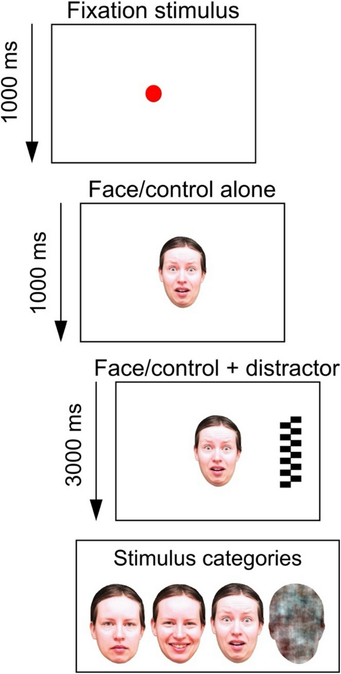
In our previous studies, we have examined how 8-month-old infants avert their gaze from fearful faces relative to non-fearful faces. In general, children of this age tend to stay looking at fearful faces more easily, a phenomenon called fear bias. However, in our previous study, we found that a smaller left amygdala volume after birth was associated with a greater likelihood of averting gaze from fearful faces at 8 months of age.

Our latest study builds on this by extending the analysis longitudinally. We investigated whether neonatal amygdala volume and microstructural properties, indexed by mean diffusivity, are associated with attentional biases toward fearful faces at 30 and 60 months. Neonatal MRI was acquired at 2–8 weeks of age using 3T MRI. The same cohort completed eye-tracking at follow-ups (n = 57 at 30 months; n = 54 at 60 months).

Our results show that larger newborn left amygdala volume was associated with decreased disengagement from fearful (vs. non-fearful) faces at 30 months (p = .041), but not at 60 months (p = .553). Moreover, sex-specific analyses indicated that higher mean diffusivity in the left amygdala was associated with lower fear bias at 60 months in boys (p = .046).

These findings highlight the dynamic nature of amygdala-related fear processing across early development. Associations between neonatal amygdala characteristics and fear bias appeared age-dependent and sex-specific, consistent with developmental changes in fear processing, with fear bias typically elevated in infancy and becoming less pronounced by around five years of age.

https://doi.org/10.1007/s00787-026-03041-3

#amygdala #EyeTracking #MRI #EmotionalProcessing #FearProcessing
Neonatal amygdala and fear processing across early childhood - European Child & Adolescent Psychiatry

The amygdala plays a crucial role in emotional processing, particularly in detecting threat-related stimuli and regulating responses to them. Fear processi

SpringerLink
vt.tiktok.com/ZSHkxLkbt/ Activists need to understand our own #basalganglia and how we encode it into our stories and thus our #amygdala anger is memory on autopilot - shut up, lock down, inhale 4 exhale 6, find 5 neutral facts, signal safety to amygdala..

TikTok - Make Your Day

TAPE: Amygdala, Suave, Ch4i, Jtec @ Rex Club - 18 Mar feat. Amygdala, Suave

#SESH #Amygdala #Suave

https://sesh.sx/e/1738618

TAPE: Amygdala, Suave, Ch4i, Jtec @ Rex Club - 18 Mar feat. Amygdala, Suave

#SESH #Amygdala #Suave

https://sesh.sx/e/1738618

The human #hippocampus and #amygdala actively broadcast signals to the #cerebral cortex during both sleep and wakefulness, contrary to previous rodent models that suggested a reversal of signal flow during sleep.
#Neuroscience #Neurology #sflorg
https://www.sflorg.com/2026/02/ns02192601.html
The dialogue happening in our heads: New study decodes how regions in the brain communicate with each other

World's first study relying on precise spatiotemporal brain signals