𝐅𝐫𝐨𝐦 𝐖𝐚𝐲𝐰𝐨𝐫𝐝𝐬: "𝐌𝐮𝐥𝐭𝐢𝐭𝐮𝐝𝐞𝐬" -

Admittedly, this "poem" has a bit of inside/very local humor, mostly as an affront to aesthetic decency. Still . . .

https://waywordsstudio.com/verse/multitudes/

#poetry #originalpoetry #adverbs #languagefun #antipoetry #aesthetics #poeticstyle #absurd

‘Life’ by Charlotte Brontë

Originally published in 1846, Life is a three-stanza poem by the eldest of the famous Brontë sisters, Charlotte. It appeared in their first, self-published, collection of works which—unpromisingly—sold only two copies. However, only a year later Charlotte managed to get her novel Jane Eyre published, and the rest is history, as they say.

Charlotte Brontë (1816-1855)

Life is a delightfully optimistic poem. In stanza 1, the poet counters the prevailing opinion of the wise men (the ‘sages’), positing that life is not as gloomy and difficult as it’s often claimed. If and when there is hardship, it’s there only to enable something better to come out of it. 

The very brief second stanza is a poetic take on the carpe diem philosophy of life: life is short and fleeting; seize the day and make the best of it! In the longest, third stanza, Brontë muses on the power of hope and courage, using a number of adjectives and adverbs to describe their characteristics.

Speaking of adjectives and adverbs, there’s a vocabulary exercise below the poem intended for English language learners. I hope you find it useful! And if you’d like to learn more about the Brontë sisters, have a look at my selection of resources for further study.

Life, believe, is not a dreamSo dark as sages say;Oft a little morning rainForetells a pleasant day.Sometimes there are clouds of gloom,But these are transient all;If the shower will make the roses bloom,O why lament its fall ?Rapidly, merrily,Life's sunny hours flit by,Gratefully, cheerily,Enjoy them as they fly !What though Death at times steps inAnd calls our Best away ?What though sorrow seems to win,O'er hope, a heavy sway ?Yet hope again elastic springs,Unconquered, though she fell;Still buoyant are her golden wings,Still strong to bear us well.Manfully, fearlessly,The day of trial bear,For gloriously, victoriously,Can courage quell despair!

VOCABULARY EXERCISES

  • Match the following adjectives related to the poem above with their definitions or synonyms:
  • TRANSIENT | RAPID | MERRY | GRATEFUL | CHEERY | ELASTIC | UNCONQUERED | BUOYANT | MANFUL

    • capable of floating; not easily depressed; cheerful
    • flexible, resilient, springy
    • lasting a short time, temporary
    • thankful
    • fast, quick, sudden
    • bold, brave, courageous, strong
    • lively, cheerful, joyous
    • not defeated or overcome
    • happy, bright, joyful
  • All of the above adjectives have an adverb form—except one. Which one is it? And can you make the adverbs out of these adjectives?
  • Check your answers in the answer key!

    ADDITIONAL READING

    Charlotte Brontë – biography on the English History website

    Ten Facts About the Most Interesting Literary Family – a Book Riot listicle 

    Brontë Parsonage Museum

    Cover photo by Sasha Freemind on Unsplash.

    NOTES

    I’m a freelance language tutor (English, Latin, Classical Greek), researcher, and a literary scholar currently based in Belgrade, Serbia.  

    If you wish to receive new content from my blog – as soon as it’s published – please enter your email address in the box below. You can also subscribe to my free monthly Newsletter and get a regular recap with additional content.

    To support my work, you can send me a donation via PayPal. It would be greatly appreciated!

    #19thCentury #adjectives #adverbs #CharlotteBronte #EnglishLiterature #EnglishVocabulary #learningEnglish #poem #poetry #vocabularyQuiz

    Does anyone else find this a problem?

    "My heart *happily thumped* ... as I *carefully turned* into the top of the ... lane ..."

    After several more of these 'subject-adverb-verb' constructions I was feeling quite sea-sick

    #adverbs #EnglishGrammar

    From Lincoln Michel's "Counter Craft" Defending Adverbs Exuberantly if Conditionally

    In Puryear’s piece, there is this passage:

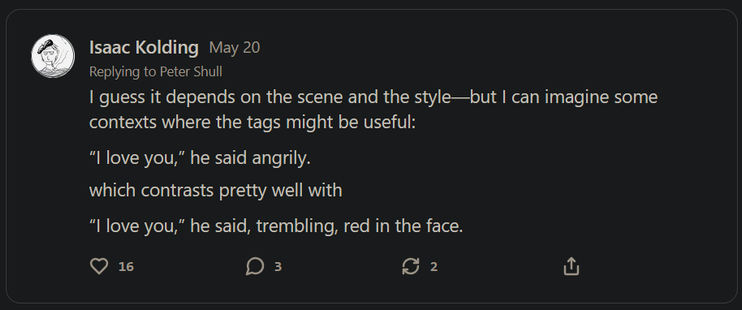
    There’s your pre-packaging. Just one way in which your creative freedom is stifled, a product of a systematic, state-issued conveyor belt of bourgeoise schlock, a thing worth screaming about on the internet. Unfortunately, if you believe this, then you might also believe that “Kurt said angrily” is as strong as “Kurt said, trembling, red in the face,” and that’s just too bad.

    And there was a rebuttal image (attached).

    I wanted to offer my own opinion because it has been weighing on me as I edit and write a set of short stories for a contest at the end of the month.

    I use adverbs often. I try to "show" when I can but, as someone on the autism spectrum, I tend to go overboard when "showing" as well.
    I can't help it.
    What does

    "I love you," he said, trembling, red in the face.

    even mean? Love itself could make you tremble. You could be red in the face because you are bashful.
    You'd need way more context clues to understand what it is saying. You'd really have to paint the entire scene. Maybe you are writing a novel and you can do that.

    "I love you," he said angrily.

    Cool. I can imagine that immediately. I know what "angrily" means to me and I will instantly apply that template to the scenario.
    It makes sense. It gets the point across.

    Sure, I might sometimes write a line like this.

    “She's not back yet, hon,” I say, my chest tightening making it hard to swallow.

    But I might also write this:

    Skeletal trees shone like crystal, whistling tunelessly in the wind.

    And they are both fine. Is there a verb that means "whistling tunelessly"? Probably. But you understand what I'm saying there. You see it and get it.

    I think adverbs have their place. Sometimes a fancy verb can pull your audience out of the story if it doesn't' match the voice you are using to tell it.

    This sentence?

    Metaphysical Eschatologists from the abyssal trenches of Deep Water to the coldest, highest peaks of Kadath have endlessly debated, researched, and bloviated about The Blight since the first sapient lifeform caught a glimpse of its inevitable, insurmountable, and insatiable rush backwards through time to devour every dream, every thought, every glimmer, ever breath, and every light that ever was such that it will have never been in the first place.

    It is exactly as pretentious as I want it to be, for example.

    #Writing #Adverbs

    How to use comparative and superlative #adverbs in #English

    Learn how to form and use #comparative and #superlative adverbs in English. Discover the rules, exceptions, and practical examples to improve your #language skills.

    https://preply.com/en/blog/comparative-and-superlative-adverbs-in-english/

    Then again, #Adverbs encompass a large group of words and perform many functions. Of those, I only try to avoid -ly modifier words b/c I prefer using one word over two or more.

    #WritersCoffeeClub Jan. 9: Do you avoid or embrace #Adverbs? He said provocatively.

    I don't avoid them completely, but I try to use descriptive nouns and verbs where possible instead b/c adverbs seem weaker tack-ons next to nouns and verbs, the essential elements of sentences.

    She said loudly.

    She hollered.

    See?

    Anaphora and Discourse Structure
    (2003) : Webber, Bonnie et al
    DOI: https://doi.org/10.1162/089120103322753347
    #adverbs #NLP #anaphora #discourse #language #my_bibtex
    Anaphora and Discourse Structure

    Abstract. We argue in this article that many common adverbial phrases generally taken to signal a discourse relation between syntactically connected units within discourse structure instead work anaphorically to contribute relational meaning, with only indirect dependence on discourse structure. This allows a simpler discourse structure to provide scaffolding for compositional semantics and reveals multiple ways in which the relational meaning conveyed by adverbial connectives can interact with that associated with discourse structure. We conclude by sketching out a lexicalized grammar for discourse that facilitates discourse interpretation as a product of compositional rules, anaphor resolution, and inference.

    MIT Press

    Just about any writing question that starts with "Can you" or "Should you" can be answered with "yes, if you do it well."

    #adverbs #PassiveVoice #CliffHangers #prologues #DialogueTags #OmniscientVoice #Exposition
    #WritingAdvice

    An adverb is (not always) a beautiful thing – an off-the-cuff joint.

    Once upon a time, I believed I was a writer-savant. I came to that belief during my school years, and the feelings solidified during my all-lower-case university days. In my defense, I tend to do w…

    From Famine to Feast.