If you're interested in participating in #ColiveVoice, find more details at https://www.colivevoice.org.
Should you want to partner with Colive Voice and aid in recruiting participants (open to anyone above the age of 15, regardless of health status and conditions), please contact us https://www.colivevoice.org/en/contact/
#Diabetes #Cancer #MentalHealth #RespiratoryHealth #Research #Science #DigitalHealth #DigitalEpidemiology #DigitalBiomarkers #VocalBiomarkers
I am spending my vacation in #Guadeloupe with my family-in-law, so I took this opportunity to visit our friends at the Diabetology Department of CHU de la Guadeloupe.
Like many other partners, they assist the Luxembourg Institute of Health / Deep Digital Phenotyping research unit in recruiting participants for the Colive Voice research program.
#Research #DigitalHealth #DigitalEpidemiology #VocalBiomarkers #DigitalBiomarkers #ColiveVoice #Diabetes #Cancer #MentalHealth
There is an important rule in the @[email protected] lab for PhD students.
1 first author paper accepted = I buy sushis 🍣.
Today was the celebration of the recent publications from @[email protected] @[email protected] @[email protected] ✊
#DigitalEpidemiology #DigitalHealth #VocalBiomarkers
#DigitalHealth #DigitalBiomarkers #VocalBiomarkers #COVID19
This study demonstrates the feasibility of identifying and remotely monitoring fatigue thanks to voice.
Some limitations were identified 👇
5/
#DigitalHealth #DigitalBiomarkers #VocalBiomarkers #COVID19
We used pre-trained models that were further fine-tuned on our dataset 👇
3/
#DigitalHealth #DigitalBiomarkers #VocalBiomarkers #COVID19
This work has been led by the great @[email protected] and our @[email protected] @[email protected]. Thanks to the coauthors & the @[email protected] & the Losch Foundation for funding the Predi-Cohort study 🙏
7/
Vocal biomarker predicts fatigue in people with COVID-19: results from the prospective Predi-COVID cohort study
Objective To develop a vocal biomarker for fatigue monitoring in people with COVID-19.
Design Prospective cohort study.
Setting Predi-COVID data between May 2020 and May 2021.
Participants A total of 1772 voice recordings were used to train an AI-based algorithm to predict fatigue, stratified by gender and smartphone’s operating system (Android/iOS). The recordings were collected from 296 participants tracked for 2 weeks following SARS-CoV-2 infection.
Primary and secondary outcome measures Four machine learning algorithms (logistic regression, k-nearest neighbours, support vector machine and soft voting classifier) were used to train and derive the fatigue vocal biomarker. The models were evaluated based on the following metrics: area under the curve (AUC), accuracy, F1-score, precision and recall. The Brier score was also used to evaluate the models’ calibrations.
Results The final study population included 56% of women and had a mean (±SD) age of 40 (±13) years. Women were more likely to report fatigue (p<0.001). We developed four models for Android female, Android male, iOS female and iOS male users with a weighted AUC of 86%, 82%, 79%, 85% and a mean Brier Score of 0.15, 0.12, 0.17, 0.12, respectively. The vocal biomarker derived from the prediction models successfully discriminated COVID-19 participants with and without fatigue.
Conclusions This study demonstrates the feasibility of identifying and remotely monitoring fatigue thanks to voice. Vocal biomarkers, digitally integrated into telemedicine technologies, are expected to improve the monitoring of people with COVID-19 or Long-COVID.
Trial registration number [NCT04380987][1].
Data are available in a public, open access repository. Audio data, datasets and source code used in this study are publicly available. Audio data available in Zenodo repository, (DOI: 10.5281/zenodo.5937844]Datasets and source code available in Github, ([https://github.com/LIHVOICE/Predi\_COVID\_Fatigue\_Vocal\_Biomarker][2]).
[1]: /lookup/external-ref?link_type=CLINTRIALGOV&access_num=NCT04380987&atom=%2Fbmjopen%2F12%2F11%2Fe062463.atom
[2]: https://github.com/LIHVOICE/Predi_COVID_Fatigue_Vocal_Biomarker
#DigitalHealth #DigitalBiomarkers #VocalBiomarkers #COVID19
This is a summary of the best performances obtained in men and women for Android and iOS devices. 👇
4/
#DigitalHealth #DigitalBiomarkers #VocalBiomarkers #COVID19
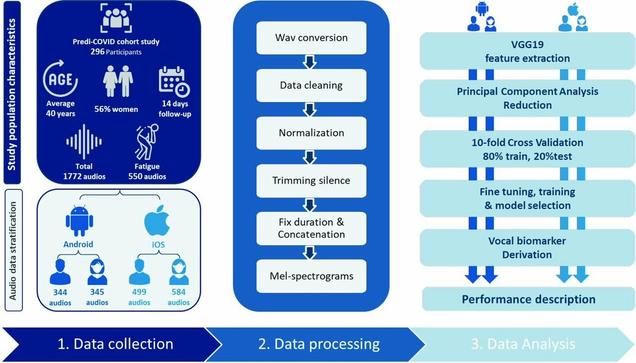
This is the study design
- we regularly recorded participants along with symptoms (including fatigue)
- we preprocessed the data and trained #AI models, separated by gender and smartphone OS
2/
Vocal biomarker predicts fatigue in people with COVID-19: results from the prospective Predi-COVID cohort study
Objective To develop a vocal biomarker for fatigue monitoring in people with COVID-19.
Design Prospective cohort study.
Setting Predi-COVID data between May 2020 and May 2021.
Participants A total of 1772 voice recordings were used to train an AI-based algorithm to predict fatigue, stratified by gender and smartphone’s operating system (Android/iOS). The recordings were collected from 296 participants tracked for 2 weeks following SARS-CoV-2 infection.
Primary and secondary outcome measures Four machine learning algorithms (logistic regression, k-nearest neighbours, support vector machine and soft voting classifier) were used to train and derive the fatigue vocal biomarker. The models were evaluated based on the following metrics: area under the curve (AUC), accuracy, F1-score, precision and recall. The Brier score was also used to evaluate the models’ calibrations.
Results The final study population included 56% of women and had a mean (±SD) age of 40 (±13) years. Women were more likely to report fatigue (p<0.001). We developed four models for Android female, Android male, iOS female and iOS male users with a weighted AUC of 86%, 82%, 79%, 85% and a mean Brier Score of 0.15, 0.12, 0.17, 0.12, respectively. The vocal biomarker derived from the prediction models successfully discriminated COVID-19 participants with and without fatigue.
Conclusions This study demonstrates the feasibility of identifying and remotely monitoring fatigue thanks to voice. Vocal biomarkers, digitally integrated into telemedicine technologies, are expected to improve the monitoring of people with COVID-19 or Long-COVID.
Trial registration number [NCT04380987][1].
Data are available in a public, open access repository. Audio data, datasets and source code used in this study are publicly available. Audio data available in Zenodo repository, (DOI: 10.5281/zenodo.5937844]Datasets and source code available in Github, ([https://github.com/LIHVOICE/Predi\_COVID\_Fatigue\_Vocal\_Biomarker][2]).
[1]: /lookup/external-ref?link_type=CLINTRIALGOV&access_num=NCT04380987&atom=%2Fbmjopen%2F12%2F11%2Fe062463.atom
[2]: https://github.com/LIHVOICE/Predi_COVID_Fatigue_Vocal_Biomarker
 Dr Guy Fagherazzi, MSc, PhD