#Methode
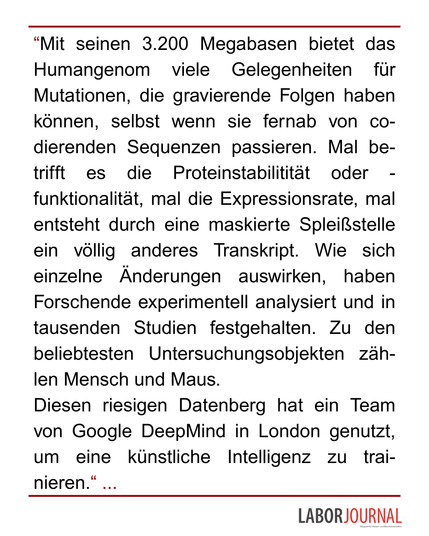
Das neu #KI-Tool #AlphaGenome sagt voraus, wie sich Sequenzänderungen durch Mutationen z.B. auf Genexpression oder Splicing auswirken. Mit Vorhersagen zu 11 Eigenschaften ist es umfassender als bisherige Tools, dennoch ist es nicht fehlerfrei, zelltypspezifische Expression bleibt eine Herausforderung und jenseits von Maus & Mensch ist das Modell keine Hilfe.

Mehr im Artikel von Andrea Pitzschke: https://www.laborjournal.de/editorials/3425.php

#Laborjournal #LifeSci #Bioinformatik #Genomics #VariantAnalysis

🔎 Day 8 of #OpenCRAVAT: Eight Data Filtering Options!
Refine your results with precision: filter by gene, variant type, pathogenicity score, or population frequency.
Which filter is most useful for your research? Comment below!
🔗Filtering Tutorial: https://docs.opencravat.org/en/latest/Filter-Tutorial.html
#12DaysofOpenCRAVAT #VariantAnalysis 🧬 🖥️
Filter tutorial — open-cravat documentation

🎁 Day 7: Customize Your Analysis with OpenCRAVAT!

1️⃣ Choose annotations from hundreds of modules.
2️⃣ Filter to focus on specific genes or variants.
3️⃣ Automate with custom Python scripts.
4️⃣ Select input formats: VCF, HGVS, or dbSNP.
5️⃣ Adjust visualization settings.
6️⃣ Export reports as TXT, Excel, or SQLite.
7️⃣ Run analyses locally or in the cloud.

Explore these features today! What’s your favorite way to customize? Let us know! #12DaysofOpenCRAVAT #Genomics #VariantAnalysis

🌟 On the 6th day of #OpenCRAVAT, my database gave to me…Six Gene-Level Insights!

Which insight is most valuable for your research? CHASMplus, REVEL, PolyPhen-2, gnomAD, ClinVar, or COSMIC?

Explore OpenCRAVAT at opencravat.org

#Genomics #VariantAnalysis #OpenCRAVAT 🧬 🖥️

✨ On the 3rd day of #OpenCRAVAT, my tools gave to me…
🎄 Three Custom Report Options!
Choose from TXT, Excel, or Sqlite outputs to fit your workflow. Which report type is your favorite? Reply below!
🔗https://docs.opencravat.org/en/latest/3.-Viewing-Results.html#downloadable-reports
🔗https://docs.opencravat.org/en/latest/3.-Viewing-Results.html#viewing-results
#12DaysofOpenCRAVAT #Genomics #VariantAnalysis
Viewing Results — open-cravat documentation

🌐 Exciting news! OpenCRAVAT has a brand-new website AND logo 🎉. Check it out at https://opencravat.org.

🧬 Explore our Single Variant Tool directly on the landing page—annotate a single variant with ease and see how OpenCRAVAT simplifies genomic analysis! 🚀

Let us know your thoughts! #Genomics #VariantAnalysis #OpenCRAVAT

OpenCRAVAT

I open sourced a tool to create lists of repos to run GitHub CodeQL’s Multi-Repository Variant Analysis on, using a keyword search on GitHub.

It's a Bash script you can trigger with a VSCode build task. It uses the GitHub API (via the GitHub CLI) to fill a list in the VSCode settings.

It’s a stopgap before this sort of feature makes it into the product.

https://github.com/advanced-security/mrva-code-search

#MRVA #VariantAnalysis #CodeQL #GitHub #VSCode #BuildTask #SAST #VulnerabilityResearch

You can now run a single static analysis query across thousands of repos on GitHub using CodeQL's MRVA (Multi-repo Variant Analysis).

That's great both for security research and rapidly auditing exposure to a single vuln or weakness for security teams.

It works from the CodeQL extension for VSCode, with open source public repos & private repos where CodeQL Code Scanning is enabled.

https://github.blog/2023-03-09-multi-repository-variant-analysis-a-powerful-new-way-to-perform-security-research-across-github/

#GitHub #SecurityResearch #VulnerabilityResearch #CodeQL #VariantAnalysis #MRVA #SAST

Multi-repository variant analysis: a powerful new way to perform security research across GitHub | The GitHub Blog

Multi-repository variant analysis lets you scale security research across thousands of repositories, giving you a powerful tool to find and respond to newly discovered vulnerabilities.

The GitHub Blog