
Moez Dawood, an MD/PhD student at Baylor College of Medicine, created the AllofUs 250k annotator for OpenCRAVAT to improve genomic research by integrating diverse data, including ancestry-specific allele frequencies. You can read more about Moez's experience developing the annotator here: https://www.opencravat.org/bringing-genetic-diversity-to-the-forefront-moez-dawood-on-the-allofus-250k-annotator-for-opencravat/
#annotator #opencravat #bioinformatics #opensource #genomics
Would you be interested in organizing or speaking at meetups, writing blog posts, or promoting the project?
Are you part of any communities or organizations where you could share our project? #annotator #opencravat #bioinformatics #opensource #genomics
Can you help test new features or provide feedback on pre-release versions?
Would you be interested in setting up automated test cases or improving test coverage?
Would you be open to helping improve documentation or writing user guides?
Do you have skills in UI/UX design, and would you be interested in helping us improve the user interface?
#annotator #opencravat #bioinformatics #opensource #genomics
We are seeking community members interested in taking part in OpenCRAVAT's future.
Let us know if you might contribute in any of these areas:
Would you be interested in contributing code, bug fixes, or performance improvements?
Are there features or issues you’d like to help implement or debug?
Would you be willing to review pull requests or help triage GitHub issues?πŸ–₯️ 🧬 πŸ§ͺ #annotator #opencravat #bioinformatics #opensource #genomics
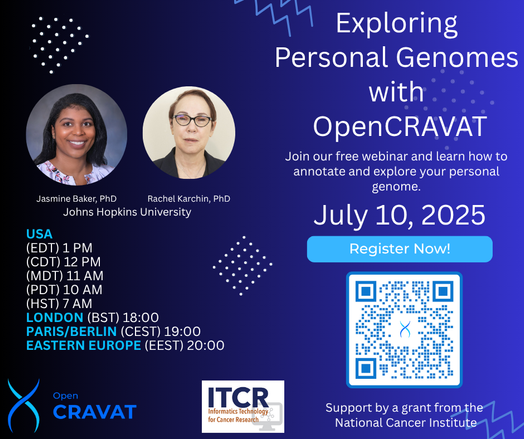
🧬 Want to explore your own genome?

Join our free webinar on how to use OpenCRAVAT to annotate & interpret your personal variants.

πŸ“… July 10 | πŸ• 1 PM EDT
πŸŽ™οΈ With Jasmine Baker, PhD & Rachel Karchin, PhD
πŸ”— https://tinyurl.com/3ur6vv35
#Genomics #Bioinformatics #OpenSource #OpenCRAVAT

Welcome! You are invited to join a webinar: Exploring Personal Genomes with OpenCRAVAT. After registering, you will receive a confirmation email about joining the webinar.

One-hour webinar teaching how to utilize OpenCRAVAT as an annotation tool for personal genomic data.

Zoom

🧬 Curious about your genome?
Join our free webinar on OpenCRAVAT to explore and annotate your own data!

πŸ“… July 10 – 1 PM EDT
πŸŽ™οΈ Baker & Karchin (JHU)
πŸ”— https://tinyurl.com/3ur6vv35
#Genomics #Bioinformatics #OpenScience
#annotator #opencravat #bioinformatics #opensource #webinar #genomes πŸ–₯πŸ§ͺ

Discover the power of OpenCRAVAT's cutting-edge annotation features that ensure seamless collaboration among users. Its intuitive design makes it easy for everyone to navigate, while enhancing productivity across the board. Whether you're a beginner or a seasoned pro, OpenCRAVAT opens up a world of possibilities, making your workflow smoother and more efficient.#annotator #opencravat #bioinformatics #opensource #genomics
Discover the power of the All of Us annotator with Open Cravat! This tool leverages the vast allele frequency data from the All of Us Research Program, offering insights into genetic variations across diverse populations. By using this annotator, researchers can delve into non-European genetic diversity and advance precision medicine. Let's drive innovation in healthcare together! #PrecisionMedicine #Genomics #AllOfUs #OpenCravat#annotator #bioinformatics #opensource
Do you have research goals for 2025!? We'd love to hear them! #annotation #OpenCRAVAT #2025 πŸ§ͺπŸ–₯

🧬 New Blog by Dr. Rachel Karchin!

Dr. Karchin shares how OpenCRAVAT and CIViC are addressing transparency and interpretability in variant effect predictors. Discover how calibrated predictors are transforming clinical variant classification.

πŸ”— Read the full post: https://www.opencravat.org/variant-effect-predictors-in-the-clinic-working-with-calibrated-predictors-in-opencravat/

What are your thoughts on the new ACMG/AMP framework integration? Let us know below!
#Genomics #VariantAnnotation #OpenCRAVAT πŸ–₯️

Variant effect predictors in the clinic: Working with calibrated predictors in OpenCRAVAT

Computational methods for predicting the effects of genetic variants are used by clinicians for interpreting genetic test results and by researchers for scientific exploration. However, their utility is limited by several issues. First, hundreds of methods are available without clear standards for s

OpenCRAVAT