Children traumatised by the war in Gaza are taking part in a pioneering therapy programme that uses virtual reality (VR) headsets to transport them to peaceful digital worlds far removed from the devastation around them.
https://english.mathrubhumi.com/news/world/vr-therapy-gaza-children-trauma-healing-e6975tn4?utm_source=dlvr.it&utm_medium=mastodon #Gazachildren #VRTherapy #IsraelPalestine #psychologicaltrauma🌌🧠 Mind-bending VR breakthrough! “Cyberdelics” uses immersive virtual reality to mimic psychedelic effects—boosting creativity & cognitive flexibility without drugs. A drug-free path to therapy benefits! Read more: https://thedebrief.org/cyberdelics-enable-researchers-to-produce-mind-altering-vr-hallucinations-that-mimic-the-effects-of-psychedelic-drugs/
#GoodNews #Cyberdelics #VRTherapy #PsychedelicScience #MentalHealthWin

'Cyberdelics' Enable Researchers to Produce Mind-Altering VR Hallucinations that Mimic the Effects of Psychedelic Drugs
Science, Tech and Defense for the Rebelliously Curious.

Self-guided VR therapy shows promise for managing social anxiety
A recent study found that the oVRcome app reduced social anxiety symptoms in six weeks, with sustained benefits. Its low-cost, self-guided VR approach improves accessibility, offering a scalable alternative for treating social anxiety disorder.
Review on the Role of Virtual Reality in Reducing Mental Health Diseases Specifically Stress, Anxiety, and Depression
Sadia Saeed, Khan Bahadar Khan, Muhammad Abul Hassan, Abdul Qayyum, Saba Salahuddin
https://arxiv.org/abs/2407.18918 https://arxiv.org/pdf/2407.18918
#VirtualReality #vr #VRtherapy #stress #anxiety #depression
https://mastoxiv.page/@arXiv_csHC_bot/112874107556705076

Review on the Role of Virtual Reality in Reducing Mental Health Diseases Specifically Stress, Anxiety, and Depression
Objective: Virtual Reality (VR) is a technological interface that allows users to interact with a simulated environment. VR has been used extensively for mental health and clinical research. Mental health disorders are globally burdening health problems in the world. According to the Psychological Interventions Implementation Manual published by WHO on 6th March 2024, around one in eight people in the world lived with a mental disorder. This literature review is synthesized to find out the effects of VR therapy on stress, anxiety and depression. Method: We used Google Scholar database using keywords of VR, stress, anxiety and depression. Publication from last ten years (2014 to 1024) are considered. Researches only in the English language are included. All the papers and articles with the keyword VR missing were rejected. Result: Google Scholar yielded 17,700 results from our keywords. Nine studies met our search criteria that are included in this review. Out of nine, five studies encountered mental stress and gave effective results in reducing it by VR therapy. The other four targeted mood disorders, Social anxiety disorders, depression, loss of happiness and sleep deprivation. They also showed immense potential in reducing mental illness while using VR. Conclusion: Findings are in favor of the effectiveness of VR in reducing stress, anxiety and depression. Still, it is insufficient evidence to consider VR as solely independent treatment over the traditional medication. In future, the limitations can be overcome to relying on VR and using it in hospitals as a reliable source of cure for mental illness.
 Mathrubhumi English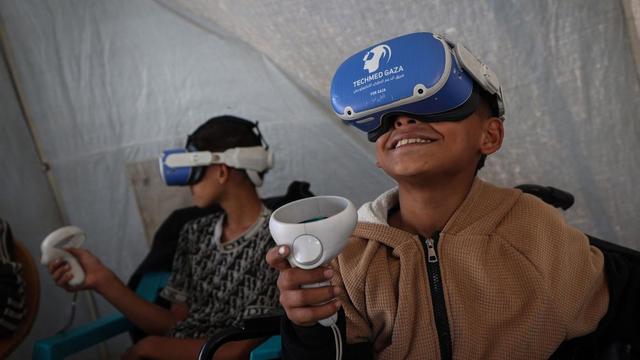
 Good News Community
 PsyPost
 Francis Mangion (M) (VR/AR/*)