
#Apple lies. I'm not surprised *that* this is true; I'm surprised *how* this manifests.

I was looking for a #game in the #AppStore. Not a specific game, but some kind of puzzle game that has reasonable #privacy practices.

Apple is *all* about how their #App Store has only curated #apps.

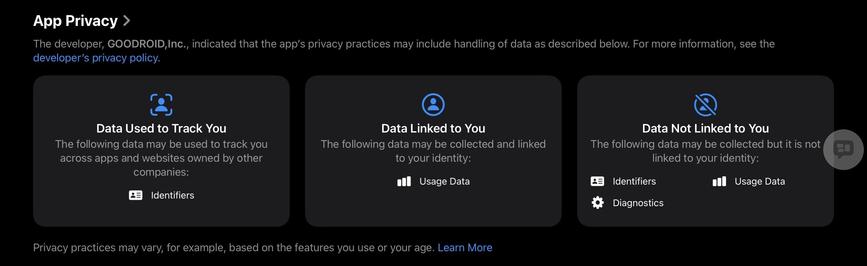
There are up to three parts to this standard disclosure. This particular set has the following:

- #Data shared across all the apps on your device that is used to #track you

- Data linked to your #identity that the app is not specifically sharing

- Data that is *not* linked to you with no indication whether or how it's shared

This particular set lists #Identifiers in both the "Data Used to Track You" section and the "Data Not Linked to You" and these are mutually exclusive.

Same for #UsageData that is "Data Linked to your Identity" and "Data Not Linked to You"

wtaf?

There's some kinda #fraud happening here, though I can't say I'm shocked. #Logic should prevent this listing from even being possible. You cannot track me with something not linked to my identity. Likewise, something cannot be both linked to my identity and *not* linked to my identity. I'm not the brightest cookie in the drawer, but this isn't rocket surgery, either.

And no, I didn't install that game.

#tracking #trackers #surveillance #iOS #iPadOS #walledGarden
Pew Research: “Google Users are Less Likely to Click On Links When An AI Summary Appears In The Results”

From Pew Research: Last year, Google introduced “AI Overviews,” a feature that displays an artificial intelligence-generated result summary at the top of many Google search pages. This feature is available to millions of U.S. Google users. Online publishers recently have attributed declining web traffic to these summaries replacing traditional search results, claiming that many users are relying on the […]

Library Journal infoDOCKET
Exploring National Infrastructures to Support Impact Analyses of Publicly Accessible Research: A Need for Trust, Transparency and Collaboration at Scale – InfoDoc MicroVeille

Measured in a context: making sense of open access book data

by Ronald Snijder

https://doi.org/10.1629/uksg.627

#UKSGInsights #OAbooks #UsageData

Measured in a context: making sense of open access book data

Normal 0 false false false EN-GB X-NONE X-NONE /* Style Definitions */ table.MsoNormalTable {mso-style-name:"Table Normal"; mso-tstyle-rowband-size:0; mso-tstyle-colband-size:0; mso-style-noshow:yes; mso-style-priority:99; mso-style-parent:""; mso-padding-alt:0cm 5.4pt 0cm 5.4pt; mso-para-margin-top:0cm; mso-para-margin-right:0cm; mso-para-margin-bottom:8.0pt; mso-para-margin-left:0cm; line-height:107%; mso-pagination:widow-orphan; font-size:11.0pt; font-family:"Calibri",sans-serif; mso-ascii-font-family:Calibri; mso-ascii-theme-font:minor-latin; mso-hansi-font-family:Calibri; mso-hansi-theme-font:minor-latin; mso-bidi-font-family:"Times New Roman"; mso-bidi-theme-font:minor-bidi; mso-font-kerning:1.0pt; mso-ligatures:standardcontextual; mso-fareast-language:EN-US;} Open access (OA) book platforms, such as JSTOR, OAPEN Library or Google Books, have been available for over a decade. Each platform shows usage data, but this results in confusion about how well an individual book is performing overall. Even within one platform, there are considerable usage differences between subjects and languages. Some context is therefore necessary to make sense of OA books usage data. A possible solution is a new metric – the Transparent Open Access Normalized Index (TOANI) score. It is designed to provide a simple answer to the question of how well an individual open access book or chapter is performing. The transparency is based on clear rules, and by making all of the data used visible. The data is normalized, using a common scale for the complete collection of an open access book platform and, to keep the level of complexity as low as possible, the score is based on a simple metric. As a proof of the concept, the usage of over 18,000 open access books and chapters in the OAPEN Library has been analysed, to determine whether each individual title has performed as well as can be expected compared to similar titles.

#Apple Is #Tracking You Even When Its Own #Privacy Settings Say It’s Not, New #Research Says
https://gizmodo.com/apple-iphone-analytics-tracking-even-when-off-app-store-1849757558

Apple Says Your iPhone's #UsageData is Anonymous, but New Tests Say That's Not True
https://gizmodo.com/apple-iphone-privacy-dsid-analytics-personal-data-test-1849807619

I'm sooo glad, I got rid of everything from Apple. They do not have any respect at all. Others steal our data too but they are more open about it and most of the time you do have more options at hand in contrast to Apple devices.

Apple Is Tracking You Even When Its Own Privacy Settings Say It’s Not, New Research Says

An independent test suggests Apple collects data about you and your phone when its own settings promise to “disable the sharing of Device Analytics altogether.”

Gizmodo

Interested in the role of #usagedata and #analytics in helping to build sustainable #openaccess #scholcomm #publishing ecosystems? Join us for this free #openaccess #book network #webinar. ‘Open Access Usage Data: Present Knowledge, Future Developments’

Sign up here: https://us06web.zoom.us/meeting/register/tZEvceqvqDkiH9B6tKhxlSHg6ppcvhrGVEPU

Welcome! You are invited to join a meeting: Open Access Usage Data: Present Knowledge, Future Developments. After registering, you will receive a confirmation email about joining the meeting.

Join the Open Access Books Network (OABN) in a chat with Christina Drummond and Lucy Montgomery to discuss the OAeBU Usage Data project and the new developments the work will take over the coming years.

Zoom