NASA’s Nancy Grace Roman Space Telescope's ‘Spy Mirror’ Could Transform How We Map The Universe
--
https://www.discovermagazine.com/nasa-s-nancy-grace-roman-space-telescope-s-spy-mirror-could-transform-how-we-map-the-universe-49239 <-- shared technical article
--
https://www.mos.org/article/ready-roman-nancy-grace-roman-space-telescope <-- shared technical article
--
https://www.space.com/space-exploration/the-nancy-grace-roman-space-telescope-nasas-next-great-observatory-is-finally-complete <-- shared technical article
--
https://youtu.be/TcjuucVEB5g?si=I93BjarghNcYKKqj <-- shared NASA Goddard technical overview video
--
https://youtu.be/lBAuc057pVA?si=IghhCWC915FO3y3C <-- shared media video
--
“… Roman is set to launch on August 30, 2026, and will help us gain a wider view of the universe and collect data faster than its predecessors, such as the Hubble Space Telescope. The telescope will do so thanks to the incredible equipment and instruments built into it.
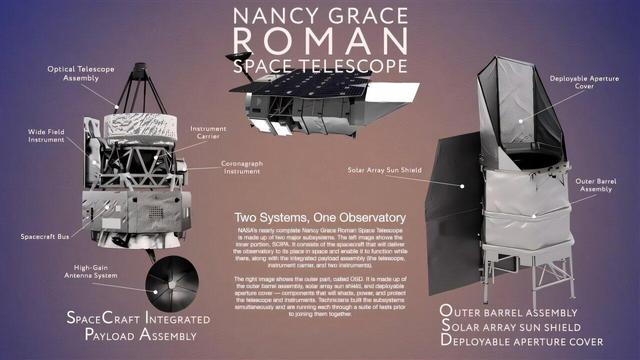
These instruments include the primary mirror, which was gifted to NASA by a U.S. intelligence agency, the Wide Field Instrument, and an advanced coronograph. Altogether, these instruments could help us map out more of the universe than we ever imagined.
“It is an incredible feat of precision engineering. It's quite possibly the most complex scientific instrument that NASA has ever built,” Dominic Benford, …program scientist for the Nancy Grace Roman Space Telescope…”
--
“Named after NASA’s first chief astronomer, the ‘mother of the Hubble Space Telescope,’ the Nancy Grace Roman Space Telescope will have a field of view at least 100 times larger than Hubble's, potentially measuring light from a billion galaxies in its lifetime. This observatory will also be able to block starlight to directly see exoplanets and planet-forming disks, complete a statistical census of planetary systems in our galaxy, and settle essential questions in the areas of dark energy, exoplanets, and infrared astrophysics…”
--
The Roman Space Telescope is engineered to investigate the biggest mysteries in astrophysics:
• Dark Energy & Dark Matter: By surveying billions of galaxies and mapping their distribution, Roman will explore why the universe's expansion is accelerating and trace cosmic history.
• Exoplanets: It will utilize gravitational microlensing to complete a statistical census of planetary systems in our galaxy, aiming to find thousands of exoplanets, including elusive rogue planets.
• Infrared Astrophysics: The telescope's deep, crisp infrared vision will help astronomers measure light from up to a billion galaxies over its lifetime.
#coronograph #astronomy #mapping #exoplanets #universe #telescope #spacetelescope #darkenergy #darkmatter #NancyGrace #NASA #Roman #astrophysics #cosmic #infrared #launch #WideFieldInstrument #instumentation #exploration extraterrestrial observatory
#space #remotesensing #galacticbulge #spatialanalysis #spatiotemporal #supernova @nasa @nasa Goddard @Discover Magazine
 AlcorNews
 TKSST • seethis.tv 🌈🪐✨
 AlcorNews
 TheYearofLove🌈
 FutureByMuskTech
 💧🌏 Greg Cocks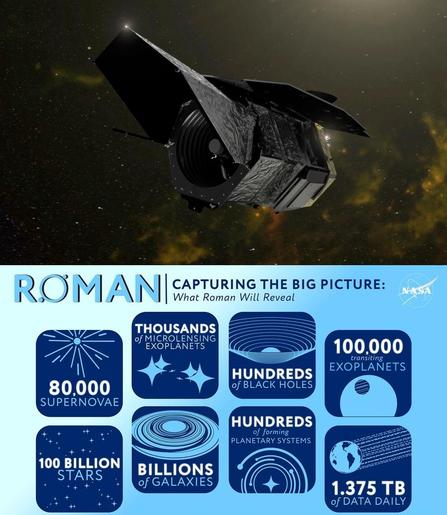


 Miro Collas