 Michael
New blog post: https://blog.mei-home.net/posts/tp2-fw-update/
This time about updating the firmware on my Turing Pi 2 boards.
I had to touch hardware for this one. *shudder*
New blog post: https://blog.mei-home.net/posts/tp2-fw-update/
This time about updating the firmware on my Turing Pi 2 boards.
I had to touch hardware for this one. *shudder*
Here is the offending SD card slot. I really don't know why they couldn't at least put it on the edge, so it is accessible without taking the board out of the case.
Also: Every time I have to do something with the Homelab hardware, I'm thinking to myself: How expensive can a bundle of VMs with a cloud provider really be?
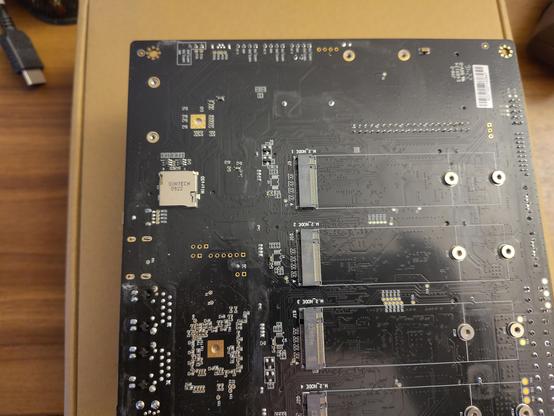
Today's fun Homelab activity: Finally updating the Firmware on my Turing Pi 2 boards (https://turingpi.com/product/turing-pi-2-5/). I've already prepared the SD card. My biggest worry is that it looks like the SD card slot is on the back of the board. So I might need to take it out of the case. 😔
Turing Pi 2 - Retrofitting an EMC2301 Fancontroller
The Turing Pi 2 (v.2.4) has actually some secrets that just start to get uncovered. Looking closely at the board, you will find the red marked area with what seems to be an unpopulated 4-pin fan header (J16) and an unpopulated IC spot (U109).
These spots were, as found out by Sam Edwards (CFSworks) actually a place to install Molex 47053-1000 4-p
https://www.nico-maas.de/?p=2702
#Computer #Hardware #ProductSpecific #Projects #TuringPi2
The Turing RK1 Compute Module is powered by Rockchip RK3588 SoC. This chip utilizes an 8nm LP process and boasts an 8-core (Cortex-A76x4+ Cortex-A55x4) 64-bit CPU, capable of speeds up to 2.4 GHz. Incorporating an ARM Mali-G610MP4 quad-core GPU and a dedicated AI accelerator NPU, the Turing RK1 can ...

The Turing Pi 2.5 is an updated version of the Turing Pi 2.0, a 4-node mini ITX cluster board compatible with Raspberry Pi CM4 modules and Nvidia Jetson modules. This compact device is designed for applications such as building Homelabs, self-hosting, and machine learning tasks, as it is capable of continuous 24/7 operation.
Been running K3s on four RK1 compute modules plugged into a TuringPi2 board for almost two weeks now. Everything except media stuff has been moved over, including this Mastodon instance.
It's been working a lot better than when I had previously tried RaspberyPis. Being able to use NVME storage (I'm using Longhorn) is a huge improvement to the RPi’s USB.
Parts for my Turing Pi v2 finally showed up. I've had the board for over 12 months but never had Pi's to stick in it. I now have 2 32GB Pi4's for it, and I think I will get a NVIDIA Jetson to go in the other board and essentially turn it into 1 node for general containers/API's and stuff, and the Jetson for running ollama with local models and doing some light model training/customization experimentation.
Before I get to that, I need my 20core Xeon Proxmox box up and running, my Ubiquiti gateway updated so I can run dual failover connections (NBN and Starlink) and my wifi hot spots for the house cabled and mounted in the right places.
time to get in the roof I think.
Oh and I got the latest protocol spec PDF from Polyaire for my AirTouch2+ and need to get my #AI powered aircon client functioning.
If I ever hit lotto, I might be able to get to some of this.. heh.
I've had the TuringPi2 (v2.4) for over a year, but never got around to setting it up until recently. The build is a WIP, waiting on two additional Jetson Orin NX 16GB modules and am testing different arrangements for the node storage, networking, and oob/remote access functions.
There are also several CM4 8GB modules, one presently installed, but the final deployment will be 3x Orin NX + 1x Xavier NX (16GB on all).
#Sunday #HomeLab #Ai #nvidia #TuringPi2 #arm #hardware #Linux #FreeBSD

 Nico
Nico Brad Linder
 sean
sean Zate 🦘🇦🇺
 Eva Winterschön
 Bill Plein🌶