MER 30/07 : USERBAND + LE SATELLITE DE LA TÉLÉVISION + CENT D'OR + DJ STEVE NO JOBS - Grrrnd Zero, Salle de concerts et hebergement d activites collectives sur Lyon
Grrrnd zero, salle de concert et association independante sur Lyon / Vaulx-en-Velin de Concerts, evenements et hebergement d'associations et d'artistes.
MER 30/07 : USERBAND + LE SATELLITE DE LA TÉLÉVISION + CENT D'OR + DJ STEVE NO JOBS - Grrrnd Zero, Salle de concerts et hebergement d activites collectives sur Lyon
Grrrnd zero, salle de concert et association independante sur Lyon / Vaulx-en-Velin de Concerts, evenements et hebergement d'associations et d'artistes.

NSF–DOE Vera C. Rubin Observatory Launches Orbitviewer App - New 3D, interactive visualization of planets and minor planets in our Solar System lets you explore Rubin discoveries in real time
NSF–DOE Vera C. Rubin Observatory Launches Orbitviewer App
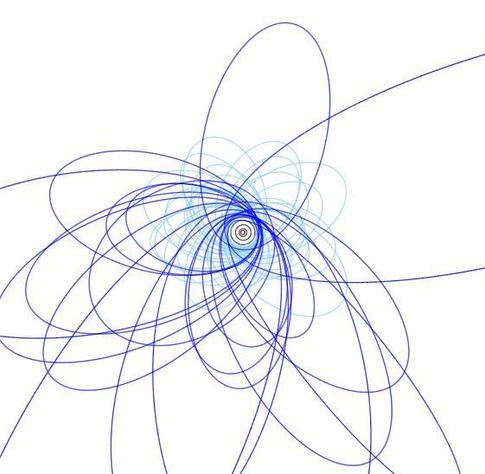

Orbit of a Possible Planet X
The plausibility of an unseen planet in the outer solar system, and the expected orbit and mass of such a planet, have long been a topic of inquiry and debate. We calculate the long-term orbital stability of distant TNOs, which allows us to expand the sample of objects that would carry dynamical information about a hypothetical unseen planet in the solar system. Using this expanded sample, we find statistically significant clustering at the $\sim 3 σ$ level for TNOs with semimajor axes $>170$ AU, in longitude of perihelion ($\varpi$), but not in inclination ($i$), argument of perihelion ($ω$) or longitude of node ($Ω$). Since a natural explanation for clustering in $\varpi$ is an unseen planet, we run 300 $n$-body simulations with the giant planets, a disk of test particles representing Kuiper belt objects, and an additional planet with varied initial conditions for its mass, semimajor axis, eccentricity, and inclination. Based on the distribution of test particles after $1-2$ Gyr, we compute relative likelihoods given the actual distribution of $\varpi$ as a function of semimajor axis for distant TNOs on stable orbits using a significantly larger sample than previous work. We find the best-fit unseen planet parameters to be: mass $m_p = 4.4\pm1.1\mathrm{\;M_{\oplus}}$, semimajor axis $a_p=290\pm30\mathrm{\;AU}$, eccentricity $e_p=0.29\pm0.13$, and inclination $i_p=6.8\pm5.0^{\circ}$. Only $0.06\%$ of the Brown & Batygin (2021) Planet Nine reference population produce probabilities within $1σ$ of the maximum within our quadrivariate model, indicating that our work identifies a distinct preferred region of parameter space for an unseen planet in the solar system.

SwRI scientists find evidence of geothermal activity within icy dwarf planets
Webb telescope observes potentially young methane deposits on surfaces of Eris, Makemake.
There could be a hidden planet in our solar system, the size of Uranus. A new study suggests a large object beyond Neptune, orbiting the sun in a highly elongated path. The object could explain the unusual movements of some trans-Neptunian objects or small icy bodies in the outer solar system.
#HiddenPlanet #SolarSystem #TransNeptunianObjects https://www.newscientist.com/article/2379864-our-solar-system-could-be-hiding-an-extra-planet-the-size-of-uranus/?utm_source=flipboard&utm_content=HariTulsidas%2Fmagazine%2FMind+and+Matter

Our solar system could be hiding an extra planet the size of Uranus
Many planets are thought to be flung away from their stars, but it’s possible that some get trapped on the way out – and one could be lurking at the edge of our own solar system
 。°○。。。°。。。🫧。。°。。。。°。。。。。°。。○
 Daniel Pomarède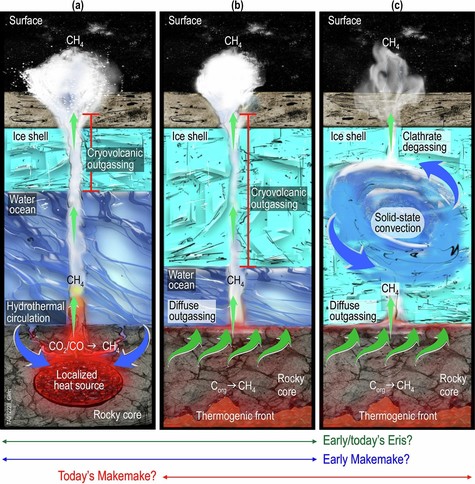
 Hari Tulsidas