The Bug That Painted Europe Red (and Made Spain Very Rich)

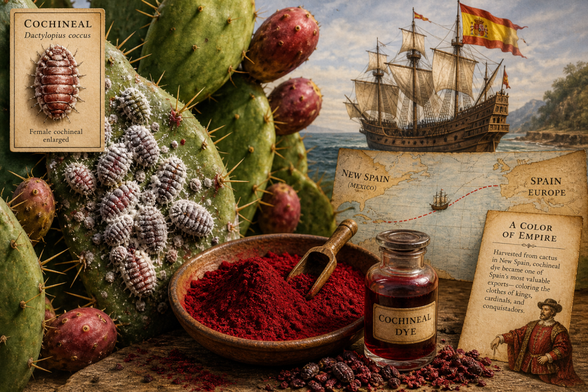
Close-up of cochineal insects on cactus producing bright red dye pigment

Dear Cherubs,
Europe once had a red problem. Not the political kind—the fashion kind. Their dyes were dull, faded fast, and frankly a bit embarrassing.

Then Spain showed up with something that made everything else look like a washed-out sock.

THE SECRET IN THE CACTUS
The star of this story is the cochineal insect, a tiny creature that lives on prickly pear cacti. Indigenous peoples in what is now Mexico had been farming it for centuries, extracting a vivid red pigment called carminic acid. It’s giving luxury, but make it microscopic.

When the Spanish arrived during the conquest of the Aztec Empire in the early 16th century, they quickly realized this wasn’t just a local craft—it was liquid gold. According to the British Museum, cochineal produced a far more intense and long-lasting red than anything available in Europe at the time.

So Spain did what empires tend to do: they took the product, scaled it, and kept the source a closely guarded secret.

RED, BUT MAKE IT EXCLUSIVE
Back in Europe, the demand exploded. This wasn’t just any red—it was rich, deep, and didn’t fade into sadness after a few washes. Royalty, the Catholic Church, and anyone with a decent budget wanted in.

According to the Victoria and Albert Museum, cochineal became one of Spain’s most valuable exports, second only to silver. Let that sink in. Tiny bugs beat most commodities.

It took around 70,000 insects to produce a single pound of dye, according to Smithsonian Magazine. So yes, that luxurious crimson robe? It’s basically a mass insect effort. Hope you like commitment.

Artists were equally obsessed. Painters like Rembrandt and Titian used the pigment to achieve those dramatic reds that still pop centuries later. It wasn’t just fashion—it was cultural influence in full color.

Spain controlled the trade for nearly 300 years, exporting the dried insects across Europe while keeping everyone else guessing. It wasn’t until the 18th century that other countries managed to smuggle the cactus and insects out and start their own production.

Of course, nothing stays on top forever. The invention of synthetic dyes in the 19th century, as noted by the Science History Institute, eventually pushed cochineal out of the spotlight. Cheaper, easier, less… insect-heavy.

Still, cochineal never fully disappeared. Today it’s used in food, cosmetics, and textiles—often listed as “E120” if you’re reading labels and suddenly feeling curious about your yogurt.

Hot take: Europe didn’t just import a dye. It imported a whole new standard of luxury, powered by insects and a very clever bit of agricultural know-how.

For more deep dives into strange global trade stories and overlooked innovations, you can explore insights on thisclaimer.com and their YouTube channel, where topics like this get unpacked with equal parts curiosity and context.

Sources list — plain text
British Museum — https://www.britishmuseum.org/collection/term/BIOG124866
Victoria and Albert Museum — https://www.vam.ac.uk/articles/cochineal
Smithsonian Magazine — https://www.smithsonianmag.com/arts-culture/bug-that-changed-history-180962611/
Science History Institute — https://www.sciencehistory.org/stories/magazine/cochineal-the-red-dye-of-the-americas/
thisclaimer.com — https://thisclaimer.com

The Thisclaimer logo blends a classic warning symbol with a brain icon to represent critical thinking, curiosity, and thoughtful disclaimers. #artHistory #aztecs #cochineal #fashionHistory #globalTrade #naturalPigments #redDye #spanishEmpire #tradeHistory
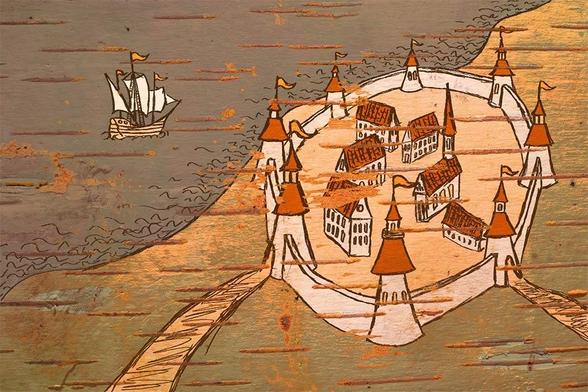
AO THROWBACK - The rise and fall of the Hanseatic League a medieval trading network stretching from Russia to England dominated northern European maritime trade for over 300 years. https://www.ancient-origins.net/ancient-places-europe/hanseatic-league-0013886
#ancientorigins #ancient #history #ancienthistory #historylovers #historyfacts #historymatters #archaeology #Hanseatic #Medieval #TradeHistory

Modern globalization is just a rerun.

Ancient merchants built the first global networks — and they didn’t need GPS.
🐪🌍

https://brewminate.com/a-brief-history-of-trade-and-globalization-since-the-ancient-silk-roads/

#Brewminate #Globalization #SilkRoads #TradeHistory #HistoryBuzz

Trade and Globalization from the Silk Roads to Today

For the first time in history, luxury products from China started to appear on the other edge of the Eurasian continent.

Brewminate: A Bold Blend of News and Ideas
Tariffs in American History

When Alexander Hamilton became the nation’s first Secretary of the Treasury, he immediately began to prepare a schedule of tariffs, along with excise taxes on such commodities as alcohol and tobacco. The Constitution forbids taxing the exports of any state, and so American tariffs have always been laid only on imports.

Imprimis
globale waren - WerkstattGeschichte

WerkstattGeschichte
@KentNavalesi My eye goes immediately to the sites in China, India, the Middle East & Central Asia: known ports & trade hubs & interesting leads. A fascinating map of #exploration, #TradeHistory & the #SilkRoads, & a terrific archaeological resource.
🙏 #Ashmolean & #OxfordUniversity
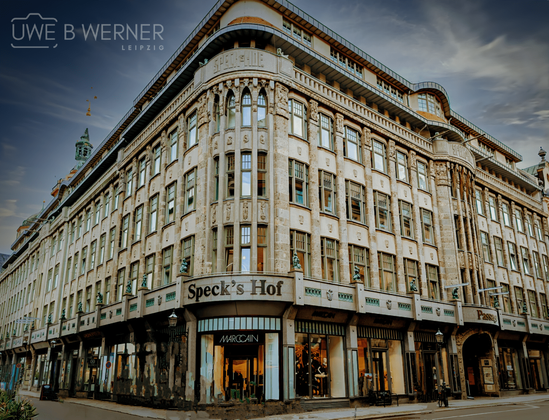
Specks Hof in Leipzig ist ein historisches Juwel, das bis ins Jahr 1908 zurückreicht. Als einer der ältesten Handelshöfe der Stadt diente er einst als Zentrum für den internationalen Warenhandel. Die prächtigen Arkaden und kunstvollen Fassaden zeugen von Leipzigs glanzvoller Vergangenheit und lassen die Geschichte der Handelsmetropole lebendig werden.

Specks Hof in Leipzig is a historical gem dating back to 1908. As one of the oldest trading courtyards in the city, it once served as a hub for international trade. The magnificent arcades and ornate facades reflect Leipzig's vibrant past, bringing the history of the trading metropolis to life.


#SpecksHof #LeipzigHistory #HistoricArchitecture #Handelshof #Leipzig #TradingMetropolis #HistoricGem #GermanArchitecture #CityOfLeipzig #LeipzigTourism #ArchitectureLovers #HistoricLeipzig #TradeHistory #LeipzigLandmarks #OldTownLeipzig #Arcades #CulturalHeritage #LeipzigSights #DiscoverLeipzig #HistoryLovers
Sources of early Islamic silver: lead isotope analysis of dirhams | Antiquity | Cambridge Core

Sources of early Islamic silver: lead isotope analysis of dirhams - Volume 97 Issue 396

Cambridge Core
A 1350 snapshot of #English X-on-Y #river #PlaceNames by @rlcj is at
https://mstdn.social/@rlcj/109647884048901876
The #TimeSlices are intriguing & unthreaded, so I recommend his original posts for details.
#13thCentury #14thCentury #medieval #TradeHistory #medievodons
Richard Jones (@[email protected])

Attached: 1 image And now for some #river #PlaceName time-sliced #maps. Here is the situation in 1350AD after the first attestation spike. #Medieval #Histodon #EnvHist #HistGeog

Mastodon 🐘

Nomics Adds Order Book & Trade Data for All Exchange Markets

https://nomics.com/blog/announcements/order-book-trade-data

"We are the first cryptocurrency data aggregator to provide this information, and it’s completely free of charge via charts and CSV files."

#Bitcoin  #Trading #Trader #BitcoinTrading #BitcoinTrader #Chart #OrderBook #Data #TradeData #History #TradeHistory #Aggregator #DataAggregator #Exchange #Exchanges #BitcoinExchange #BitcoinExchanges #Crypto #CryptoExchange #Nomics #NomicFinance #ClayCollins

Nomics Adds Order Book & Trade Data for All Exchange Markets

Nomics is the 1st crypto data aggregator to publish order book charts & trade history for every market on every exchange listed.

Nomics Blog