 Craig Constantine
Options
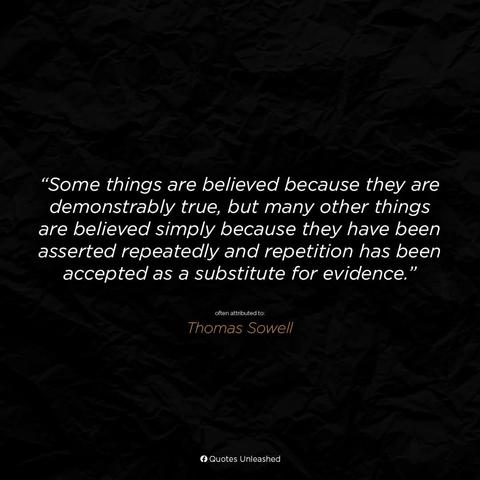
Life does not ask what we want. It presents us with options.
~ Thomas Sowellslip:4a628.
#Quotes #ThomasSowellOptions
Life does not ask what we want. It presents us with options.
~ Thomas Sowellslip:4a628.
#Quotes #ThomasSowellBook Review: A Conflict of Visions by Thomas Sowell
Most political arguments feel like they are about specific policies: tax rates, minimum wage laws, immigration quotas, criminal sentencing guidelines. Thomas Sowell’s A Conflict of Visions, first published in 1987, makes a compelling case that this is an illusion.
The real disagreements, he argues, run much deeper than any particular policy debate. They trace back to fundamentally different assumptions about human nature itself, assumptions so basic that most people hold them without ever having examined them consciously. That idea alone makes this one of the more genuinely illuminating books written about political and economic thought in the past half century.
Who Is Thomas Sowell?
Thomas Sowell was born in 1930 in Gastonia, North Carolina, grew up in Harlem, and came to economics through a path that included leaving high school early, working manual jobs, serving in the Marines during the Korean War era, and eventually earning a bachelor’s degree magna cum laude from Harvard, a master’s from Columbia, and a doctorate from the University of Chicago, where he studied under Milton Friedman.
He spent most of his career as a senior fellow at the Hoover Institution at Stanford University and authored more than 30 books on economics, history, culture, and social policy. His best-known work, Basic Economics, introduced millions of general readers to economic thinking without a single graph or equation. A Conflict of Visions is a different kind of book, more philosophical and more demanding, but it may ultimately be his most important contribution to how people think about ideas and ideology. He retired from his syndicated newspaper column in 2016.
Buy A Conflict of Visions on Amazon
What the Book Is About
The central argument of A Conflict of Visions is that the recurring disagreements between what we loosely call the political left and the political right are not primarily the result of different values, different levels of intelligence, or different amounts of compassion. They are the result of two fundamentally different visions of human nature, which Sowell calls the constrained vision and the unconstrained vision.
The constrained vision holds that human nature is essentially fixed. People are self-interested, limited in their knowledge and rationality, and prone to error in predictable ways. Because human nature cannot be meaningfully improved, social systems must be designed to work within those constraints, channeling self-interest through institutions, laws, traditions, and incentive structures rather than trying to appeal to altruism or cultivate virtue directly. The market economy, common law, and constitutional checks and balances are all examples of institutions built around the constrained vision. Adam Smith is Sowell’s primary example of a constrained vision thinker.
The unconstrained vision holds that human nature is malleable and that people are capable of significant moral and intellectual improvement given the right conditions, education, and leadership. Social problems are not inherent to human nature but are the result of flawed institutions, bad incentives, or insufficient knowledge among decision-makers. If the right people, with the right understanding, are in a position to design better systems, human welfare can be dramatically improved. William Godwin and Jean-Jacques Rousseau are Sowell’s primary examples of unconstrained vision thinkers.
Sowell is careful to note that these are not perfectly binary categories. Most people and most ideological traditions draw on elements of both visions. But he argues that one or the other tends to dominate in any given thinker’s worldview, and that the resulting differences in how people see human nature lead almost inevitably to different conclusions about trade-offs, process versus outcomes, and the role of expertise and authority in social decision-making.
The book then traces how these two visions play out across a remarkably wide range of debates, including war and peace, equality, power, and the role of law, showing how the same underlying disagreement about human nature generates consistent patterns of political disagreement across centuries and across cultures.
Buy A Conflict of Visions on Amazon
Lessons Readers Can Take Away
The most important lesson of A Conflict of Visions is also the most humbling: most of us walk around with a set of deep assumptions about human nature that we have never examined and that drive our political and economic opinions far more than the specific facts of any particular debate. Becoming aware of those assumptions is a genuine act of intellectual growth.
For readers interested in personal finance and economics, this has direct practical value. The constrained vision has obvious implications for how you think about your own financial behavior. If human nature is fixed and self-interest is a constant, then the most reliable financial strategies are those that work with human psychology rather than against it. Automatic contributions to a savings account or retirement fund, for example, do not rely on sustained willpower or virtue. They channel behavior through structure, which is exactly what constrained vision thinking recommends.
The unconstrained vision, by contrast, tends to produce financial advice that asks people to simply try harder, be more disciplined, and make better choices through conscious effort. That advice is not wrong, but it often underestimates how difficult sustained behavioral change is in the absence of structural support. Understanding the difference between these two approaches can help you design your own financial life more realistically.
A second lesson is about the nature of trade-offs versus solutions. Constrained vision thinkers tend to see trade-offs everywhere, because resources are limited and human nature imposes real constraints on what is achievable. Unconstrained vision thinkers tend to see problems as having solutions, if only the right policies or the right people are applied to them. In personal finance, the constrained vision is more useful. There are no solutions to the tension between spending and saving, only trade-offs. Accepting that reality is the beginning of a realistic financial plan.
A third lesson is about the value of process over outcomes. Constrained vision thinkers tend to trust evolved institutions and established processes, such as markets, legal systems, and democratic deliberation, because those systems encode accumulated knowledge that no individual fully possesses. Unconstrained vision thinkers tend to be more willing to override existing processes in favor of outcomes that seem clearly better to the experts involved. For investors, the parallel is between trusting a systematic, rules-based approach to investing, such as consistent contributions to a low-cost S&P 500 index fund, versus trying to beat the market through active management based on the belief that sufficiently smart analysts can identify the right outcomes in advance. The evidence on that particular question has generally favored the constrained vision.
Buy A Conflict of Visions on Amazon
Criticisms of the Book
A Conflict of Visions has earned genuine admiration across ideological lines, but it has also attracted substantive criticism that is worth engaging with honestly.
The most common critique is that Sowell’s framework, despite his stated evenhandedness, consistently portrays the constrained vision in a more favorable light. Critics point out that the constrained vision’s emphasis on evolved institutions and the limits of human reason has historically been used to defend arrangements that were not merely imperfect but actively unjust, including slavery, legal segregation, and the exclusion of women from political and economic life. The unconstrained vision’s willingness to override tradition in pursuit of better outcomes is precisely what drove the abolition movement, the suffrage movement, and the civil rights movement. A framework that treats institutional conservatism as the more intellectually humble position has to reckon with that history.
A second criticism is that the binary of constrained versus unconstrained, however useful as a rough heuristic, oversimplifies the actual diversity of political and philosophical thought. Many serious thinkers do not map cleanly onto either category, and Sowell’s assignment of historical figures to one vision or the other sometimes requires ignoring significant portions of their work.
A third critique is that the book is more descriptive than prescriptive. It explains why people disagree with remarkable clarity, but it does not ultimately tell you which vision is more correct, or how to adjudicate between them when they produce conflicting policy recommendations. Readers looking for a resolution to the tensions Sowell describes will not find one here.
These are legitimate criticisms of a serious book, and they are reasons to read widely rather than reasons to avoid this particular work.
Should You Buy This Book?
Yes, and fairly emphatically so, with the understanding of what kind of book it is.
A Conflict of Visions is not a personal finance book in any conventional sense. It will not tell you how to budget, which index funds to buy, or how to build an emergency fund. What it will do is give you a more sophisticated framework for understanding why people disagree so consistently about economic and political questions, and for examining the assumptions that drive your own opinions about money, markets, and policy.
For readers who have already worked through books like Basic Economics by Sowell himself, The Wealth of Nations by Adam Smith, or The Intelligent Investor by Benjamin Graham, A Conflict of Visions represents a natural next step in building a more complete intellectual foundation. It is the kind of book that changes how you think rather than simply adding to what you know, and those books are rarer and more valuable than any other kind.
It is worth noting that the book is academic in its pacing. It rewards careful reading rather than skimming. If you prefer books that move quickly through concrete examples and practical recommendations, this one will require some patience. The payoff is real, but it takes longer to arrive than it does in Sowell’s more accessible works.
Final Thoughts
A Conflict of Visions is one of those books that readers tend to describe as clarifying. After finishing it, you will find yourself noticing the underlying vision in op-eds, policy debates, financial arguments, and casual conversations about economics in ways you likely did not before. That kind of perceptual shift is rare and valuable.
Thomas Sowell wrote this book not to settle the debate between the constrained and unconstrained visions but to show that the debate is real, that it is coherent, and that understanding it is prerequisite to thinking seriously about almost any social or economic question. On that count, he succeeds.
The lessons it offers about human nature, trade-offs, the limits of expertise, and the value of process over outcomes translate directly into better financial thinking. The investor who trusts a systematic process over their own ability to outsmart the market, the saver who builds structure into their habits rather than relying on willpower, and the consumer who thinks carefully about second-order effects before making a major financial decision are all, in their own way, applying the constrained vision to their personal finances.
That is not a bad framework to carry with you.
Buy A Conflict of Visions on Amazon
#AConflictOfVisions #BasicEconomics #BookReviews #Books #MiltonFriedman #Politics #ThomasSowell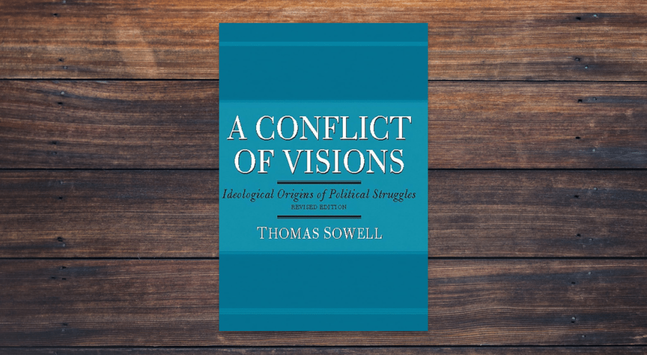
Who Is Thomas Sowell?
There are very few public intellectuals who have written with equal authority about economics, history, culture, education, and social policy across a career spanning more than five decades. Thomas Sowell is one of them. Whether you agree with his conclusions or not, engaging seriously with his ideas is a worthwhile exercise for anyone trying to develop a more rigorous understanding of how economies work, why policies succeed or fail, and how to think clearly about trade-offs. For readers interested in building genuine financial literacy, Sowell’s work represents one of the most accessible and substantive entry points available.
Early Life and Education
Thomas Sowell was born on June 30, 1930, in Gastonia, North Carolina. He was the youngest of five children, and his father died before he was born. His family moved to Harlem in New York City when he was a young child, as part of the broader Great Migration of Black Americans from the rural South to northern cities during the early and mid-twentieth century.
Sowell grew up in poverty. He left Stuyvesant High School, one of New York City’s most competitive public schools, before graduating, citing economic necessity. He worked various jobs, including as a photographer’s assistant and a Western Union messenger, before being drafted into the United States Marine Corps during the Korean War era. His time in the Marines, where he worked as a photographer, gave him his first sustained exposure to a meritocratic environment that he later credited with shaping his views on the relationship between incentives, effort, and outcomes.
After leaving the Marines, Sowell pursued his education with remarkable intensity. He earned a bachelor’s degree magna cum laude in economics from Harvard University in 1958, a master’s degree in economics from Columbia University in 1959, and a doctorate in economics from the University of Chicago in 1968. At Chicago, he studied under Milton Friedman, one of the most influential economists of the twentieth century and a central figure in the free-market tradition that would shape much of Sowell’s subsequent thinking.
Early Career and Intellectual Evolution
Sowell’s intellectual journey is itself one of the more interesting features of his biography. As a young man and early in his academic career, he held broadly left-leaning and Marxist views. His doctoral dissertation examined Marxist economics, and he approached economic questions from a perspective sympathetic to government intervention and redistribution.
His thinking shifted significantly during his late twenties and early thirties, partly as a result of what he observed working as an economist for the federal government during a summer internship at the Department of Labor. What he found, by his own account, was that government bureaucracies were frequently more concerned with their own institutional interests than with the welfare of the people they were supposed to serve. That experience planted a seed of skepticism about the mechanisms of government intervention that grew considerably over the following decades.
By the time he completed his doctorate and began his academic career in earnest, Sowell had moved firmly into the free-market, classical liberal tradition associated with the Chicago School. He held faculty positions at several institutions, including Cornell University, Brandeis University, and UCLA, before joining the Hoover Institution at Stanford University in 1980. He remained at the Hoover Institution as a senior fellow for the rest of his active career, retiring from his syndicated newspaper column in 2016.
The Scope of His Work
Sowell has authored more than 30 books, a body of work that is unusual both for its volume and its range. His writing spans technical academic economics, accessible popular economics, social history, cultural analysis, and commentary on education, race, and public policy. A brief survey of his major works gives a sense of how wide that range actually is.
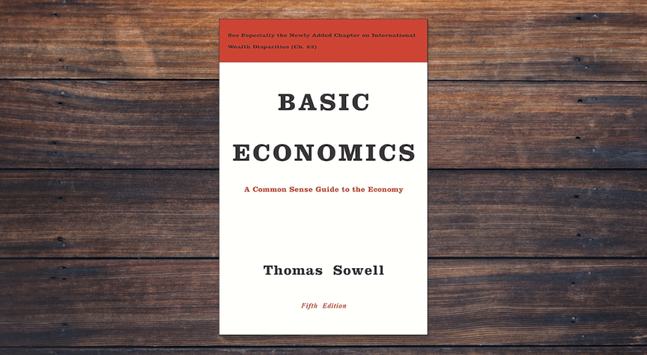
Basic Economics, first published in 2000 and now in its fifth edition, is probably his most widely read book. It is an introduction to economic thinking written entirely without graphs, equations, or jargon, aimed at general readers who want to understand how markets work and why so many well-intentioned policies produce counterproductive results.
A Conflict of Visions, published in 1987, is perhaps his most intellectually ambitious work. In it, Sowell argues that most political and ideological disagreements ultimately trace back to two fundamentally different assumptions about human nature, what he calls the constrained vision, which holds that human nature is fixed and that social systems must work within those limits, and the unconstrained vision, which holds that human beings are capable of substantial improvement through the right institutions and education. This framework has influenced thinkers across the ideological spectrum and is worth reading regardless of where you fall politically.
The Vision of the Anointed, published in 1995, applies that framework to contemporary social policy, arguing that a certain class of intellectuals and policymakers systematically ignore evidence that contradicts their preferred conclusions. Intellectuals and Society, published in 2009, extends that argument further.
His three-volume work on cultural history, Race and Culture, Migrations and Cultures, and Conquests and Cultures, published in the 1990s, examines how geographic, cultural, and historical factors have shaped economic outcomes across different populations and regions of the world. These books are dense and require patience, but they offer a genuinely distinctive perspective on questions of inequality and economic development.
The Thomas Sowell Reader, published in 2011, is a useful anthology for readers who want a curated introduction to his thinking across multiple domains before committing to his longer works.
His Core Ideas
Several themes run consistently through Sowell’s work and are worth understanding as a foundation for engaging with his books.
The most central is the idea of trade-offs. Sowell argues repeatedly that there are no solutions, only trade-offs. Every policy choice, every resource allocation, every financial decision involves giving something up in order to get something else. The failure to reckon honestly with those trade-offs, he believes, is the root cause of most bad policy and most muddled economic thinking. For personal finance readers, this is a principle with direct practical application. Every dollar spent is a dollar not saved or invested. Every financial decision has an opportunity cost.
A second core idea is the distinction between intentions and results. Sowell is relentlessly focused on outcomes rather than motives. He argues that evaluating a policy by the good intentions behind it, rather than by the evidence of its actual effects, is a form of intellectual dishonesty. This applies to government policy and to personal financial decisions alike.
A third theme is the importance of knowledge, specifically its dispersal and limits. Drawing on the work of Friedrich Hayek, Sowell argues that no central authority, whether a government agency or a corporate board, can possess the full range of local, specific, and constantly changing knowledge that is distributed across millions of individuals in a functioning economy. Prices, in this view, are not just numbers but information systems that coordinate behavior across vast networks of people who will never meet or communicate directly. Interfering with price signals, even with good intentions, disrupts that coordination in ways that are difficult to predict and often costly.
Criticism and Controversy
Sowell is not without his critics, and a fair assessment of his work requires acknowledging where the pushback comes from.
The most substantive criticism is that his writing often presents a particular school of economic thought as settled economic science when many of the questions he addresses remain genuinely contested among professional economists. On topics like the minimum wage, rent control, and immigration, Sowell tends to present the market-oriented position with a confidence that critics argue is not fully warranted by the empirical evidence.
His work on race and culture has drawn criticism from scholars who argue that he underweights the role of systemic discrimination and historical injustice in explaining economic disparities, focusing instead on cultural and behavioral factors in ways that, critics contend, can shift moral responsibility in misleading directions. These are serious debates with serious people on both sides, and readers are best served by engaging with multiple perspectives rather than treating any single author as the final word.
What is less contested is that Sowell is a careful, clear, and intellectually serious writer who forces his readers to examine their assumptions. That alone makes his work valuable, even for those who ultimately disagree with his conclusions.
Why His Work Matters for Financial Literacy
Building genuine financial literacy is not only about mastering spreadsheets, understanding index funds, or knowing what a high-yield savings account is, though all of those things matter. It is also about developing a framework for thinking clearly about economic claims, policy proposals, and financial decisions under uncertainty.
Sowell’s work contributes to that framework in concrete ways. His insistence on thinking through second-order effects, his focus on incentives rather than intentions, and his emphasis on the limits of centralized knowledge all translate directly into more disciplined personal financial thinking. The investor who asks not just what a financial product promises but what incentives it creates for the person selling it is applying a distinctly Sowellian lens. So is the person who evaluates a budgeting strategy not by how good it feels in the first week but by whether the incentive structure it creates is sustainable over years.
Basic Economics is the natural starting point for readers new to his work. From there, A Conflict of Visions offers a deeper engagement with the philosophical underpinnings of his thinking. Paired with books like The Wealth of Nations by Adam Smith, Thinking, Fast and Slow by Daniel Kahneman, and The Worldly Philosophers by Robert Heilbroner, Sowell’s work forms part of a reading foundation that will serve any serious student of money and markets for a long time.
A Life’s Work in Perspective
Thomas Sowell turned 90 in 2020. His career spans a period of extraordinary change in American economic life, from the postwar expansion through the stagflation of the 1970s, the market liberalization of the 1980s, the technology boom of the 1990s, the financial crisis of 2008, and the economic disruptions of the pandemic era. He wrote about all of it, consistently and with a clarity of purpose that is rare in any field.
Whether you read him as a guide, a foil, or simply a rigorous thinker worth arguing with, Thomas Sowell is one of the most important economic writers of the past century. His books are widely available, inexpensive, and written to be understood. For anyone serious about financial literacy, that combination is hard to pass up.
#AConflictOfVisions #Author #BasicEconomics #Biography #Books #Economics #Nonfiction #ThomasSowell
Book Review: Basic Economics by Thomas Sowell
There are not many economics books that have gone through five editions, sold hundreds of thousands of copies, and remained genuinely readable from cover to cover. Basic Economics by Thomas Sowell is one of them. First published in 2000, it has outlasted countless other introductory economics texts by doing something deceptively simple: explaining how economies work in plain English, without graphs, without equations, and without assuming the reader has any prior knowledge of the subject. For anyone trying to build a real understanding of money, markets, and financial decision-making, it deserves a serious look.
Who Is Thomas Sowell?
Thomas Sowell was born in 1930 in Gastonia, North Carolina, and grew up in Harlem. He left high school without graduating, served in the Marines during the Korean War, and later earned a bachelor’s degree from Harvard, a master’s from Columbia, and a PhD in economics from the University of Chicago, where he studied under Milton Friedman. That lineage places him firmly in the free-market, classical liberal tradition of economic thought.
Sowell spent decades as a senior fellow at the Hoover Institution at Stanford University and authored more than 30 books covering economics, social policy, history, and culture. His academic work focused on Marxist economics early in his career before he shifted toward a market-oriented framework. He is a prolific and distinctly American intellectual voice, and Basic Economics is widely considered his most accessible and enduring work. He retired from writing his syndicated newspaper column in 2016.
What the Book Is About
The premise of Basic Economics is straightforward. Sowell argues that most bad economic policy, and most confused thinking about economic issues, stems from a failure to understand basic economic principles. His goal is not to push a political agenda, though his perspective is clearly present throughout. His goal is to give readers the conceptual tools to evaluate economic claims on their own terms.
The book covers a wide range of topics including prices and their role in allocating resources, the economics of housing and rent control, labor markets and minimum wage, international trade, and the role of government in the economy. Each topic is addressed through real-world examples drawn from history, policy experiments around the world, and observable outcomes rather than theoretical models.
The organizing principle of the book is a single idea that Sowell returns to repeatedly: economics is the study of the use of scarce resources which have alternative uses. That definition sounds dry, but Sowell uses it as a lens to examine why policies that seem beneficial on the surface so often produce unintended and counterproductive consequences.
Lessons Readers Can Take Away
The most durable lesson in Basic Economics is the distinction between what Sowell calls the first-order effects of a policy and its secondary and tertiary effects. Rent control is his most frequently cited example. A city caps rents to make housing more affordable. In the short run, some tenants pay less. In the longer run, landlords reduce maintenance, convert rental units to condominiums, and developers build fewer rental properties because the returns no longer justify the investment. The supply of affordable housing shrinks. The policy intended to help renters ends up harming the very people it was designed to protect. Sowell uses dozens of similar examples to illustrate the same underlying point: good intentions do not guarantee good outcomes, and ignoring second-order effects is the most common and costly mistake in economic reasoning.
A second major lesson is about the role of prices as information. Prices are not just numbers on a tag. They are signals that coordinate the behavior of millions of people who have no direct knowledge of or connection to each other. When prices are allowed to rise after a natural disaster, for example, they attract suppliers from other regions, which replenishes scarce goods faster than any centrally coordinated relief effort typically can. Price controls in those situations feel compassionate but routinely produce shortages. Understanding this mechanism changes how you evaluate a wide range of policy debates.
A third lesson is about the difference between intentions and incentives. Sowell argues that understanding economic outcomes requires analyzing what incentives a policy creates, not what goals it pursues. People respond to incentives, and when policies create incentives that conflict with their stated goals, the incentives usually win.
For personal finance readers specifically, these lessons translate into a clearer framework for evaluating financial decisions. Understanding that there are always trade-offs, that resources have alternative uses, and that second-order effects matter as much as immediate ones is valuable not just for analyzing government policy but for managing your own money.
Criticisms of the Book
Basic Economics is not without legitimate criticism, and a fair review requires acknowledging them.
The most common critique is that the book presents a particular school of economic thought, broadly market-oriented and skeptical of government intervention, as if it were settled, neutral economic science. Critics from across the political spectrum have pointed out that many of the topics Sowell addresses are genuinely contested among professional economists, and that the book sometimes presents one side of those debates more forcefully than the uncertainty in the evidence warrants.
On issues like the minimum wage, for example, Sowell’s treatment reflects older economic consensus more than current academic debate, which has become more nuanced following influential research by economists like David Card and Alan Krueger. Card won the Nobel Prize in Economics in 2021 partly for work that complicated the straightforward prediction that minimum wage increases always reduce employment.
A second criticism is that the book is long. At over 700 pages in its later editions, it tests the patience of some readers, particularly because the core arguments are made clearly and early, and later chapters sometimes feel repetitive in their application of the same principles to new contexts.
A third criticism, more philosophical, is that Sowell’s consistent focus on market mechanisms and the unintended consequences of intervention can crowd out serious analysis of market failures, externalities, and situations where the absence of regulation produces demonstrably bad outcomes. Readers who finish the book with the impression that markets always outperform intervention will have drawn a conclusion that even many free-market economists would consider too strong.
None of these criticisms make the book a bad book. They make it an incomplete one, which is true of virtually every book on economics. The appropriate response is to read it alongside other perspectives, not to avoid it.
Should You Buy This Book?
Yes, with one qualification.
Basic Economics is one of the most effective introductions to economic thinking available to a general reader. It does not require a background in math or prior knowledge of economics. It is written in clear, confident prose. And the core mental models it teaches, particularly around trade-offs, incentives, prices as information, and unintended consequences, are genuinely useful for anyone trying to think more clearly about money, policy, and financial decision-making.
The qualification is this: read it as a starting point, not an ending point. Sowell’s perspective is a valuable one, but it is a perspective. Following Basic Economics with something like Thinking, Fast and Slow by Daniel Kahneman, which explores the psychology of economic decision-making, or The Worldly Philosophers by Robert Heilbroner, which surveys the full sweep of economic thought from Adam Smith forward, will give you a more complete picture than any single book can provide.
For readers who are just beginning to learn about economics and want a foundation that will help them evaluate financial news, political claims, and their own money decisions more clearly, Basic Economics is an excellent place to start.
Final Thoughts
Thomas Sowell wrote Basic Economics because he believed most economic confusion is not a matter of complexity but of clarity. He wanted to give ordinary readers the conceptual vocabulary to cut through the noise. On that front, the book largely succeeds. Its lessons about trade-offs, incentives, and the gap between policy intentions and policy outcomes are as relevant today as they were when the first edition was published.
Building financial literacy is not just about knowing how to budget or which index fund to buy, though those things matter enormously. It is also about developing a way of thinking that helps you evaluate information critically and make decisions with a clear sense of what you are actually trading off. Basic Economics contributes meaningfully to that foundation. It is worth the time.
#BasicEconomics #BookReviews #Books #Economics #ThomasSowell
When issues of public policy are discussed in the outward form of an argument, often the conclusions reached are predetermined by the assumptions and definitions inherent in a particular vision of social processes. Different visions, of course, have different assumptions.... To a remarkable extent, however, empirical evidence is neither sought beforehand nor consulted after a policy has been instituted. Facts may be marshaled for a position already taken, but that is very different from systematically testing opposing theories by evidence. Momentous questions are dealt with essentially as conflicts of vision.
-- Thomas Sowell

🌹Thomas Sowell’s quote, “No one is equal to anything. Even the same man is not equal to himself on different days,” challenges the simplistic notion of equality and highlights the fluidity of human experience.🌹
At its core, the statement argues against rigid definitions of sameness or equivalence, especially when applied to human beings.
Sowell suggests that individuals are in constant flux—physically, mentally, emotionally, and situationally—and as such, cannot be fairly or meaningfully compared either with others or with themselves at different points in time.
This casts doubt on ideological frameworks that insist on equality as uniformity, and instead invites a more nuanced understanding of human complexity.
By observing that even the same individual varies from day to day, Sowell emphasizes the dynamic nature of identity and ability.
A person may be more focused, patient, or energetic one day and entirely different the next due to sleep, stress, nutrition, mood, or circumstance.
This variability means that any attempt to fix individuals into static categories—whether for assessment, judgment, or entitlement—ignores the inherently unstable and evolving nature of human life.
It also implies that personal development, regression, and transformation are natural and unavoidable, making true constancy or equivalence an illusion.
Finally, Sowell’s insight can be seen as a critique of political or philosophical ideologies that treat people as interchangeable units—particularly in economic or social policy.
If people are not even equal to themselves over time, then policies built on assumptions of equality in capability, motivation, or outcomes are likely to be flawed or unjust.
Instead, his remark encourages an appreciation for individuality, imperfection, and the unpredictable journey of each human life.
It invites us to approach both others and ourselves with humility, recognizing that who we are is shaped by an ever-changing interplay of internal and external forces.
Be inspired 📌
#phylosophy #phylosophyoflife #stoicism #viralpost2025シ #viralpost2025Today #stoicphilosophy #stoic #stoicmindset #stoicwisdom #stoicquotes #unitedstatesofamerica #unitedarabemirates #UnitedNations #unitedkingdomdaily #unitedkingdom #UnitedStates #canada #japan #australia #austria #nigeria #ghana #sirk4 #ThomasSowell #HumanNature #Change #Equality #Philosophy #SelfReflection
Politeness and consideration for others is like investing pennies and getting dollars back.
-- Thomas Sowell
⬆ #Wisdom #Quotes #ThomasSowell #Etiquette
⬇ #Photography #Panorama #Pictographs #RockArt #NativeAmerican #Utah


 Winchell House
 Wisdom in Space
 David Hogberg
 Keith Daggett
 Nicole F