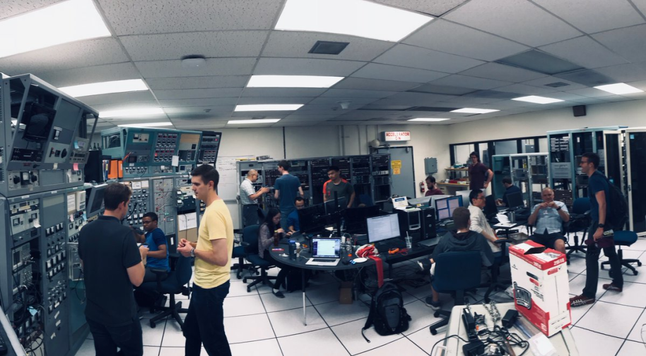
Curious about #SuperCDMS? I had the pleasure of chatting with “Morning North” host Markus Schwabe about the recent milestones in this cool experiment.

https://www.cbc.ca/listen/live-radio/1-41-morning-north/clip/16208508-searching-dark-matter-sudburys-snolab

If that link won’t work for you, then check out:

https://media.cooleysekula.net/w/oqB6c8MQDwsco8SUdbgyji

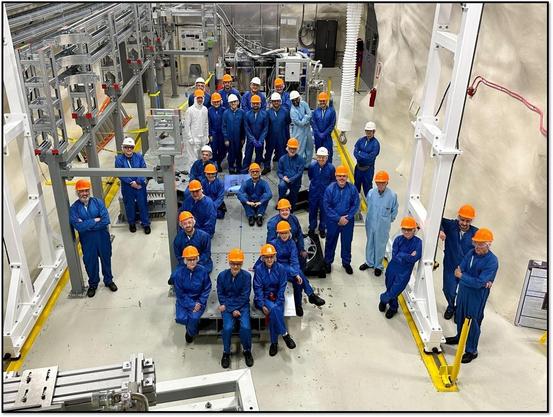
Fundamentally, #SuperCDMS is a bunch of really awesome people trying very hard to solve one of the most difficult questions in the universe: why won’t most of the matter in this universe talk to us #atoms?

Being #atomic matter is lonely, it turns out. Having great colleagues in a dedicated collaboration makes the loneliness more tolerable. Maybe, together, we can do what no atomic matter on Earth has ever done before: directly engage with the dominant #darkmatter of this universe.

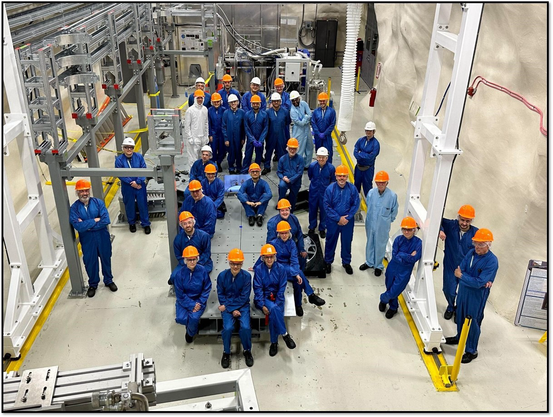
Fundamentally, #SuperCDMS is a bunch of really awesome people trying very hard to solve one of the most difficult questions in the universe: why won’t most of the matter in this universe talk to us atoms?

Being atomic matter is lonely, it turns out. Having great colleagues in a dedicated collaboration makes the loneliness more tolerable. Maybe, together, we can do what no atomic matter on Earth has ever done before: directly engage with the dominant dark matter of this universe.

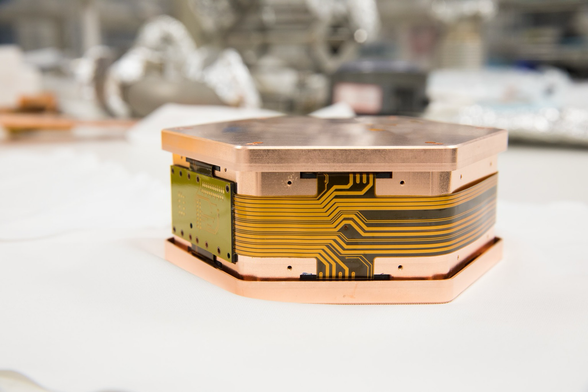
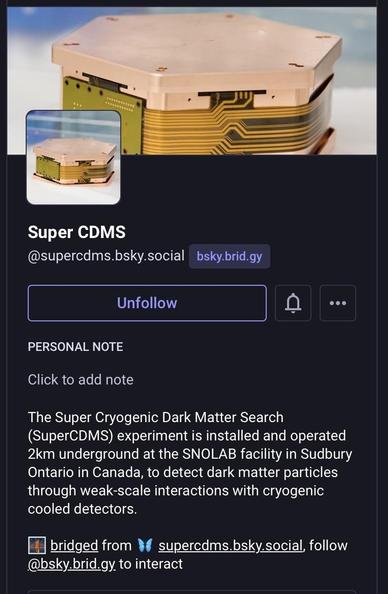
#SuperCDMS uses stacks of hockey-puck-sized silicon and germanium crystals like ultra-cold tuning forks that ring when struck by subatomic particles. Shielding prevents most normal particles from ringing the detectors … leaving them to be struck only by things that can penetrate normal matter without being stopped.

Neutrinos and dark matter are excellent candidates for ringing these detectors!

They have to be ultra-cold because heat is atoms moving, and atoms moving makes noise.

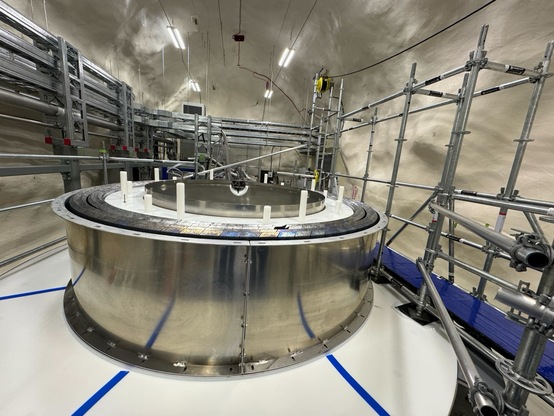
I am super-excited to welcome @ @supercdms.bsky.social to the Fediverse! The Super Cryogenic #DarkMatter Search is a @snolabscience.bsky.social -hosted ultra-sensitive instrument intended to hunt for constituents of dark matter.

#SuperCDMS recently passed a bunch of milestones, including achieving their operational target temperature … just thousandths of a degree above ABSOLUTE ZERO!

Welcome to the #Fediverse! I encourage dark-matter-curious fedizens to follow!

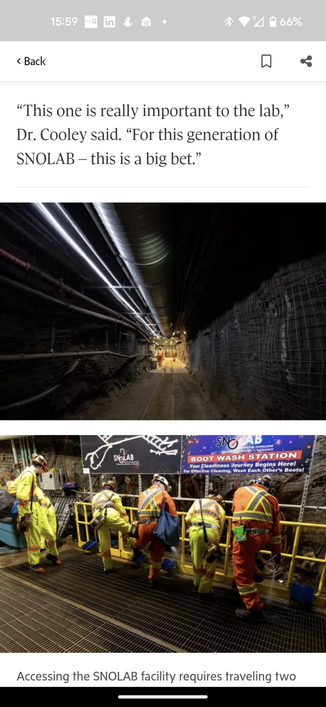
Very excited about Ivan Semeniuk's article on the hunt for #darkmatter, #SNOLAB, and #SuperCDMS. Beautiful front page spread teasing the piece in today's edition of the Globe and Mail.

https://www.theglobeandmail.com/canada/article-the-new-hunt-for-dark-matter/

The new hunt for dark matter

The vast majority of everything in the universe is made of an unknown substance that has so far eluded detection. Now, Canada is at the forefront of a new phase in the search for dark matter. The Globe and Mail ventured deep beneath northern Ontario to see the hunt getting underway.

The Globe and Mail
New analysis of SuperCDMS data sets tighter detection limits for dark matter

For nearly a century, dark matter has continued to evade direct detection, pushing scientists to come up with even more creative methods of searching. Increasingly sensitive detection experiments are a major undertaking, however, which means scientists want to be sure they analyze data from these experiments in the most thorough and robust way possible.

Phys.org

#introduction #reintroduction for all the new folks around here I'm hearing about.

I'm an experimental particle physicist working on the CMS experiment. My primary foci at the moment are top quark physics through the lens of EFT (effective field theory), and FPGA programming for the purpose of development, testing, and operations of detector electronics.

Before CMS, I worked on the SuperCDMS experiment looking for dark matter. I developed the level 1 trigger for the upcoming SuperCDMS run at SNOLAB, and also developed the simulation of the transition edge sensors and charge sensors that are part of the SuperCDMS detectors.

Before SuperCDMS, I worked on the CDF (Collider Detector at Fermilab) experiment. There, I studied the top quark and the Higgs boson. I performed the world's first-ever published search for ttH production, and measured the forward-backward asymmetry in top-antitop production at the Tevatron.

#topquark #EFT #fpga #electronics #darkmatter #simulations #detectors #Higgs #Higgsboson #CMS #CERN #LHC #Tevatron #CDF #Fermilab #darkmatter #SuperCDMS #SNOLAB

From SMUPhysics https://twitter.com/SMUPhysics on Twitter: Congratulations to Dr. Dan Jardin for the successful defense of his PhD thesis! #SuperCDMS https://twitter.com/SMUPhysics/status/1150899161547640833/photo/1 https://chirp.cooleysekula.net/attachment/59510
SMU Physics (@SMUPhysics) | Twitter

Die neuesten Tweets von SMU Physics (@SMUPhysics). The department of #physics at @SMU. Dallas, TX

Twitter
From psbarbeau https://twitter.com/psbarbeau on Twitter: Busy month calibrating detectors at TUNL! MicroChandler (@MobileNuLab @JonLinkPhD ) running, with #supercdms getting set up. @COHERENT_NUS students operating or getting trained to operate the beam. Former student @graysonrich also stopped by to chat. https://twitter.com/psbarbeau/status/1144453011621601280/photo/1 https://chirp.cooleysekula.net/attachment/58833
Phil Barbeau (@psbarbeau) | Twitter

Die neuesten Tweets von Phil Barbeau (@psbarbeau). Neutrino wrangler and Dark Matter hunter | He/Him/His | Assistant professor of Physics and cool things at Duke University | Opinions are.... ooh! Squirrel!. Durham, NC

Twitter