#CMSPAS: Measurement of the 3 Top Quark Production (CMS-PAS-TOP-24-006)
https://cds.cern.ch/record/2957967 #Moriond #TopQuark 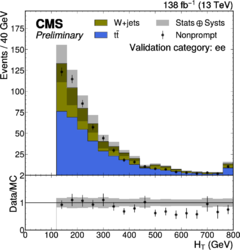
Measurement of the 3 Top Quark Production
A search for the standard model production of three top quarks is presented. The data analyzed were collected with the CMS detector at the CERN LHC in proton-proton collisions at a center-of-mass energy of $13~\mathrm{TeV}$ and correspond to an integrated luminosity of $138~\mathrm{fb}^{-1}$. Selected events are required to contain jets and either one lepton (electron or muon), two same-sign charged leptons, or at least three leptons. The results are derived from the combination of these three lepton categories. Novel multivariate techniques are employed to take full advantage of kinematic differences between the studied signal and the major background. This analysis provides the first LHC result specifically targeting three-top-quark production. No significant deviations with respect to the standard model predictions are observed, and an upper limit of $25~\mathrm{fb}$ is set on the signal cross section at $95\%$ confidence level.
#CMSpaper: Measurement of the t-channel single top quark cross section in proton-proton collisions at √s = 5.02 TeV (arXiv:2603.13592)
https://arxiv.org/abs/2603.13592 #TopQuark 
Measurement of the $t$-channel single top quark cross section in proton-proton collisions at $\sqrt{s}$ = 5.02 TeV
The single top quark $t$-channel production cross section is measured in proton-proton collisions at the CERN LHC at $\sqrt{s}$ = 5.02 TeV, using data recorded with the CMS detector in 2017, corresponding to an integrated luminosity of 302 pb$^{-1}$, and resulting in the first CMS measurement of the process at that energy. Events with one electron or muon and two or more jets, among which at least one is identified as originating from a b quark fragmentation, are analyzed. The combined cross section of single top quark (tq) and single top antiquark ($\mathrm{\bar{t}q}$) production is $σ_{\mathrm{tq+\bar{t}q}}$ = 25.4$^{+3.6}_{-3.5}$ (stat) $^{+4.2}_{-3.9}$ (syst) $\pm$ 0.5 (lumi) pb. The individual cross sections are measured to be $σ_{\mathrm{tq}}$ = 17.6$^{+2.8}_{-2.7}$ (stat) $^{+2.6}_{-2.4}$ (syst) $\pm$ 0.3 (lumi) pb and $σ_{\mathrm{\bar{t}q}}$ = 6.6$^{+2.4}_{-1.6}$ (stat) $^{+2.1}_{-2.5}$ (syst) $\pm$ 0.1 (lumi) pb. Their ratio is measured to be $\mathcal{R}_{\mathrm{t-ch}}$ = 2.7$^{+1.5}_{-0.8}$ (stat) $^{+1.3}_{-0.3}$(syst). The absolute value of the Cabibbo$-$Kobayashi$-$Maskawa matrix element is found to be $\lvert f_{\mathrm{LV}}V_\mathrm{tb}\rvert$ = 0.92 $\pm$ 0.09 (exp) $\pm$ 0.01 (thy). The measurements are in good agreement with the standard model predictions at next-to-next-to-leading order accuracy in quantum chromodynamics.
#CMSpaper soon on arXiv: Measurement of the t-channel single top quark cross section in proton-proton collisions at √s = 5.02 TeV (CERN-EP-2025-289)
https://cds.cern.ch/record/2957466 #TopQuark Measurement of the $t$-channel single top quark cross section in proton-proton collisions at $\sqrt{s}$ = 5.02 TeV
The single top quark $t$-channel production cross section is measured in proton-proton collisions at the CERN LHC at $\sqrt{s}$ = 5.02 TeV, using data recorded with the CMS detector in 2017, corresponding to an integrated luminosity of 302 pb$^{-1}$, and resulting in the first CMS measurement of the process at that energy. Events with one electron or muon and two or more jets, among which at least one is identified as originating from a b quark fragmentation, are analyzed. The combined cross section of single top quark (tq) and single top antiquark ($\mathrm{\bar{t}q}$) production is $\sigma_{\mathrm{tq+\bar{t}q}}$ = 25.4$^{+3.6}_{-3.5}$ (stat) $^{+4.2}_{-3.9}$ (syst) $\pm$ 0.5 (lumi) pb. The individual cross sections are measured to be $\sigma_{\mathrm{tq}}$ = 17.6$^{+2.8}_{-2.7}$ (stat) $^{+2.6}_{-2.4}$ (syst) $\pm$ 0.3 (lumi) pb and $\sigma_{\mathrm{\bar{t}q}}$ = 6.6$^{+2.4}_{-1.6}$ (stat) $^{+2.1}_{-2.5}$ (syst) $\pm$ 0.1 (lumi) pb. Their ratio is measured to be $\mathcal{R}_{\mathrm{t-ch}}$ = 2.7$^{+1.5}_{-0.8}$ (stat) $^{+1.3}_{-0.3}$(syst). The absolute value of the Cabibbo$-$Kobayashi$-$Maskawa matrix element is found to be $\lvert f_{\mathrm{LV}}V_\mathrm{tb}\rvert$ = 0.92 $\pm$ 0.09 (exp) $\pm$ 0.01 (thy). The measurements are in good agreement with the standard model predictions at next-to-next-to-leading order accuracy in quantum chromodynamics.
#CMSPAS: Observation of a pseudoscalar excess at the top quark pair production threshold in the single lepton channel (CMS-PAS-TOP-25-002)
https://cds.cern.ch/record/2957425 #Moriond #TopQuark #CMSPAS: Four-top-quark production in final states with hadronically decaying tau leptons and search for vector-like leptons at √s = 13 TeV (CMS-PAS-TOP-24-017)
https://cds.cern.ch/record/2957343 #Moriond #TopQuark #CMSPAS: Measurement of single top and ttbar production cross sections in association with a photon in proton-proton collisions at sqrt(s) = 13 TeV (CMS-PAS-TOP-25-003)
https://cds.cern.ch/record/2957059 #TopQuark #CMSPAS: Combination of ATLAS and CMS measurements of the azimuthal spin correlation variable in dilepton top quark pair events at 13 TeV (CMS-PAS-TOP-22-004)
https://cds.cern.ch/record/2952446 #TopQuark #CMSpaper: Characterization of the quantum state of top quark pairs produced in proton-proton collisions at √s = 13 TeV using the beam and helicity bases (arXiv:2512.17557)
https://arxiv.org/abs/2512.17557 #TopQuark #CMSpaper soon on arXiv: Characterization of the quantum state of top quark pairs produced in proton-proton collisions at √s = 13 TeV using the beam and helicity bases (CERN-EP-2025-287)
https://cds.cern.ch/record/2951662 #TopQuark Characterization of the quantum state of top quark pairs produced in proton-proton collisions at $ \sqrt{s}= $ 13 TeV using the beam and helicity bases
Measurements of the spin correlation coefficients in the beam basis are presented for top quark-antiquark ($ \mathrm{t} \overline{\mathrm{t}} $) systems produced in proton-proton collisions at $ \sqrt{s}= $ 13 TeV collected by the CMS experiment in 2016-2018, and corresponding to an integrated luminosity of 138 fb$ ^{-1} $. The $ \mathrm{t} \overline{\mathrm{t}} $ system is reconstructed from final states containing an electron or muon, and jets. Together with the previously reported results in the helicity basis, these measurements are used to decompose the system into the Bell and spin eigenstates in various kinematic regions. The spin correlation coefficients are also used to evaluate properties of the $ \mathrm{t} \overline{\mathrm{t}} $ quantum state, such as the purity, von Neumann entropy, and entanglement. All results are consistent with standard model predictions.
#CMSpaper: Inclusive and differential measurements of the ttγ cross section and the ttγ/tt cross section ratio in proton-proton collisions at √s = 13 TeV (arXiv:2511.01995)
https://arxiv.org/abs/2511.01995 #TopQuark  CMS Publications