Home ━ The European Conservative [Unofficial]
Are Some Bishops Thinking the Church Is in a ‘State of Exception’?

Are Some Bishops Thinking the Church Is in a ‘State of Exception’?
Considering all the #conspiracytheories revolving about #covid, it's surprising that the one making the most sense isn't even mentioned: that the #trump administration itself released it in order to either weaken its rival #china, or simply to call for a #stateofexception which could've opened Trump a path to a long-wished-for #dictatorship.
Instead, he managed to put blame, somehow, on Davos and the european establishment of all things. Yet, many "accusations" of his tend to be "confessions".
"The Department of Homeland Security is expanding its efforts to identify Americans who oppose Immigration and Customs Enforcement by sending tech companies legal requests for the names, email addresses, telephone numbers and other identifying data behind social media accounts that track or criticize the agency.
In recent months, Google, Reddit, Discord and Meta, which owns Facebook and Instagram, have received hundreds of administrative subpoenas from the Department of Homeland Security, according to four government officials and tech employees privy to the requests. They spoke on the condition of anonymity because they were not authorized to speak publicly.
Google, Meta and Reddit complied with some of the requests, the government officials said. In the subpoenas, the department asked the companies for identifying details of accounts that do not have a real person’s name attached and that have criticized ICE or pointed to the locations of ICE agents. The New York Times saw two subpoenas that were sent to Meta over the last six months.
The tech companies, which can choose whether or not to provide the information, have said they review government requests before complying. Some of the companies notified the people whom the government had requested data on and gave them 10 to 14 days to fight the subpoena in court."
#USA #Trump #SocialMedia #DHS #ICE #Surveillance #PoliceState #BigTech #StateOfException #Authoritarianism
"Federal records obtained by WIRED show that over the past several months, Immigration and Customs Enforcement (ICE) and the Department of Homeland Security (DHS) have carried out a secret campaign to expand ICE’s physical presence across the US. Documents show that more than 150 leases and office expansions have or would place new facilities in nearly every state, many of them in or just outside of the country’s largest metropolitan areas. In many cases, these facilities, which are to be used by street-level agents and ICE attorneys, are located near elementary schools, medical offices, places of worship, and other sensitive locations.
In El Paso, Texas, for example, the agency is moving into a large campus of buildings right off of Interstate 10 near multiple local health providers and other businesses. In Irvine, California, ICE is moving into offices located next to a childcare agency. In New York, ICE is moving into offices on Long Island near a passport center. In a wealthy community near Houston, Texas, ICE appears poised to move into an office building blocks away from a preschool.
The General Services Administration (GSA), which manages federal buildings and functions as the government’s internal IT department, is playing a critical role in this aggressive expansion. In numerous emails and memorandums viewed by WIRED, DHS asked GSA explicitly to disregard usual government lease procurement procedures and even hide lease listings due to “national security concerns” in an effort to support ICE’s immigration enforcement activities across the US."
https://www.wired.com/story/ice-expansion-across-us-at-heres-where-its-going-next/
#USA #Trump #Immigration #ICE #PoliceState #Surveillance #Militia #Paramilitary #StateOfException
"Homan’s return has been welcomed by nearly all of the career ICE and CBP officials I’ve been in touch with, many of whom say that Trump’s deportation campaign—whose goals they largely share—will be more effective if it is more low-key and less provocative. That means returning to a focus on immigrants with criminal records (including those with nonviolent offenses such as illegally reentering the United States) and those who disobey deportation orders from immigration courts.
Homan has worked under Democratic administrations—he received an award from President Obama in 2015—and is well versed in the arguments about public safety and crime that ICE leaders have long used to defend the agency when its legitimacy has come under attack. It was Homan who, after Trump appointed him to lead ICE in 2017, famously said that officers would be freed from “the shackles” of tighter oversight. Now it’s Homan’s job to restore some of those restraints.
At the White House, Miller is still running 10 a.m. conference calls six days a week to issue orders and demand updates on the metrics that matter most to him: deportations, new-ICE-officer deployments, and prosecutions. ICE field commanders have not been waved off the ambitious arrest quotas he set last May, and they remain under orders to maintain staffing levels at 70 percent, even on the weekends, two current officials told me."
#USA #Trump #Immigration #Minnesota #Minneapolis #ICE #PoliceState #Militias #StateOfException
"It is true that would-be authoritarians often try to strengthen their grip on power by creating forces answerable only to themselves. These have several common characteristics. First, to encourage loyalty, they are usually paid well. Iran’s Islamic Revolutionary Guard Corps, which reports directly to the supreme leader, has a far larger budget than the regular army and its officers run coercive business empires on the side.
Second, whereas regular military forces are supposed to be politically neutral, at least in democracies, unorthodox ones may be fiercely partisan. India’s Hindu-nationalist paramilitary groups (who tend to carry sticks rather than guns) are open about their support for the ruling Bharatiya Janata Party.
Third, a strongman’s pet force is often allowed to break the law. In Venezuela it is illegal to kidnap and torture dissidents, or to stand outside polling stations shooting bullets in the air to intimidate voters, but motorbike gangs known as colectivos and sponsored by the regime have done so without fear of arrest.
Fourth, leaders who sponsor the irregular use of force nearly always claim it is to protect the public. Rodrigo Duterte won the presidency of the Philippines by promising to “forget the laws on human rights” when fighting drug dealers. He urged the police to “fatten all the fish” of Manila Bay with the corpses of criminals to make the streets safe again.
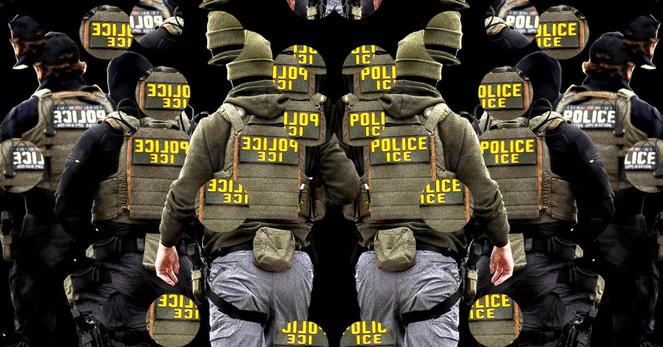
Clearly, although America is a far cry from all these places, with vastly stronger institutions, there are some echoes in ICE’s deployment, from $50,000 sign-up bonuses to the claim (since watered down) of J.D. Vance, the vice-president, that ICE agents have “absolute immunity” from prosecution for how they carry out their jobs."
#USA #Trump #Immigration #ICE #Militarism #Paramilitary #Militias #PoliceState #Authoritarianism #StateOfException
"...ICE’s budget has more than tripled in the past year, from roughly $10 billion in 2024 to almost $30 billion in 2025. As Lindsay Koshgarian and Sarah Lazare detailed at In These Times, if ICE were a national army, it would be the 13th biggest in the world, larger than the militaries of Poland, Italy, Australia, Canada, Turkey, and Spain. Last year, the federal government received, via Trump’s “Big Beautiful Bill,” a staggering $170 billion in new funding for immigration enforcement through September 2029. On an annual basis, Koshgarian and Lazare note, “this adds about $42.5 billion per year for immigration enforcement.”
It’s from this place we must begin any discussions of “reform.” An entity that has tripled in size with the explicit mandate to round up, deport, and terrorize immigrant communities—while punishing anyone who gets in their way—cannot be meaningfully challenged without addressing the funding source for this mandate.
(...)
What is essential to understand is that it’s from this obscene budget that ICE and CBP are able to run Donald Trump and Stephen Miller’s terror campaign at scale. This injection of $170 billion last year, on top of their baseline budget, is how the DHS can scale up hiring, how they can offer $50,000 sign up bonuses to new, ideologically-motivated recruits, and produce the mass saturation of armed agents to blanket multiple cities to create the requisite tension needed for their liberal city harassment and mass deportation campaigns.
The fact that progressives in Congress aren’t even advocating DHS’s budget return to its 2024 levels, or a reduction of ~66 percent, shows just how far to the right the Overton Window is. This should be a common sense, likely very popular, minimum ante to any discussion of meaningful reform—instead it’s relegated to the fringes of activist Twitter."
https://www.columnblog.com/p/senate-democrats-dhs-reforms-shaping
#USA #Trump #ICE #Militias #PoliceState #StateOfException #CivilWar #Democrats #DemocraticParty #Immigration
"ICE, resistance, and 'capitalism without humans' w/ Sarah Jaffe
On January 7th, Renee Nicole Good, a 37 year old prize winning poet and mother of three was murdered in Minneapolis by Immigration and Customs Enforcement officer Jonathan Ross. Sarah Jaffe has reported extensively on protests and organising in Minnesota and in today's episode we spoke about the political background to the current situation in the twin cities of Minneapolis and St Paul. We talked about the central role of the Somali community in resistance and union organising (and how this has drawn the ire of Donald Trump). And we talked about longer recent history of protest in the region that includes the state's central role in the Black Lives Matter movement. We also spoke about the entwinement of the tech industry, the surveillance state, and the border regime, and how protesters in some US cities have sought to target tech company assets that are believed to be aiding ICE and U.S. Customs and Border Protection. SHOW NOTES: From the Ashes: Grief and Revolution in a World on Fire"
#USA #Trump #Immigration #Capitalism #ICE #PoliceState #StateOfException #Minnesota #Minneapolis
"Federal agents who were wrestling a man to the ground in Minneapolis early Saturday secured a handgun he was carrying moments before shooting him multiple times, according to a Washington Post analysis of videos that captured the incident from several angles.
As many as eight agents were attempting to detain Alex Pretti, a 37-year-old ICU nurse, videos show. One emerged from the scrum holding Pretti’s gun, and less than a second later, the first of what appear to be 10 shots was fired. It is not clear from the video whether the other agents realized Pretti — who local authorities believe had a permit to carry the weapon — had been disarmed.
Pretti was the third person in recent weeks to be shot, and the second to be killed, by federal agents in Minneapolis, the epicenter of nationwide upheaval sparked by the Trump administration’s immigration crackdown."
https://www.washingtonpost.com/investigations/2026/01/25/minneapolis-shooting-video-gun/
#USA #Trump #ICE #Minnesota #Minneapolis #Immigration #PoliceState #StateOfException
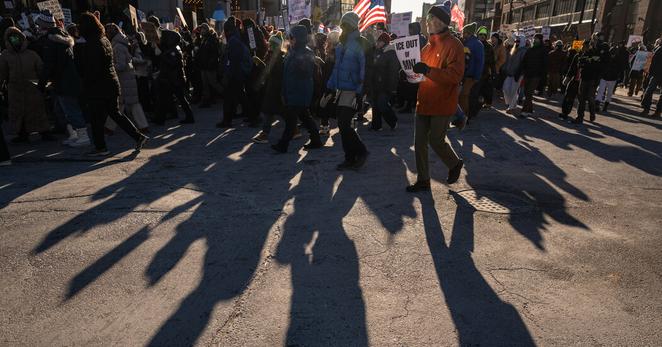
"I have been thinking about what it was about the ICE phenomenon that felt chillingly familiar to someone who grew up under repressive regimes. It wasn’t the deployment of huge numbers of forces, nor was it even the violence. It was the sense that anything could happen to anyone, not just those expressly identified as the legitimate targets of crackdown. The abiding experience of living with authoritarianism is the sense not of imminent assault, but of the constant possibility that suddenly, you could be in trouble. At a traffic incident where the officer didn’t like your tone, at a gathering that was deemed to violate a curfew and then forcibly dismantled, or even on social media where a mindless post could affect your ability to leave the country. It is a state of effacement of all civil rights, and a swelling of government into a volatile, capricious overlord, as safe or scary as the single enforcer in front of you who happens to be vested with its power.
The US has passed through that veil. But there are warning signs in the UK. The relentless portrayal of immigrants as a threat to safety and social cohesion. The same glamorisation of the imagery of crackdown, now a feature of government propaganda as ministers attend Home Office immigration raids. The same expansion of powers and discretion to the police to include ever wider definitions of what a public order infraction is, such as factoring in the “cumulative impact” of pro-Palestine rallies. The transformation of protest into dissidence.
(...)
Throw in one charismatic and mendacious political leader, and a rightwing press amplifying all the necessary fever dreams of a country in crisis, and you are on a path to passing through that veil. It can happen in Britain too, just with fewer guns."
https://www.theguardian.com/commentisfree/2026/jan/19/ice-crackdown-britain
#USA #Trump #Immigration #Deportation #ICE #PoliceState #StateOfException #Surveillance #UK
 janus_k
 Miguel Afonso Caetano