 Slow Mover
Mirrors of God’s Goodness
A Sermon on Reflecting the Goodness of God
Philippians 4:8-9
Introduction
Over the past several weeks, we have been reflecting on the goodness of God.
First, we started at the big inning — and I don’t mean a moment in a baseball game where the home team hits a grand slam. I mean the beginning, the dawn of Creation. At the beginning, God created everything, and God saw that it was good.
God is good, and what God creates is good.
Last week, we reflected on how we have experienced God’s goodness. God is good, and God has been good to us. We talked about remembering, noticing, and naming the ways God’s goodness has touched our lives. We talked about how goodness is not just an abstract doctrine, but something we taste and see, something we experience, something we can look back on and say, “Yes, God has been good to me.”
So we have these first two movements.
God is good and what God creates is good.
And God has been good to us.
Today we come to the next question: what do we do with that?
If we do not fundamentally believe that God is good, that what God creates is good, and if we are not able to see how God has been good to us, then we are probably going to have a hard time reflecting God’s goodness to creation and her people.
Because the goodness of God is not only something we believe. It is not only something we receive. It is something we are called to reflect. It is something we are called to practice. It is something we are called to embody in our lives together.
My first car was a 1972 Ford Pinto, as some of you know. And no, I didn’t have to worry about it blowing up if I got rear-ended. At least, that was not my main concern at the time.
With my Kraco cassette player, Pioneer coaxials in the doors, and two generic subwoofers in the back, I would often cruise down 8th Street in Meridian, Mississippi, on Friday nights, blasting my Christian rock — Resurrection Band most likely — driving from McDonald’s down to the Sonic drive-through and back again.
But there was something missing. At least, I thought there was.
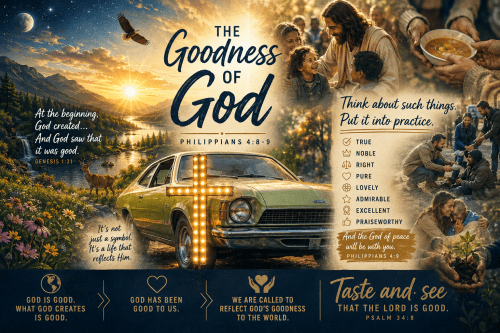
On one of our family road trips, I saw a tractor-trailer rig with a cool set up, and it gave me an idea. I decided I could do something similar to my car. So I got a friend of mine in a workshop to make me a cross out of metal. Then I took yellow trailer lights and attached them to the cross, which I then attached to the front bumper of my car.
That way folks could really see my commitment to Jesus. You know, this little light of mine.
The problem came when I tried to hook up the lights to the electrical wiring in my car. I was hoping to be able to turn on the lights with my parking light switch, but I wound up frying the electronics. I can still remember the smell of burnt wiring and bitter disappointment as that little light of mine flickered once and went out.
I did figure out a workaround. So for a while there I was cruising 8th Street in my 1972 lime green Ford Pinto, with a lighted cross on the front, blaring Christian rock to all the world.
Now, there is probably a whole sermon right there about youthful zeal and questionable judgment.
But here is the connection for today: if we talk about the goodness of God and how God has been good to us, that is great. But if we forget this third aspect of the goodness of God, then it is like shorting out the cross on the front of my Pinto.
Because if we believe God is good, and if we know how God has been good to us, then we need to be reflecting God’s goodness to those around us. And not only reflecting it, but being a people who do good.
Let us pray.
May the words of my mouth and the meditations of every heart here be acceptable in your sight, O God, our rock and our Redeemer. Amen.
Homily
Paul writes in Philippians 4:8-9:
“Finally, brothers and sisters, whatever is true, whatever is noble, whatever is right, whatever is pure, whatever is lovely, whatever is admirable — if anything is excellent or praiseworthy — think about such things. Whatever you have learned or received or heard from me, or seen in me — put it into practice. And the God of peace will be with you.”
There are two parts here that belong together.
First, Paul tells them what to think about. Whatever is true. Whatever is noble. Whatever is right. Whatever is pure. Whatever is lovely. Whatever is admirable. If anything is excellent or praiseworthy, think about such things.
But then he says, “Whatever you have learned or received or heard from me, or seen in me — put it into practice.”
Think about such things.
Put it into practice.
The goodness of God shapes our imagination, but it does not stop there. It moves into our hands, our words, our relationships, our decisions, our treatment of creation, our care for neighbors, our willingness to forgive, our resistance to evil, and our practice of peace.
This is not simply positive thinking. Paul is not asking the church to pretend the world is better than it is. He is writing from prison. He knows suffering. He knows conflict. He knows disappointment. He knows opposition. He knows what it is to live in a world where goodness is contested.
So when Paul says, “Think about such things,” he is not saying, “Ignore what is wrong.”
He begins with truth.
Whatever is true.
Christian goodness is not denial. Christian hope is not pretending. Christian love does not require us to lie about harm, injustice, pain, grief, or evil.
But truth is larger than the worst thing that has happened.
Truth includes the goodness of creation.
Truth includes the image of God in every person.
Truth includes the mercy of Christ.
Truth includes resurrection.
Truth includes forgiveness.
Truth includes the Spirit still moving.
Truth includes beauty, grace, and the possibility of new creation.
And if we spend all our time thinking only about what is ugly, false, fearful, bitter, and broken, it will shape us.
If we constantly feed on fear, we will have a hard time practicing peace.
If we constantly feed on outrage, we will have a hard time practicing gentleness.
If we constantly feed on resentment, we will have a hard time practicing forgiveness.
If we constantly feed on despair, we will have a hard time seeing hope.
If we constantly rehearse what is wrong with people, we will have a hard time seeing the image of God in them.
Paul is inviting us into holy attention.
He is inviting us to pay attention to what is true, noble, right, pure, lovely, admirable, excellent, and praiseworthy — not so we can escape the world, but so we can live faithfully in it.
What we behold, we begin to reflect.
If we behold only fear, we reflect fear.
If we behold only anger, we reflect anger.
If we behold only contempt, we reflect contempt.
But if we behold the goodness of God, we can begin to reflect the goodness of God.
That is why Genesis matters so much.
At the beginning, God creates, and again and again the refrain comes: “And God saw that it was good.”
Light is good.
Sky is good.
Land and sea are good.
Plants and trees are good.
Sun, moon, and stars are good.
Birds and fish are good.
Animals are good.
Human beings, made in the image of God, are very good.
Before there is sin, there is goodness.
Before there is shame, there is blessing.
Before there is violence, there is peace.
Before there is scarcity and fear, there is abundance and delight.
The Communicator’s Commentary on Genesis makes this connection practical. It says, “Those who believe God created everything good certainly will not be indifferent to developments which may serve only to pollute and ruin, exterminate and defile all that God has made.”
Believing in the goodness of creation shapes the way we live.
If creation is good, then we receive it with gratitude and protect it with care. We do not worship creation, but neither do we treat it as disposable. We care for what God has called good.
That means the goodness of God is not merely spiritual in some narrow sense. It touches the soil. It touches water. It touches air. It touches animals. It touches bodies. It touches neighborhoods. It touches the vulnerable. It touches how we live in the world God made.
The goodness of God gives us permission to name evil as evil and to resist what destroys life. It gives us permission to lament, protest, pray, feed, heal, repair, reconcile, and work for peace.
If the world begins in goodness, and if God is good, and if goodness and mercy follow us, then part of faith is learning to see what God has already called good.
To see creation not as disposable, but as gift.
To see our bodies not as shameful, but as part of God’s good creation.
To see other people not first as problems or enemies, but as made in God’s image.
To see ourselves not first as failures, but as beloved creatures made by a good God.
This does not mean we deny sin or excuse harm. But it does mean we begin where Scripture begins: with our good, good God who creates good things.
And that goodness is not merely something we believe about God. It is something we are called to reflect.
If we want to know what this looks like, we look to Jesus.
Jesus is the goodness of God in human form.
He touches the untouchable.
He welcomes children.
He eats with sinners.
He forgives enemies.
He heals the sick.
He feeds the hungry.
He notices the overlooked.
He tells the truth to the powerful.
He weeps at the tomb of his friend.
He breaks bread with those who will fail him.
He prays forgiveness over those who crucify him.
This is goodness.
But goodness is not the same as niceness.
Niceness often avoids hard things. Goodness moves toward healing.
Niceness wants to be liked. Goodness seeks the wholeness of the other.
Niceness may keep things pleasant on the surface. Goodness tells the truth in love.
Niceness may walk past suffering politely. Goodness stops on the road and binds up wounds.
Jesus is good. He is not merely nice.
The goodness of Jesus is tender, but not weak.
It is merciful, but not passive.
It is truthful, but not cruel.
It is holy, but not harsh.
It is welcoming, but not shallow.
And this is the goodness we are called to reflect.
Paul says, “Whatever you have learned or received or heard from me, or seen in me — put it into practice.”
Practice matters.
We can believe beautiful things and still live in ugly ways.
We can say God is good and still treat people as if they are disposable.
We can say creation is good and still live carelessly toward the earth.
We can say God has been merciful to us and still refuse mercy to others.
We can say we follow Jesus and still sound more like fear, anger, and contempt than like Christ.
This is where the lighted cross on the Pinto comes back for me.
It is possible to have the symbol right out front and still have the wiring messed up.
It is possible to display faith outwardly while something inward is shorting out. It is possible to announce Jesus loudly while not reflecting the goodness of Jesus clearly.
That does not mean we have to be perfect. Thank God. But it does mean we have to pay attention to what is forming us.
Are we being formed by the goodness of God?
Are we being formed by the mercy of Jesus?
Are we being formed by what is true, noble, right, pure, lovely, admirable, excellent, and praiseworthy?
Or are we being formed by fear, suspicion, resentment, and despair?
The church is called to be a community where people can taste the goodness of God: a community not ruled by fear, condemnation, suspicion, or bitterness, but a community of goodness and mercy.
A community that tells the truth with love.
A community that resists evil without becoming evil.
A community that cares for creation.
A community that feeds the hungry.
A community that welcomes the stranger.
A community that protects the vulnerable.
A community that forgives.
A community that practices peace.
This does not happen by accident.
It happens as we return again and again to the goodness of God. It happens as we remember how God has been good to us. It happens as we practice gratitude. It happens as we confess when we fail. It happens as we forgive and are forgiven. It happens as we train our attention toward what is true and lovely. It happens as we put into practice what we have learned and received and heard and seen in Jesus.
And often, reflecting God’s goodness looks small.
A meal delivered.
A note written.
A phone call made.
A child listened to.
A stranger welcomed.
A harsh word left unsaid.
A truthful word spoken gently.
A grudge released.
A prayer offered.
A garden planted.
A lonely person noticed.
A wounded person treated with dignity.
A disagreement handled without contempt.
Small goodness matters.
Jesus compared the kingdom to mustard seed, yeast, salt, and light. Small things. Ordinary things. Hidden things. Things that do not always look impressive at first. And yet God works through them.
The church reflects God’s goodness not only through grand gestures, but through ordinary faithfulness.
We reflect God’s goodness when our worship helps people taste and see that the Lord is good.
We reflect God’s goodness when our fellowship gives lonely people a place to belong.
We reflect God’s goodness when our care for creation treats the earth as beloved, not disposable.
We reflect God’s goodness when children are safe and cherished.
We reflect God’s goodness when elders are honored.
We reflect God’s goodness when the poor are not forgotten.
We reflect God’s goodness when strangers are welcomed.
We reflect God’s goodness when people who disagree still recognize one another as image-bearers of God.
And we reflect God’s goodness when we receive ourselves as part of God’s good creation too.
Some of us find that hard.
We may believe God loves the world, but struggle to believe God loves us. We may believe God forgives others, but struggle to receive forgiveness ourselves. We may believe creation is good, but look at our own bodies, our own lives, our own stories, and see only what is wrong.
But you, too, are God’s creation.
You are not God, but you are made by God.
You are not perfect, but you are loved.
You are not finished, but you are being formed.
You are not the source of goodness, but you can reflect it.
So maybe the invitation this week is simple.
Taste and see.
Take time to notice the goodness of God. Name it. Write it down. Speak it aloud. Share it at the table. Pray it before sleep. Look for it in creation. Look for it in Scripture. Look for it in the life of Jesus. Look for it in your own story. Look for it in someone you find difficult.
And then ask: how can I reflect this goodness today?
How can I reflect God’s goodness in one conversation?
How can I reflect God’s goodness in one act of care?
How can I reflect God’s goodness in the way I use my words?
How can I reflect God’s goodness toward creation?
How can I reflect God’s goodness toward someone who feels forgotten?
How can I reflect God’s goodness toward myself?
Because if we do not fundamentally believe that God is good, that what God creates is good, and if we are not able to see how God has been good to us or spend regular time reflecting on that, then we are probably going to have a hard time reflecting God’s goodness to creation and her people.
But if we do believe God is good, if we learn to see creation as good, if we take time to remember how God has been good to us, then we may become people through whom others taste and see that goodness too.
May our minds dwell on what is true and lovely.
May our hearts remember what God has done.
May our hands practice mercy.
May our words carry grace.
May our lives become small mirrors of the goodness of God.
And may creation and her people taste and see, through us, that the Lord is good.
Amen.
Homily
Paul writes in Philippians 4:8-9:
“Finally, brothers and sisters, whatever is true, whatever is noble, whatever is right, whatever is pure, whatever is lovely, whatever is admirable — if anything is excellent or praiseworthy — think about such things. Whatever you have learned or received or heard from me, or seen in me — put it into practice. And the God of peace will be with you.”
There are two parts here that belong together.
First, Paul tells them what to think about. Whatever is true. Whatever is noble. Whatever is right. Whatever is pure. Whatever is lovely. Whatever is admirable. If anything is excellent or praiseworthy, think about such things.
But then he says, “Whatever you have learned or received or heard from me, or seen in me — put it into practice.”
Think about such things.
Put it into practice.
The goodness of God shapes our imagination, but it does not stop there. It moves into our hands, our words, our relationships, our decisions, our treatment of creation, our care for neighbors, our willingness to forgive, our resistance to evil, and our practice of peace.
This is not simply positive thinking. Paul is not asking the church to pretend the world is better than it is. He is writing from prison. He knows suffering. He knows conflict. He knows disappointment. He knows opposition. He knows what it is to live in a world where goodness is contested.
So when Paul says, “Think about such things,” he is not saying, “Ignore what is wrong.”
He begins with truth.
Whatever is true.
Christian goodness is not denial. Christian hope is not pretending. Christian love does not require us to lie about harm, injustice, pain, grief, or evil.
But truth is larger than the worst thing that has happened.
Truth includes the goodness of creation.
Truth includes the image of God in every person.
Truth includes the mercy of Christ.
Truth includes resurrection.
Truth includes forgiveness.
Truth includes the Spirit still moving.
Truth includes beauty, grace, and the possibility of new creation.
And if we spend all our time thinking only about what is ugly, false, fearful, bitter, and broken, it will shape us.
If we constantly feed on fear, we will have a hard time practicing peace.
If we constantly feed on outrage, we will have a hard time practicing gentleness.
If we constantly feed on resentment, we will have a hard time practicing forgiveness.
If we constantly feed on despair, we will have a hard time seeing hope.
If we constantly rehearse what is wrong with people, we will have a hard time seeing the image of God in them.
Paul is inviting us into holy attention.
He is inviting us to pay attention to what is true, noble, right, pure, lovely, admirable, excellent, and praiseworthy — not so we can escape the world, but so we can live faithfully in it.
What we behold, we begin to reflect.
If we behold only fear, we reflect fear.
If we behold only anger, we reflect anger.
If we behold only contempt, we reflect contempt.
But if we behold the goodness of God, we can begin to reflect the goodness of God.
That is why Genesis matters so much.
At the beginning, God creates, and again and again the refrain comes: “And God saw that it was good.”
Light is good.
Sky is good.
Land and sea are good.
Plants and trees are good.
Sun, moon, and stars are good.
Birds and fish are good.
Animals are good.
Human beings, made in the image of God, are very good.
Before there is sin, there is goodness.
Before there is shame, there is blessing.
Before there is violence, there is peace.
Before there is scarcity and fear, there is abundance and delight.
The Communicator’s Commentary on Genesis makes this connection practical. It says, “Those who believe God created everything good certainly will not be indifferent to developments which may serve only to pollute and ruin, exterminate and defile all that God has made.”
Believing in the goodness of creation shapes the way we live.
If creation is good, then we receive it with gratitude and protect it with care. We do not worship creation, but neither do we treat it as disposable. We care for what God has called good.
That means the goodness of God is not merely spiritual in some narrow sense. It touches the soil. It touches water. It touches air. It touches animals. It touches bodies. It touches neighborhoods. It touches the vulnerable. It touches how we live in the world God made.
The goodness of God gives us permission to name evil as evil and to resist what destroys life. It gives us permission to lament, protest, pray, feed, heal, repair, reconcile, and work for peace.
If the world begins in goodness, and if God is good, and if goodness and mercy follow us, then part of faith is learning to see what God has already called good.
To see creation not as disposable, but as gift.
To see our bodies not as shameful, but as part of God’s good creation.
To see other people not first as problems or enemies, but as made in God’s image.
To see ourselves not first as failures, but as beloved creatures made by a good God.
This does not mean we deny sin or excuse harm. But it does mean we begin where Scripture begins: with our good, good God who creates good things.
And that goodness is not merely something we believe about God. It is something we are called to reflect.
If we want to know what this looks like, we look to Jesus.
Jesus is the goodness of God in human form.
He touches the untouchable.
He welcomes children.
He eats with sinners.
He forgives enemies.
He heals the sick.
He feeds the hungry.
He notices the overlooked.
He tells the truth to the powerful.
He weeps at the tomb of his friend.
He breaks bread with those who will fail him.
He prays forgiveness over those who crucify him.
This is goodness.
But goodness is not the same as niceness.
Niceness often avoids hard things. Goodness moves toward healing.
Niceness wants to be liked. Goodness seeks the wholeness of the other.
Niceness may keep things pleasant on the surface. Goodness tells the truth in love.
Niceness may walk past suffering politely. Goodness stops on the road and binds up wounds.
Jesus is good. He is not merely nice.
The goodness of Jesus is tender, but not weak.
It is merciful, but not passive.
It is truthful, but not cruel.
It is holy, but not harsh.
It is welcoming, but not shallow.
And this is the goodness we are called to reflect.
Paul says, “Whatever you have learned or received or heard from me, or seen in me — put it into practice.”
Practice matters.
We can believe beautiful things and still live in ugly ways.
We can say God is good and still treat people as if they are disposable.
We can say creation is good and still live carelessly toward the earth.
We can say God has been merciful to us and still refuse mercy to others.
We can say we follow Jesus and still sound more like fear, anger, and contempt than like Christ.
This is where the lighted cross on the Pinto comes back for me.
It is possible to have the symbol right out front and still have the wiring messed up.
It is possible to display faith outwardly while something inward is shorting out. It is possible to announce Jesus loudly while not reflecting the goodness of Jesus clearly.
That does not mean we have to be perfect. Thank God. But it does mean we have to pay attention to what is forming us.
Are we being formed by the goodness of God?
Are we being formed by the mercy of Jesus?
Are we being formed by what is true, noble, right, pure, lovely, admirable, excellent, and praiseworthy?
Or are we being formed by fear, suspicion, resentment, and despair?
The church is called to be a community where people can taste the goodness of God: a community not ruled by fear, condemnation, suspicion, or bitterness, but a community of goodness and mercy.
A community that tells the truth with love.
A community that resists evil without becoming evil.
A community that cares for creation.
A community that feeds the hungry.
A community that welcomes the stranger.
A community that protects the vulnerable.
A community that forgives.
A community that practices peace.
This does not happen by accident.
It happens as we return again and again to the goodness of God. It happens as we remember how God has been good to us. It happens as we practice gratitude. It happens as we confess when we fail. It happens as we forgive and are forgiven. It happens as we train our attention toward what is true and lovely. It happens as we put into practice what we have learned and received and heard and seen in Jesus.
And often, reflecting God’s goodness looks small.
A meal delivered.
A note written.
A phone call made.
A child listened to.
A stranger welcomed.
A harsh word left unsaid.
A truthful word spoken gently.
A grudge released.
A prayer offered.
A garden planted.
A lonely person noticed.
A wounded person treated with dignity.
A disagreement handled without contempt.
Small goodness matters.
Jesus compared the kingdom to mustard seed, yeast, salt, and light. Small things. Ordinary things. Hidden things. Things that do not always look impressive at first. And yet God works through them.
The church reflects God’s goodness not only through grand gestures, but through ordinary faithfulness.
We reflect God’s goodness when our worship helps people taste and see that the Lord is good.
We reflect God’s goodness when our fellowship gives lonely people a place to belong.
We reflect God’s goodness when our care for creation treats the earth as beloved, not disposable.
We reflect God’s goodness when children are safe and cherished.
We reflect God’s goodness when elders are honored.
We reflect God’s goodness when the poor are not forgotten.
We reflect God’s goodness when strangers are welcomed.
We reflect God’s goodness when people who disagree still recognize one another as image-bearers of God.
And we reflect God’s goodness when we receive ourselves as part of God’s good creation too.
Some of us find that hard.
We may believe God loves the world, but struggle to believe God loves us. We may believe God forgives others, but struggle to receive forgiveness ourselves. We may believe creation is good, but look at our own bodies, our own lives, our own stories, and see only what is wrong.
But you, too, are God’s creation.
You are not God, but you are made by God.
You are not perfect, but you are loved.
You are not finished, but you are being formed.
You are not the source of goodness, but you can reflect it.
So maybe the invitation this week is simple.
Taste and see.
Take time to notice the goodness of God. Name it. Write it down. Speak it aloud. Share it at the table. Pray it before sleep. Look for it in creation. Look for it in Scripture. Look for it in the life of Jesus. Look for it in your own story. Look for it in someone you find difficult.
And then ask: how can I reflect this goodness today?
How can I reflect God’s goodness in one conversation?
How can I reflect God’s goodness in one act of care?
How can I reflect God’s goodness in the way I use my words?
How can I reflect God’s goodness toward creation?
How can I reflect God’s goodness toward someone who feels forgotten?
How can I reflect God’s goodness toward myself?
Because if we do not fundamentally believe that God is good, that what God creates is good, and if we are not able to see how God has been good to us or spend regular time reflecting on that, then we are probably going to have a hard time reflecting God’s goodness to creation and her people.
But if we do believe God is good, if we learn to see creation as good, if we take time to remember how God has been good to us, then we may become people through whom others taste and see that goodness too.
May our minds dwell on what is true and lovely.
May our hearts remember what God has done.
May our hands practice mercy.
May our words carry grace.
May our lives become small mirrors of the goodness of God.
And may creation and her people taste and see, through us, that the Lord is good.
Amen.
 Jamin Bradley
 Bryan King







 Intentional Faith