 stoicmike
 Florian Schmidt
@bobonbooks Multisolving by @bethsawin .
It shows an escape from the #solutionism of the past, where each problem's solution creates many new problems, and from the #polycrisis we brought about with this approach. And it shows how to bring together groups working in completely different areas to co-create lasting change, instead of fighting each other.
 Dr Susi Arnott
Simply not OK to run stories like these - #feelgood #solutionism that treats #climatebreakdown as some sort of external inevitable inconvenience. Not even a tiny mention of causes, let alone #climateAction
'Saving a village from climate catastrophe'? #climateilliteracy https://www.theguardian.com/world/2025/aug/11/pralognan-alps-climate-crisis-melting-glacier?CMP=Share_AndroidApp_Other
'Saving a village from climate catastrophe'? #climateilliteracy https://www.theguardian.com/world/2025/aug/11/pralognan-alps-climate-crisis-melting-glacier?CMP=Share_AndroidApp_Other
 Alberto Cottica
Exactly that:
"While promising, progressive blockchain networks are largely still ‘thought experiments’ while the most powerful, successful ones are ‘extractive’ ."
 Andreas Hepp
I am very pleased that our article "Solving the crisis with 'do-it-yourself heroes'? The media coverage on #pioneercommunities, #Covid-19, and technological #solutionism" is now also available in print.
It remains remarkable how members of pioneer communities such as the #Maker movement were staged as #heroes and what fantasies existed about solving the problems with #DIY. In retrospect, this still says a lot about the imagination of #technology and #innovation.
https://www.degruyterbrill.com/document/doi/10.1515/commun-2023-0077/html

Solving the crisis with “do-it-yourself heroes”? The media coverage on pioneer communities, Covid-19, and technological solutionism
Protective shields and medical devices produced in Makerspaces as well as the early detection of disease through self-measurement have been widely publicized in the media coverage of the Covid-19 pandemic. This article systematically examines this phenomenon by analyzing the coverage of the Maker and Quantified Self movements in Germany and the UK. Through a discourse analysis of (online) newspapers, the article demonstrates that during the pandemic the coverage of both pioneer communities was markedly positive. Makers were often portrayed as problem solvers, while Quantified Self members were depicted as seismographs of the pandemic. Overall, our analysis reveals an overarching narrative that constructs members of these groups as “do-it-yourself heroes” who respond to the Covid-19 pandemic through their experimental practices, promoting a form of technological solutionism.
 dvd
dvdI am looking for a quote i read and then lost reference to it and its author. It goes something about "the solution(s) be the problem" but felt more in point and (i recall) with some veils of critique of western approach to things.
i read once in a text about degrowth / decomputing but that could refer from a wider critique of Western science?
Thanks for any suggestion!
 Tantek Çelik
I just participated in the first W3C Authentic Web Mini Workshop^1 hosted by the Credible Web Community Group^2 (of which I’m a longtime member) and up front I noted that our very discussion itself needed to be careful about its own credibility, extra critical of any technologies discussed or assertions made, and initially identified two flaws to avoid on a meta level, having seen them occur many times in technical or standards discussions:
1. Politician’s Syllogism — "Something must be done about this problem. Here is something, let's do it!"
2. Solutions Looking For Problems — "I am interested in how tech X can solve problem Y"
After some back and forth and arguments in the Zoom chat, I observed participants questioning speakers of arguments rather than the arguments themselves, so I had to identify a third fallacy to avoid:
3. Ad Hominem — while obvious examples are name-calling (which is usually against codes of conduct), less obvious examples (witnessed in the meeting) include questioning a speaker’s education (or lack thereof) like what they have or have not read, or would benefit from reading.
I am blogging these here both as a reminder (should you choose to participate in such discussions), and as a resource to cite in future discussions.
We need to all develop expertise in recognizing these logical and methodological flaws & fallacies, and call them out when we see them, especially when used against others.
We need to promptly prune these flawed methods of discussion, so we can focus on actual productive, relevant, and yes, credible discussions.
#W3C #credweb #credibleWeb #authenticWeb #flaw #fallacy #fallacies #logicalFallacy #logicalFallacies
Glossary
Ad Hominem
attacking an attribute of the person making an argument rather than the argument itself
https://en.wikipedia.org/wiki/Ad_hominem
Politician's syllogism
https://en.wikipedia.org/wiki/Politician%27s_syllogism
Solutions Looking For Problems (related: #solutionism, #solutioneering)
Promoting a technology that either has not identified a real problem for it to solve, or actively pitching a specific technology to any problem that seems related. Wikipedia has no page on this but has two related pages:
* https://en.wikipedia.org/wiki/Law_of_the_instrument
* https://en.wikipedia.org/wiki/Technological_fix
Wikipedia does have an essay on this specific to Wikipedia:
* https://en.wikipedia.org/wiki/Wikipedia:Solutions_looking_for_a_problem
Stack Exchange has a thread on "solution in search of a problem":
* https://english.stackexchange.com/questions/250320/a-word-that-means-a-solution-in-search-of-a-problem
Forbes has an illustrative anecdote:
* https://www.forbes.com/sites/stephanieburns/2019/05/28/solution-looking-for-a-problem/
References
^1 https://www.w3.org/events/workshops/2025/authentic-web-workshop/
^2 https://credweb.org/ and https://www.w3.org/community/credibility/
Previously in 2019 I participated @misinfocon.com #MisinfoCon:
* https://tantek.com/2019/296/t1/london-misinfocon-discuss-spectrum-recency
* https://tantek.com/2019/296/t2/misinfocon-roundtable-spectrums-misinformation
1. Politician’s Syllogism — "Something must be done about this problem. Here is something, let's do it!"
2. Solutions Looking For Problems — "I am interested in how tech X can solve problem Y"
After some back and forth and arguments in the Zoom chat, I observed participants questioning speakers of arguments rather than the arguments themselves, so I had to identify a third fallacy to avoid:
3. Ad Hominem — while obvious examples are name-calling (which is usually against codes of conduct), less obvious examples (witnessed in the meeting) include questioning a speaker’s education (or lack thereof) like what they have or have not read, or would benefit from reading.
I am blogging these here both as a reminder (should you choose to participate in such discussions), and as a resource to cite in future discussions.
We need to all develop expertise in recognizing these logical and methodological flaws & fallacies, and call them out when we see them, especially when used against others.
We need to promptly prune these flawed methods of discussion, so we can focus on actual productive, relevant, and yes, credible discussions.
#W3C #credweb #credibleWeb #authenticWeb #flaw #fallacy #fallacies #logicalFallacy #logicalFallacies
Glossary
Ad Hominem
attacking an attribute of the person making an argument rather than the argument itself
https://en.wikipedia.org/wiki/Ad_hominem
Politician's syllogism
https://en.wikipedia.org/wiki/Politician%27s_syllogism
Solutions Looking For Problems (related: #solutionism, #solutioneering)
Promoting a technology that either has not identified a real problem for it to solve, or actively pitching a specific technology to any problem that seems related. Wikipedia has no page on this but has two related pages:
* https://en.wikipedia.org/wiki/Law_of_the_instrument
* https://en.wikipedia.org/wiki/Technological_fix
Wikipedia does have an essay on this specific to Wikipedia:
* https://en.wikipedia.org/wiki/Wikipedia:Solutions_looking_for_a_problem
Stack Exchange has a thread on "solution in search of a problem":
* https://english.stackexchange.com/questions/250320/a-word-that-means-a-solution-in-search-of-a-problem
Forbes has an illustrative anecdote:
* https://www.forbes.com/sites/stephanieburns/2019/05/28/solution-looking-for-a-problem/
References
^1 https://www.w3.org/events/workshops/2025/authentic-web-workshop/
^2 https://credweb.org/ and https://www.w3.org/community/credibility/
Previously in 2019 I participated @misinfocon.com #MisinfoCon:
* https://tantek.com/2019/296/t1/london-misinfocon-discuss-spectrum-recency
* https://tantek.com/2019/296/t2/misinfocon-roundtable-spectrums-misinformation

 Miguel Afonso Caetano
"A core promise is that turning the public sector over to AI will deliver huge savings and improved delivery, although one might question the reliability of their research, given that it was based on asking ChatGPT itself how many government jobs it could do. While this sketchy approach has echoes of the Iraq ('dodgy') Dossier, it's reflecting a realpolitik that sees both AI companies and rhetoric about AI as incredibly powerful at the current moment.
This is perhaps the hole that AI fills for the Labour government; having long abandoned any substantive belief in the transformative power of socialism, it is lacking a mobilising belief system. At the same time, it's obvious to all and sundry that the status quo is in deep trouble and that being the party of continuity isn't going to convince anyone.
Ergo, the claim that AI has the power to change the world becomes a good stand-in for a transformative ideology. The bonus for the Labour government is that relying on AI to fix things avoids the need for any structural changes that might upset powerful business and media interests, and rhetoric about global AI leadership has a suitably 'Empire' vibe to appeal to nationalistic sentiments at the grassroots."
https://www.computerweekly.com/opinion/Labours-AI-Action-Plan-a-gift-to-the-far-right
#AI #GenerativeAI #UK #Labour #LabourParty #TonyBlair #Ideology #Solutionism #SiliconValley #BigTech

Labour's AI Action Plan - a gift to the far right | Computer Weekly
Critical computing expert Dan McQuillan argues that, on top of the clear social and environmental harms associated with the technology, Labour's vapid fixation on AI-led growth in lieu of real change will further enable the far right. Instead, he proposes an alternative strategy of 'decomputing'.
 Degrowth or Extinction
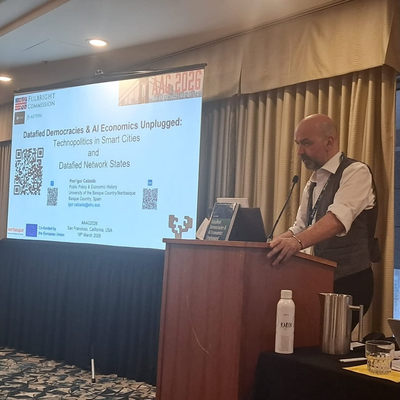 ICalzada
Escucho en #Euskadi/#España sobre las bondades del #SuperComputing #QuantumComputing en relación a los 'problemas sociales' q la #AI puede 'solucionar'
y me pregunto donde hemos dejado la #datafication...


Artificial Intelligence for Social Innovation: Beyond the Noise of Algorithms and Datafication
In an era of rapid technological advancement, decisions about the ownership and governance of emerging technologies like Artificial Intelligence will shape the future of both urban and rural environments in the Global North and South. This article explores how AI can move beyond the noise of algorithms by adopting a technological humanistic approach to enable Social Innovation, focusing on global inequalities and digital justice. Using a fieldwork Action Research methodology, based on the Smart Rural Communities project in Colombia and Mozambique, the study develops a framework for integrating AI with SI. Drawing on insights from the AI4SI International Summer School held in Donostia-San Sebastián in 2024, the article examines the role of decentralized Web3 technologies—such as Blockchain, Decentralized Autonomous Organizations, and Data Cooperatives—in enhancing data sovereignty and fostering inclusive and participatory governance. The results demonstrate how decentralization can empower marginalized communities in the Global South by promoting digital justice and addressing the imbalance of power in digital ecosystems. The conclusion emphasizes the potential for AI and decentralized technologies to bridge the digital divide, offering practical recommendations for scaling these innovations to support equitable, community-driven governance and address systemic inequalities across the Global North and South.