Fluids Can Fracture

Fracture is a sudden, brittle breaking-apart that we generally associate with solid materials that get stressed too far. Some viscoelastic, non-Newtonian fluids have been known to fracture, but that was generally thought to be unusual. But a recent study turns that idea on its head, revealing that even simple, albeit highly viscous, liquids can fracture.

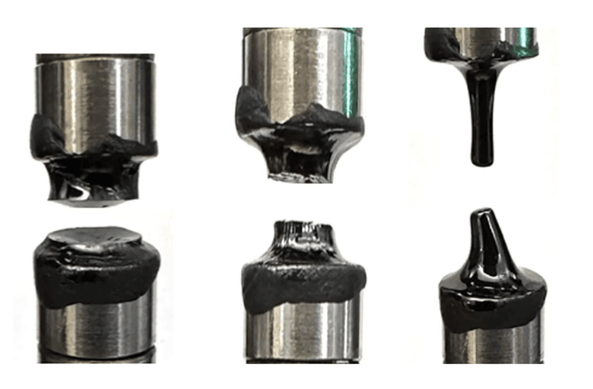
A viscous hydrocarbon fluid gets stretched at 100 mm/s, drawing it into a thinning shape.

When you stretch a liquid, the general expectation is what you see above: the liquid gets drawn into an ever thinner shape. But researchers found that–when stretched quickly–that same simple hydrocarbon liquid cracked open:

A viscous hydrocarbon fluid gets stretched at 300 mm/s, causing it to fracture like a solid.

There’s even an audible snap, which you can hear in the video below. The results were so surprising that they repeated the experiment several times and with different viscous (but Newtonian) liquids. The results held. When the liquids were pulled to a critical stress, they audibly snapped and fractured like a solid.

The next question, of course, is why this happens. The authors suspect (but have yet to show) that cavitation may be at play in the initiation of the crack that separates the liquid in two. (Image, video, and research credit: T. Lima et al.; via Gizmodo)

https://www.youtube.com/watch?v=i5TQegTyCvc

#fluidDynamics #fracture #newtonianFluids #physics #science #solidMechanics #viscousFlow

Assistant Professor (Tenure Track) in Mechanical Engineering

Post a job in 3min, or find thousands of job offers like this one at jobRxiv!

jobRxiv
Assistant Professor (Tenure Track) in Mechanical Engineering

Post a job in 3min, or find thousands of job offers like this one at jobRxiv!

jobRxiv
Lecturer Position in Mechanical Engineering

Post a job in 3min, or find thousands of job offers like this one at jobRxiv!

jobRxiv

Rolling Down Soft Surfaces

Place a rigid ball on a hard vertical surface, and it will free fall. Stick a liquid drop there, and it will slide down. But researchers discovered that with a soft sphere and a soft surface, it’s possible to roll down a vertical wall. The effect requires just the right level of squishiness for both the wall and sphere, but when conditions are right, the 1-millimeter radius sphere rolls (with a little slipping) down the wall.

Rolling requires torque, something that’s usually lacking on a vertical surface. But the team found that their soft spheres got the torque needed to roll from their asymmetric contact with the surface. More of the sphere contacted above its centerline than below it. The researchers compared the way the sphere contacted the surface to a crack opening (at the back of the sphere) and a crack closing (at the front of the sphere). That asymmetry creates just enough torque to roll the sphere slowly. The team hopes their discovery opens up new possibilities for soft robots to climb and descend vertical surfaces. (Image and research credit: S. Mitra et al.; via Gizmodo)

#adhesion #fluidDynamics #physics #science #slip #softMatter #solidMechanics

Chaotic Hose Instability

Steve Mould is back with another video looking at wild fluid behaviors. This time he’s considering hose instabilities like the one that makes a water-carrying hose beyond a certain length to whip wildly back and forth. He tries to track down the reasoning for these flexible hoses snapping and whipping. In truth, both the hoses and the wind dancers do their thing due to interactions between the elasticity of the hose and the fluid dynamics of the flows within. These applications are ripe for a few control volume thought experiments. (Video and image credit: S. Mould)

#chaos #elasticity #fluidDynamics #physics #science #solidMechanics

Ultra-Soft Solids Flow By Turning Inside Out

Can a solid flow? What would that even look like? Researchers explored these questions with an ultra-soft gel (think 100,000 times softer than a gummy bear) pumped through a ring-shaped annular pipe. Despite its elasticity — that tendency to return to an original shape that distinguishes solids from fluids — the gel does flow. But after a short distance, furrows form and grow along the gel’s leading edge.

Front view of an ultra-soft solid flowing through an annular pipe. The furrows forming along the face of the gel are places where the gel is essentially turning itself inside out.

Since the gel alongside the pipe’s walls can’t slide due to friction, the gel flows by essentially turning itself inside out. Inner portions of the gel flow forward and then split off toward one of the walls as they reach the leading edge. This eversion builds up lots of internal stress in the gel, and furrowing — much like crumpling a sheet of paper — relieves that stress. (Image and research credit: J. Hwang et al.; via APS News)

#flowVisualization #fluidDynamics #instability #physics #pipeFlow #science #softMatter #solidMechanics #stress

Congratulations to Sébastien Court, Associate Professor at the Department of #Mathematics and the DiSC of @uniinnsbruck, for receiving the prestigious Research Award of the Stiftung Südtiroler Sparkasse for his recent, outstanding research papers with contributions to the theory of partial differential equations, particularly in the field of solid and fluid mechanics: https://www.uibk.ac.at/en/disc/news/research-award-court/

#SolidMechanics #FluidMechanics

Research Award for Sébastien Court

On February 3, 2025, Sébastien Court, Associate Professor at the Department of Mathematics and the Digital Science Center (DiSC), was awarded the prestigious Research Award of the Foundation Stiftung Südtiroler Sparkasse for his recent, outstanding research papers. He received the award for his significant contributions to the theory of partial differential equations.

There will also be 4 special sessions,

https://spheric2025.upc.edu/index.php/call-for-special-sessions/

for #Aerospace and maritime applications, #SolidMechanics, #CoastalEngineering (an #SPH classic), and one focused on #RenewableEnergy modelling and innovations through #SPH

#SPH_ #SmoothedParticleHydrodynamics

3/

#SPHERIC2025 will be in #Barcelona
https://spheric2025.upc.edu/

It will be the first #SPHERIC #conference to break from the "classic" SPHERIC International Workshop format that was also employed for the SPHERIC 2022 I organized in Catania, and closer to other more traditional conferences (hence also the change in name, to SPHERIC World Conference).

1/

#SPH #CFD #SolidMechanics #AstroPhysics #ParticleMethods

SPHERIC 2025

SPHERIC 2025