“Unhappy is the land that needs a hero”*…

To the extent that evolutionary biologist and sociobiologist Robert Trivers has been in the news over the last decade, it has been for his entanglement with and highly-questionable defense of Jeffrey Epstein. But as Lionel Page reminds us, two decades before that– well before he could have known the execrable “financier”– Trivers made hugely important contributions to his field…

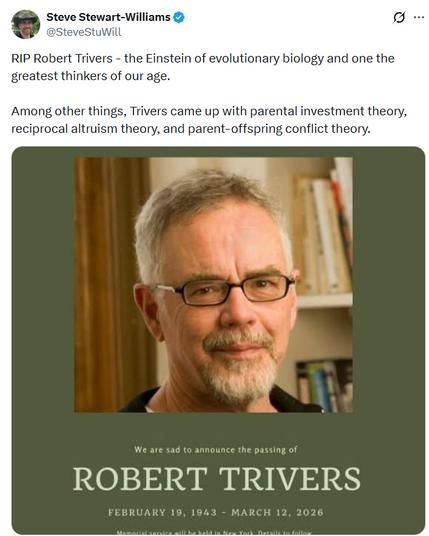
Steve Stewart-Williams announced… that Robert Trivers passed away.

Trivers was one of the most—perhaps the most—influential evolutionary biologists of the 20th century. His work should be much more widely known in social and behavioural sciences, in particular in economics, as Trivers’ intellectual approach is very much in line with a game theoretic understanding of social interactions.

It is hard to overstate the importance of his work. Einstein famously published four groundbreaking papers in 1905, a year often referred to as his “Annus mirabilis”, during which he revolutionised physics. Trivers might be said to have had a “Quinquennium Mirabile” for the five years between 1971 and 1976, during which he produced a series of ideas that revolutionised evolutionary biology…

[Page unpacks four of those contributions: Reciprocal Alturism, Parental Investment, Parental Offspring Conflict, and Self-Deception, each fascinating…]

… Trivers has been one of the most influential evolutionary biologists, and his papers are still worth reading today. His insights, published more than 50 years ago, are fascinating. They often align very well with economic theories of behaviour, and it is therefore regrettable that his ideas are not more well-known in economics, and in particular in behavioural economics.

A key feature of Trivers’ take across these contributions was to see that beneath the world of social interactions we observe, there are deep structures in terms of incentives that shape the game we play. Understanding these games and their structures helps us make sense of the seemingly endless complexity of human psychology and social dynamics. In several key contributions, Trivers helped lift the veil on the underlying logic of human behaviour…

From cooperation to conflict: the evolutionary grammar of social interactions: “The fascinating insights of Robert Trivers” from @lionelpage.bsky.social.

For more on Trivers and the controversies in his life (Epstein, but also the Black Panthers and a Rutgers set-to), all of which followed the burst of productivity described above, see here.

And for some thoughts on how one might reconcile appreciation for a scientist’s work with abhorence of his later sins, see “Ghosts of Science Past Still Haunt Us. We Can Put Them to Rest.

* Bertolt Brecht (through the mouth of Galileo, in The Life of Galileo)

###

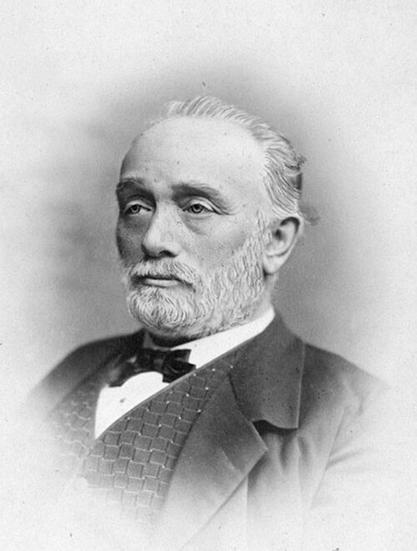
As we linger over legacies, we might send material birthday greetings to a man who helped lay the groundwork for the field to which Trivers contributed, Ludwig Büchner; he was born on this date in 1824. A philosopher, physiologist, and physician, he became one of the leading exponents of 19th-century scientific materialism. Büchner was an early champion of Darwin’s theory of evolution, endorsing it within a decade of its first issuance, then did much to spread it by citing and building on it in his own books.

As far as we know, Büchner’s life was free of the scandal and conflict that plagued Trivers. He taught at the University of Tübingen and published dozens of books and papers. Later in his life he founded he “German Freethinkers League” (“Deutsche Freidenkerbund”) and served as a member of the second chamber of the Landstände of the Grand Duchy of Hesse as a representative of the German Free-minded Party from 1884 to 1890. He was the younger brother of Georg Büchner, a famous revolutionary playwright, and Luise Büchner, a women’s rights advocate; and he was the uncle of Ernst Büchner, inventor of the Büchner flask.

source

#culture #Darwin #evolution #evolutionaryBiology #history #humanBehavior #LudwigBüchner #LudwigBuchner #Materialism #ParentalInvestment #ParentalOffspringConflict #Psychology #ReciprocalAlturism #RobertTrivers #Science #scientificMaterialism #SelfDeception #socialDynamics #sociobiology #theoryOfEvolution
Interested in #SocioBiology?

If this is your research area, there is currently a call for papers on "Socio-Ecological Frontiers of Herpetology".

It is focused on exploring the relationships between human societies and herpetofauna. Interdisciplinary contributions integrating ecological and social perspectives on conservation are especially welcome!

Submission deadline: 12 September 2026

Learn more: https://www.frontiersin.org/research-topics/78715/herpetological-socio-ecology-a-landscape-of-the-social-and-ecological-frontiers-of-herpetology

Frontiers | Herpetological Socio-Ecology: A Landscape of the Social and Ecological Frontiers of Herpetology

The conservation and study of herpetofauna are increasingly shaped by complex interactions with human societies: from climate change and habitat loss, to hum...

Frontiers

Can anyone falsify or prove scientific racism?

#science #sociobiology

This is amazing! "We" observed a #Cow using a Tool for multiple Purposes!

- Article: https://doi.org/10.1016/j.cub.2025.11.059
- Video(s):
- https://www.cell.com/cms/10.1016/j.cub.2025.11.059/asset/be3394f8-a4c7-429f-9aae-98e94e25acf6/main.assets/mmc4.mp4
- https://youtu.be/3rX1dx8HpL0

Veronica, the Cow, has adapted to use a Stick to itch and massage their Body selectively with the various Textures available on the Surface of the Stick.

#AnimalBehavior #ComparativePsychology #Psychology #AnimalFacts #Bovine #Bos_taurus #CognitiveEthology #Ethology #Cognition #Sociobiology #AnimalConsciousness #Ecology

#sociobiology

After almost 30 years, I have again laid hands on a copy of E. O. Wilson's "Sociobiology." It is a philosophy text with an amazingly dense smoke-screen. Chapter one opens,

"Camus said that the only serious philosophical question is suicide. That is wrong even in the strict sense intended. The biologist, who is concerned with questions of physiology and evolutionary history, realizes that self-knowledge is constrained and shaped by the emotional control centers in the hypothalamus and limbic system of the brain. These centers flood our consciousness with all the emotions— hate, love, guilt, fear, and others—that are consulted by ethical philosophers who wish to intuit the standards of good and evil."

Wilson was quite the scholar, but a lousy philosopher, and his book ushered in a lot of nonsense, about which much more to come.

Yes! Anti-This and That is necessary, right now.

Baddies are big and many.

But I'm Pro-Love and Caring. The need for Protection is now. Lots of Protectors

#Love is the Answer #CommunityLove #Protect #Protection

#SocioBiology is human, too.
https://mastodon.social/@tippitiwichet/114343841103799225

Cool October 2017 article with video from Scientific American about puma society. The stuff we learned in school about solitary cats was just bunk (once again).

https://www.scientificamerican.com/video/the-secret-social-live-of-a-solitary-puma/

#Biology #SocioBiology #Wildlife #WildlifePhotography

The Secret Social Life of a Solitary Puma

Hidden cameras caught these cats sharing prey with their neighbors, suggesting pumas have a more complex society than previously believed.

Scientific American

Evolutionary ethics (Evolution 🧬)

Evolutionary ethics is a field of inquiry that explores how evolutionary theory might bear on our understanding of ethics or morality. The range of issues investigated by evolutionary ethics is quite broad. Supporters of evolutionary ethics have argued that it has important implications in the fields of descri...

https://en.wikipedia.org/wiki/Evolutionary_ethics

#EvolutionaryEthics #Bioethics #Evolution #Sociobiology #DescriptiveEthics #EvolutionaryPsychology

Evolutionary ethics - Wikipedia

In 1922, Sewall Wright showed how to calculate a degree of relatedness between two individuals. #Poetry #Science #History #Sociobiology #Relatedness #Wright (https://sharpgiving.com/thebookofscience/items/p1922d.html)
1922: Coefficient of relationship - The book of science

In 1922, Sewall Wright showed how to calculate a degree of relatedness between two individuals.

" Edward O. Wilson dedicated his life to studying ants, gleaning broader insights into human behavior through the behaviors of these small but mighty insects.⁣⁣
⁣⁣
In 1975, he published a groundbreaking and controversial study, "Sociobiology: The New Synthesis." In the study, he examined the genetic basis for the evolution of ...⁣⁣

...
⁣⁣
In this portrait, Wilson sits at his desk in his office at the Harvard University’s Museum of Comparative Zoology.

https://www.facebook.com/smithsoniannpg/posts/pfbid02aa2pzUmqN9AnqvEdZG1ZC9eX2uzS9LMtu6ouQjAegVjepDxFu84dzQy3k61b7o7Yl

#Sociobiology

National Portrait Gallery USA

“Most children have a bug period. I never grew out of mine.” 🐜 Edward O. Wilson dedicated his life to studying ants, gleaning broader insights into human behavior through the behaviors of these small...