A quotation from Bertrand Russell

Differences between nations, so long as they do not lead to hostility, are by no means to be deplored. Living for a time in a foreign country makes us aware of merits in which our own country is deficient, and this is true whichever country our own may be. The same thing holds of differences between different regions within one country, and of the differing types produced by different professions. Uniformity of character and uniformity of culture are to be regretted. Biological evolution has depended upon inborn differences between individuals or tribes, and cultural evolution depends upon acquired differences. When these disappear, there is no longer any material for selection. In the modern world, there is a real danger of too great similarity between one region and another in cultural respects. One of the best ways of minimising this evil is an increase in the autonomy of different groups.

Bertrand Russell (1872-1970) English mathematician and philosopher
Lecture (1949-01-23), “Control and Initiative: Their Respective Spheres,” Reith Lecture, “Authority and the Individual” No. 5, BBC Radio

More about this quote: wist.info/russell-bertrand/840…

#quote #quotes #quotation #qotd #bertrandrussell #autonomy #culture #difference #diversity #evolution #nations #regions #similarity #uniformity #variety

Russell, Bertrand - Lecture (1949-01-23), "Control and Initiative: Their Respective Spheres," Reith Lecture, "Authority and the Individual" No. 5, BBC Radio | WIST Quotations

Differences between nations, so long as they do not lead to hostility, are by no means to be deplored. Living for a time in a foreign country makes us aware of merits in which our own country is deficient, and this is true whichever country our own may be. The…

WIST Quotations
Beyond Semantic Similarity: Rethinking Retrieval for Agentic Search via Direct Corpus Interaction

Modern retrieval systems, whether lexical or semantic, expose a corpus through a fixed similarity interface that compresses access into a single top-k retrieval step before reasoning. This abstraction is efficient, but for agentic search, it becomes a bottleneck: exact lexical constraints, sparse clue conjunctions, local context checks, and multi-step hypothesis refinement are difficult to implement by calling a conventional off-the-shelf retriever, and evidence filtered out early cannot be recovered by stronger downstream reasoning. Agentic tasks further exacerbate this limitation because they require agents to orchestrate multiple steps, including discovering intermediate entities, combining weak clues, and revising the plan after observing partial evidence. To tackle the limitation, we study direct corpus interaction (DCI), where an agent searches the raw corpus directly with general-purpose terminal tools (e.g., grep, file reads, shell commands, lightweight scripts), without any embedding model, vector index, or retrieval API. This approach requires no offline indexing and adapts naturally to evolving local corpora. Across IR benchmarks and end-to-end agentic search tasks, this simple setup substantially outperforms strong sparse, dense, and reranking baselines on several BRIGHT and BEIR datasets, and attains strong accuracy on BrowseComp-Plus and multi-hop QA without relying on any conventional semantic retriever. Our results indicate that as language agents become stronger, retrieval quality depends not only on reasoning ability but also on the resolution of the interface through which the model interacts with the corpus, with which DCI opens a broader interface-design space for agentic search.

arXiv.org

🚨 Our first scientifically proven #language #similarity metric - qWALS - has been published. Please, try it out in your research.

#langaugesimilarity #linguisticsimilarity #linguisticdistance #qwals #WALS #worldatlasoflanguagestructures #linguistics #NLProc #NLP

https://pypi.org/project/qwals/

Client Challenge

Reflection, or: Humanity

A Sijo

we lean in, studying ourselves hands pressed against the glass; and all see nearly the same reflection of humanity; what we carry as ours alone stares back from every mirror

Reena’s Xploration Challenge 425

For Reena’s RXC prompt, we are encouraged to compose poems inspired by the above image of a woman standing before a mirror, in which her reflection is reduced to an outline. Reena also offers us this caption for the visual image: ‘In the outline, she found silence.’

Sijo?

A Korean verse form related to haiku and tanka and comprised of three lines of 14-16 syllables each, for a total of 44-46 syllables. Each line contains a pause near the middle, similar to a caesura, though the break need not be metrical. The first half of the line contains six to nine syllables; the second half should contain no fewer than five. Originally intended as songs, sijo can treat romantic, metaphysical, or spiritual themes. Whatever the subject, the first line introduces an idea or story, the second supplies a “turn,” and the third provides closure. Modern sijo are sometimes printed in six lines.

Let’s write poetry together!

When it comes to partnership, some humans can make their lives alone – it’s possible. But creatively, it’s more like painting: you can’t just use the same colours in every painting. It’s just not an option. You can’t take the same photograph every time and live with art forms with no differences.

Ben Harper (b. 1969)

Would you like to create poetry with me and have a completed poem of yours featured here at the Skeptic’s Kaddish? I am very excited to have launched the ‘Poetry Partners’ initiative and am looking forward to meeting and creating with you… Check it out!

#Burdens #Existentialism #Humanism #Humanity #Mirror #Perspective #Poem #Poetry #Reflection #Sijo #Similarity

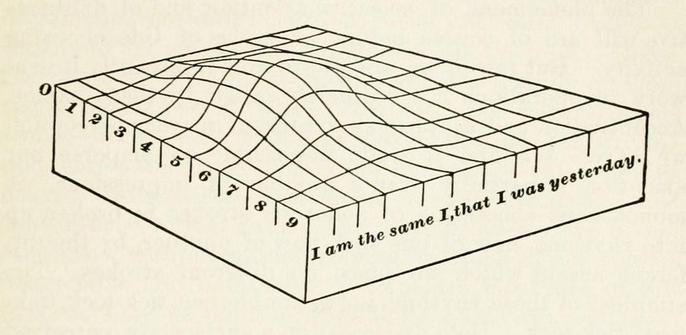
I am the same I, that I was yesterday (1890) by William James, from The Principles of Psychology.

Source: University of Toronto Libraries / Internet Archive

https://pdimagearchive.org/images/b0120127-5615-440d-a809-184c464edc52

#consciousness #wavy #modernism #psychology #three-dimensional #thought #similarity #art #publicdomain

GitStars

How does Shazam work? Music Recognition Algorithms, Fingerprinting, and Processing | Toptal®

The Shazam music recognition application made it finally possible to put a name to that song on the radio. But how does this magical miracle actually work? In this article, Toptal Freelance Software Engineer Jovan Jovanovic sheds light on the principles of audio signal processing, fingerprinting, and recognition,...

Toptal Engineering Blog

Here is a typical Russian milblogger channel. Note ”owning the libs” type naming.

Are you still surprised MAGA supports Russia?

I think they actually look up to Russia, honestly, and would love nothing more than the USA to become more like Russia.

Russian brashness and embracing being the bully excites them. Maybe even makes them jealous.

#russia #maga #admiration #similarity #bully #psychology