New research shows human‑aligned AI models like AligNet, built on Vision Transformers and SigLIP, outperform standard models on robustness tests with the THINGS and Levels datasets. Lukas Muttenthaler’s team demonstrates higher reliability across varied inputs—promising safer AI deployments. Dive into the findings! #AI #AligNet #VisionTransformers #SigLIP

🔗 https://aidailypost.com/news/human-aligned-ai-models-show-greater-robustness-reliability-study

CLIP или SigLIP. База по Computer vision собеседованиям. Middle/Senior

Вопросы о CLIP-моделях встречаются почти на каждом техническом собеседовании. Неважно, занимаетесь ли вы видеоаналитикой, создаёте генеративные модели или работаете над поиском по изображениям — CLIP и его потомки ( BLIP , SigLIP ) стали стандартом де-факто в задачах связи визуальных и текстовых данных. Почему? Потому что они позволяют решать задачи, которые ранее требовали значительных усилий

https://habr.com/ru/articles/908168/

#clip #SigLIP #компьютерное_зрение #computervision #ml #машинное+обучение #собеседование_вопросы #собеседование_в_it #comfyui

CLIP или SigLIP. База по Computer vision собеседованиям. Middle/Senior

Вопросы о CLIP-моделях встречаются почти на каждом техническом собеседовании. Неважно, занимаетесь ли вы видеоаналитикой, создаёте генеративные модели или работаете над поиском по изображениям — CLIP...

Хабр
⚡ Leverages #StableDiffusion and #SigLIP for high-fidelity visual conditioning
📊 Outperforms existing methods across multiple metrics (SSIM, FID, DISTS)
🔬 Research demonstrates superior detail preservation in patterns, logos, and textures

Edge-Ready #Vision Language Model Advances Visual #AI Processing 🌟

🧠 #OmniVision (968M params) sets new benchmark as world's smallest #VisionLanguageModel

🔄 Architecture combines #Qwen2 (0.5B) for text & #SigLIP (400M) for vision processing

💡 Key Innovations:
• 9x token reduction (729 → 81) for faster processing
• Enhanced accuracy through #DPO training
• Only 988MB RAM & 948MB storage required
• Outperforms #nanoLLAVA across multiple benchmarks

🎯 Use Cases:
• Image analysis & description
• Visual memory assistance
• Recipe generation from food images
• Technical documentation support

Try it now: https://huggingface.co/spaces/NexaAIDev/omnivlm-dpo-demo
Source: https://nexa.ai/blogs/omni-vision

Omnivlm Dpo Demo - a Hugging Face Space by NexaAIDev

Discover amazing ML apps made by the community

🔍 Major breakthrough in multimodal AI research:

#InfinityMM dataset launches with 43.4M entries across 4 categories: 10M image descriptions, 24.4M visual instructions, 6M high-quality instructions & 3M #AI generated data

🧠 Technical highlights:

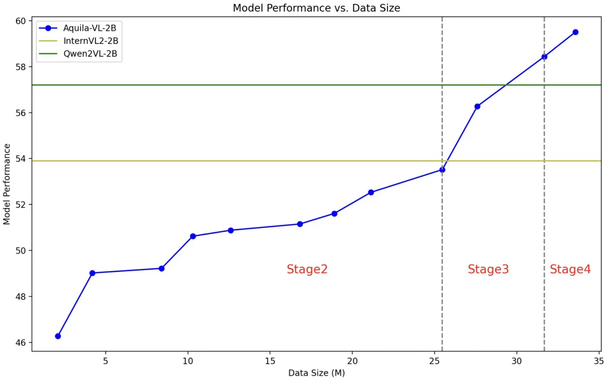
New #AquilaVL2B model uses #LLaVA architecture with #Qwen25 language model & #SigLIP for image processing
Despite only 2B parameters, achieves state-of-the-art results in multiple benchmarks
Exceptional performance: #MMStar (54.9%), #MathVista (59%), #MMBench (75.2%)

🚀 Training innovation:

4-stage training process with increasing complexity
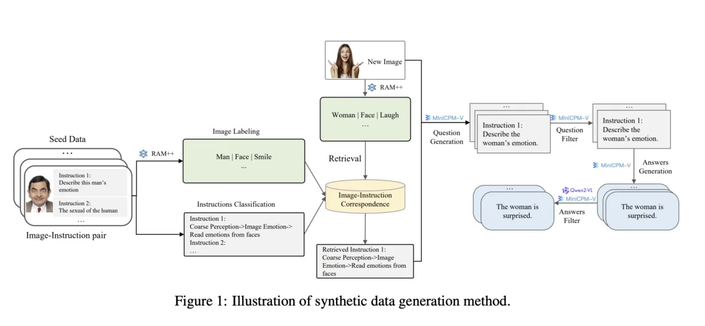
Combines image recognition, instruction classification & response generation
Uses #opensource models like RAM++ for data generation

💡 Industry impact:

Model trained on both #Nvidia A100 GPUs & Chinese chips
Complete dataset & model available to research community
Shows promising results compared to commercial systems like #GPT4V

https://arxiv.org/abs/2410.18558

Infinity-MM: Scaling Multimodal Performance with Large-Scale and High-Quality Instruction Data

Recently, Vision-Language Models (VLMs) have achieved remarkable progress in multimodal tasks, and multimodal instruction data serves as the foundation for enhancing VLM capabilities. Despite the availability of several open-source multimodal datasets, limitations in the scale and quality of open-source instruction data hinder the performance of VLMs trained on these datasets, leading to a significant gap compared to models trained on closed-source data. To address this challenge, we introduce Infinity-MM, a large-scale multimodal instruction dataset. We collected the available multimodal instruction datasets and performed unified preprocessing, resulting in a dataset with over 40 million samples that ensures diversity and accuracy. Furthermore, to enable large-scale expansion of instruction data and support the continuous acquisition of high-quality data, we propose a synthetic instruction generation method based on a tagging system and open-source VLMs. By establishing correspondences between different types of images and associated instruction types, this method can provide essential guidance during data synthesis. Leveraging this high-quality data, we have trained a 2-billion-parameter Vision-Language Model, Aquila-VL-2B, which achieves state-of-the-art (SOTA) performance among models of similar scale. The data is available at: https://huggingface.co/datasets/BAAI/Infinity-MM.

arXiv.org