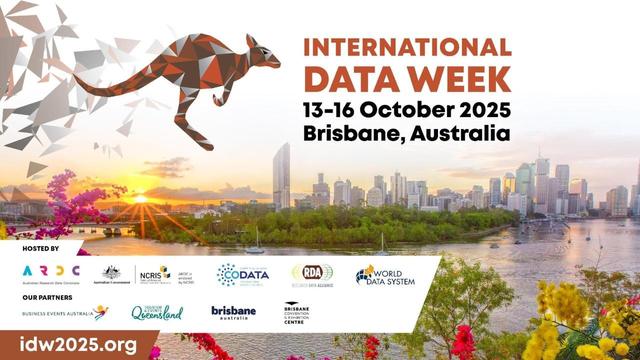
CODATA and the World Data System are pleased to announce the themes and launch of the Call for Sessions, Presentations, and Posters for the #SciDataCon component of International Data Week 2025. 🚀🚀

CODATA invites session proposals as well as abstracts for presentations and posters at International Data Week’s SciDataCon 2025: ‘Data for Positive Change’ taking place 13 – 16 October in Brisbane, Australia.

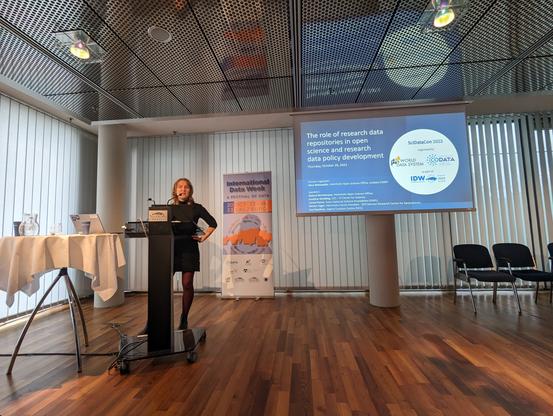
The recording of our #SciDataCon session on the role of #DataRepositories in the development of #OpenScience and #ResearchData policies has been published! 🎉

#IDW2023 #RDAplenary21

📽️ https://vimeo.com/user91439529/review/879786380/f323d40750

📑 Slides: https://doi.org/10.5281/zenodo.10047372

Thanks again to our speakers Roland Bertelmann @rbert (@HelmholtzOpenScienceOffice), Josefine Nordling (CSC – IT Center for Science), Lionel Perini (@snsf_ch), Kirsten Elger (Earth System Science Data Journal) and Joy Davidson (FAIR-IMPACT project)!

231026_549_The role of research data repositories in open science and research data policy development.mp4

Join the web’s most supportive community of creators and get high-quality tools for hosting, sharing, and streaming videos in gorgeous HD and 4K with no ads.

Vimeo

What is "coopetition" and how is it helping Dryad and other generalist data platforms stay at the forefront of best practices?

Learn more about the NIH #GREI coopetition initiative in this recap of our presentation at #SciDataCon #IDWeek2023

https://buff.ly/3sUMMw7

🤔 What role do #DataRepositories play in the development of #OpenScience and #ResearchData policy?

💡 See our answers from the #SciDataCon session at https://doi.org/10.5281/zenodo.10047372

The recording will be published on December 7. #IDW participants already find it at https://idw2023.events.whova.com/Agenda/3401599

#InternationalDataWeek #IDWeek2023

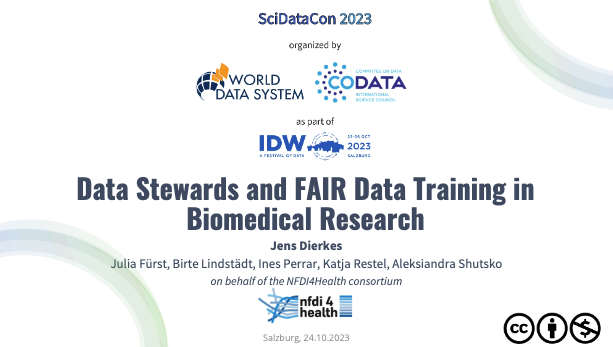
#NFDI4Health: #DataStewards and #FAIR Data Training in Biomedical Research. The slides of my presentation at #SciDataCon 2023 are now available via https://doi.org/10.5281/zenodo.10071712
Data Stewards and FAIR Data Training in Biomedical Research

AbstractThe questions in biomedicine are complex and involve a variety of tasks that can only be tackled in a team. Because the data structures and regulatory requirements involved are also complex, it is important to understand how to manage research data properly. This is where the field of tasks of data stewards has emerged. Although the concept of data stewards is not new, their importance is becoming increasingly visible and the characterisation of specific roles of participation in the research process is being refined. In Germany, the federal and state governments have been funding the development of a National Research Data Infrastructure (NFDI) since 2020. The NFDI is intended to set standards in data management and, as a digital, regionally distributed and networked knowledge repository, to secure research data in the long term and make it (re-)usable. The NFDI will also ensure connectivity to international developments such as the European Open Science Cloud (EOSC).  NFDI4Health, the National Research Data Infrastructure for Personal Health Data, aims to build a FAIR data infrastructure for epidemiological, clinical and public health research, focusing on prospectively collected data in trials and studies, while respecting privacy requirements [1]. Interaction with and feedback from user communities is essential to the service development process. A dedicated workstream within the first five years of NFDI4Health is exploring the role of data stewards (Data Steward Pilot) and providing FAIR data management training to users and multipliers of the infrastructure [2,3]. The Data Steward Pilot concept takes the perspective of a local interface of infrastructure services to researchers/users in an institution such as a university. Libraries can act as such an interface. Therefore, the pilot embedded two data stewards at two libraries (ZB MED Information Centre for Life Sciences and USB University and City Library Cologne), who help to develop the NFDI4Health services and at the same time support the main use cases of the consortium, i.e. epidemiological studies (ZB MED) and clinical trials (USB). The two data stewards are specifically involved in the development of publication guidelines and are committed to supporting users in making their study data FAIR. Direct feedback from this interaction can be used to iteratively improve the NFDI4Health services. The data stewards also develop and deliver research data management training to local researchers. These trainings range from introductory level to more advanced, NFDI4Health specific topics (e.g. distributed data analysis). The pilot project will produce a practical report with job profiles for data stewards in biomedicine, together with the training materials as open educational resources.  The results can be seen as a blueprint for other research institutions and can be reused by multipliers such as libraries or research data competence centres. In addition to the details of the concept, we will report on our experience in supporting research and providing training to user communities during the first two years of the pilot. We will put our experiences in the context of other data steward initiatives and look forward to the further development and dissemination of the concept. References [1] https://www.nfdi4health.de/en/ (12.05.2023) [2] Shutsko, Aliaksandra, and Birte Lindstädt. 'Nationale Forschungsdateninfrastruktur für personenbezogene Gesundheitsdaten – NFDI4Health: Pilotprojekt zu Bibliotheken und Forschungsdatenkompetenzzentren als Multiplikatoren ("Data Steward")'. GMS Medizin - Bibliothek - Information 20, no. 3 (22 December 2020): Doc27. https://doi.org/10.3205/mbi000484. [3] Helling, Patrick, Rau, Felix, Linne, Monika, Dierkes, Jens, Jetten, Mijke, Walek, Anna, and Szuflita-Żurawska, Magdalena. "The Importance of Demand and Environment for Defining and Establishing the Role of Data Stewards". Zenodo, May 2, 2022. https://doi.org/10.5281/zenodo.6511185. 
Zenodo

The #scidatacon #DataStew #DataSteward profiles poster is now available on Zenodo: https://doi.org/10.5281/zenodo.10040698
Was a great conference and I had many interesting discussions (old and new connections) and got a bunch new ideas.

@eta_kivilih @unibibkoeln @ZBMED

Qualified support through data stewardship: Institutional requirements driven approach through data steward profiles

Qualified support through data stewardship - a new approach to data steward profiles from GermanyThe concept of data stewardship as a support for researchers, but also as a field of research itself, is becoming increasingly important due to the overall growth in digital data volumes. Qualified employees are needed in (inter-)national data-infrastructure initiatives such as the European Open Science Cloud (EOSC) as well as the National Research Data Infrastructure (NFDI) in the German context as a national example. Also the requirements of research funders often prescribe professional data management. The demand for qualified personnel is high and will probably continue to grow.Although the term "data steward" is frequently and widely used, the tasks, roles or institutional embedding of data stewards remain ambiguous and are still not clearly defined.  In other European countries, studies e.g. in the Netherlands and Denmark have already identified somewhat congruent profiles of data stewards.  The poster presents results from a research project dealing with the German academic landscape with regard to Data Stewardship. On the one hand, the situation and needs analysis was carried out based on the relevant literature and job advertisements as well as qualitative interviews. Furthermore, the poster shows the results of focus group discussions held with different stakeholders to derive recommendations for action.The central finding the poster presents is that there is no universal way to implement data stewardship. Instead, the implementation of data stewardship is highly depending on the local conditions. The poster proposes a change of perspective, describing different models of data stewardship based on the capacities and needs of the institution. Specific teams of data stewards can be assembled in a modular system. Five data steward profiles are available for building data steward teams, based on six dimensions: (i) the size of the research institution, (ii) the institutional location, (iii) basic knowledge of research data management, (iv) the need for specialised knowledge, (v) the breadth of the range of tasks, and (vi) the need for  service orientation as opposed to scientific, research activities.  Based on different combinations of these criteria five profiles of data stewards are described, such as the data steward as a generalist at a service point in a small research institute with a broad range of tasks. As a counterpart to this, the scientific working data steward in a collaborative project with specific expertise who works closely with the researchers on a research question has emerged.Besides the proposal of a modular system of data steward profiles the poster claims a need for further research on the quantitative demand for the specific profiles. Based on this, suitable training capacities can be build aligned with the specific demand for data management experts. 

Zenodo

We are #HMC!

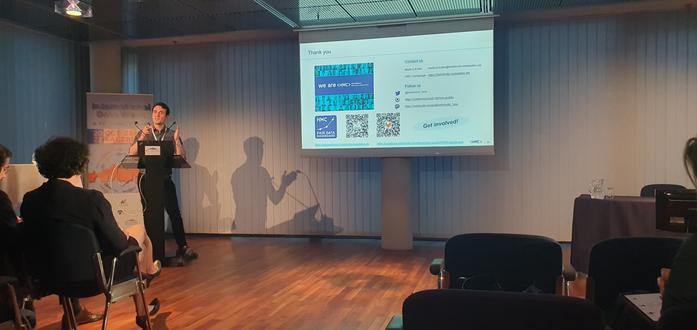
At #SciDataCon in Salzburg, Markus Kubin highlighted our approach to improve distributed #FAIRdata in a cross-disciplinary organization.

Contact us and visit https://helmholtz-metadaten.de/de/dashboards to learn more about #FAIR monitoring and assessment in the @helmholtz Association.

#InternationalDataWeek #IDWeek2023 #IDW2023 #RDAPlenary #Metadata

Session details: https://www.scidatacon.org/IDW-2023-Salzburg/sessions/571/paper/1197/

Do you want to discuss the role of #ResearchDataRepositories for #RDM policies and #OpenScience policies with us?

👉 Join tomorrow's #SciDataCon session, organized by the #re3dataCOREF project, at 11:30 CEST.

#IDWSalzburg2023 #IDWeek #InternationalDataWeek #RDAplenary21 #RDAplenary @re3data

https://www.scidatacon.org/IDW-2023-Salzburg/sessions/549/

SciDataCon

What a fun networking session at the #IDWeek2023 yesterday! 🍻

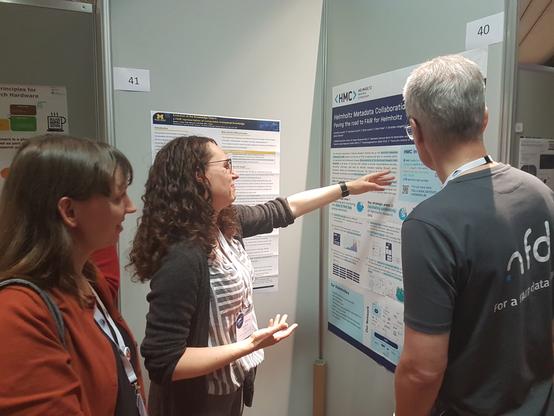
Constanze Curdt discussed with our poster visitors how the #HelmholtzMetadataCollaboration facilitates high-quality #metadata to support #FAIR research data management #RDM in @helmholtz

#InternationalDataWeek #RDAPlenary #SciDataCon

Hear from Helena Cousijn about DataCite's Global Access Program (#GAP) in the #RDAPlenary session "Equity and Inclusion: Universal Access to #PIDs" of the #PID IG tomorrow at 2:00pm (CEST) in the Mozart Hall 4+5 at the #IDWSalzburg2023.👇
https://www.rd-alliance.org/plenaries/international-data-week-2023-salzburg/equity-and-inclusion-universal-access-pids
#SciDataCon
Equity and Inclusion: universal access to PIDs

The meeting will be built around a series of presentations on global PID initiatives that focus on equity and accessibility, followed by a discussion on how best the RDA and specifically the PID IG

RDA