🧵 … so #Alphalabs #Defeedback does reduce feedback, it's certainly not a hoax.

Alphalabs offer a dedicated Windows 11 IOT PC that is optimized for De-Feedback for $699. The license for the plugin is $499. Without connectivity, which can be a simple Focusrite 2i2 interface (analog I/O), your console's USB port, if it has one, or something like the #RME #Digiface #Dante (~1300€). It also runs on #Waves #Livebox ($7000).

A #MacMiniM4 with Waves Superrack Performer would be around 700€, too.

So, approx 1200€ for one single local #AI solution that does its thing but no wonders, if you own the I/O already.

(2/x)

Testing #Alphalabs #DeFeedback for #EventTech. This is an #AI #microphone #feedback remover.

And as usual with AI, people say it does wonders. First impression: Also as usual with AI, it can do its thing, but no wonders.

This is not to be confused with generative AI running in data centers. This is more like traditional #MachineLearning. It runs entirely local, and my #Waves system based on a #MacMiniM1 can run 1 instance of it at 64 samples buffer size with a #Rme #Digiface #Dante. Which is 2 channels of de-feedback. The #plugin itself runs at zero latency.

This is all about gain before feedback: How far can you push the faders before feedback sets in?

While this is easy to measure with traditional tools like feedback destroyers, EQs, automixers, it is hard to say here. Because this tool reduces certain frequencies in a way that apparently depends on many things, not entirely on gain.

🧵 1/x

So while I was experiencing some issues with omni headset #microphone|s today, as usual in #eventtech in corporate events without soundcheck, a colleague used #alphalabs #defeedback on another stage of the event, apparently succesfully.

De-Feedback is an #AI-based #audioPlugin for Windows and macOS, and depending on whom you ask, it's a magic wand, or not that helpful.

It's $499, and you need a decent host to run on (they sell a $699 box with Windows IOT 11), or #Waves #Livebox ($7000), I myself have a MacMini M1 with a touch screen and an #Rme #DigifaceDante (~2000€) that could handle ~2 channels of it…

… But the difficult part is to convince the client that he should pay for that feature that nobody needed before. Because if you screw your sound with feedback-preventing EQing, it's still good enough for corporate events.

Same holds for Waves #xfdbk, a pretty decent clasic #Feedback destroyer.

I must say I am a little frustrated. I know how I could improve things, but it's not working out economically.

Warum in "Gottes Namen" unterstützt #RME #Linux nicht nativ? Interne Sound-Karten werden zu wirklich teuren Slotblenden. Echt schade.

🧵 … last round in the #microphone circus.

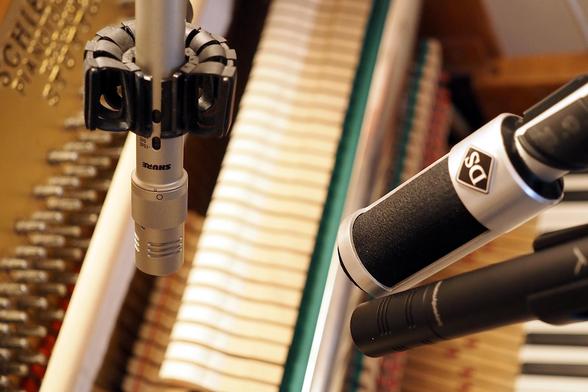
Testing the #dynamicMic|s #Beyerdynamic #M201 vs. #DieterSchoepfAudioservice #Addy2 on piano. There's also a #Shure #KSM141 involved, which permanently inhabits my piano together with it's twin, both in their omni setting.

The differences are not in quality, rather in style. The M201 sounds too fresh here, it exaggerates the mid highs. The KSM141 sounds the most honest, most like the piano unplugged. Yet, it is also a little boring. The Addy2 sits in the middle, with some presence being highlighted.

The dynamic mics M201 and Addy2 need gain settings close „to eleven“ on my #RME #OctaMic2 #preamp to work properly here. The #KlarkTeknik #CM1 cheap #CloudLifter clone lifts the M201 up to the moderate gain setting of the KSM141 condenser.

For a foreground pop piano solo, I'd probably use the M201 or Addy2, for background piano or pure piano I'd use the KSM141s, which I did here: https://nielsonaut.bandcamp.com/

#recording #eventTech #Veranstaltungstechnik

🧵 … and the winner is…

I just quickly hooked these up to some #RME #OctaMic2 and talked into them while listening via headphones.

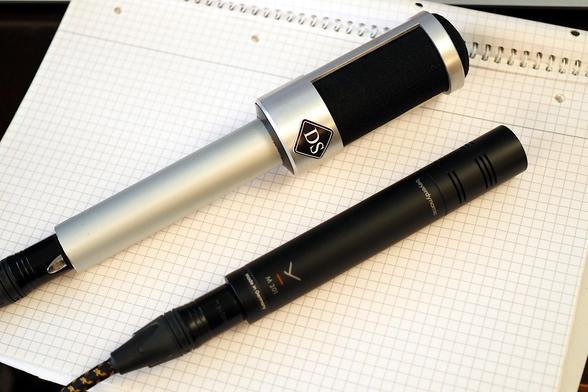
I'm not sure if I could tell the difference in an A/B blind test between the #Beyerdynamic #m201 and the #DSaudioservice #Addy2.

The Addy2 however has an integrated pop filter, while the M201 doesn't even come with a separate one.

Both mics are made in Germany. The Addy2 is handmade by #DieterSchoepf and more expensive. It provides a little higher output.

Off-axis rejection feels quite similar, and after all this is for me the most prominent reason to go for a #DynamicMic instead of a #CondenserMic: The stronger rejection of higher frequencies off-axis.

I need to check #recording some instruments flosting around here.

After this first quick test I'd say the Addy2 is more flexible because it is explicitely designed for vocals *and* instruments, while the M201 is instrument-only.

#EventTech #Veranstaltungstechnik #microphone #mikrofon #DieterSchoepfAudioservice

Strategi Manajer RS Menghadapi Dilema Mutu dan Biaya

Manajer rumah sakit di Indonesia menghadapi dilema kompleks karena akreditasi internasional dan tarif INA-CBG yang stagnan. Inflasi medis tinggi memperburuk tantangan, dengan tuntutan mutu yang semakin berat. Diperlukan strategi yang efektif untuk mengelola biaya dan mutu tanpa mengorbankan keselamatan pasien dalam konteks tekanan regulasi dan profesionalisme.

https://legawa.com/2026/05/29/strategi-manajer-rs-menghadapi-dilema-mutu-dan-biaya/

Updated the firmware of my #RME Digiface USB and also ticked the "CC Mode Active" box so that it's now a class compliant device. Ardour has no issues with it but PulseAudio on my Debian 12 system refuses to talk to it.

I kind of expected this as the USB ID stayed the same so the driver stack is still using the quirks introduced with the 6.12 kernel. That doesn't add up I guess. Probably best to flash the firmware again and untick the "CC Mode Active" box before flashing.

#RMEAudio #LinuxAudio

https://www.carlofelicemanara.it/public/file/File/Innovazione_Didattica/2012/Ripensando%20educazione%20matematica%20.pdf

Freudenthal :«Il valore che si attribuisce ai discenti come esseri umani determina il modo in cui ci si aspetta
che essi imparino la loro matematica: con libertà oppure da schiavi, guidati oppure imbrigliati».

“Nell'ambito della matematica, l'acquisizione di abilità e l'impiego di procedure e di algoritmi imposti e memorizzati, senza che siano compresi e motivati, rischia di diventare un addestramento analogo a quello degli animali da circo”.

#Freudenthal #RME

La Educazione Matematica Realista (RME), sviluppata da Hans Freudenthal, è un approccio didattico basato su

- Reinvenzione Guidata. Il docente guida gli studenti perché scoprano le procedure matematiche, anziché riceverle passivamente.

- Interattività. Gli studenti cooperano per trovare le soluzioni, l'esperienza del mondo reale è all'inizio del processo di apprendimento

Nei metodi tradizionali prima vengono le definizioni e poi le applicazioni.

#RME #Freudenthal #matematica #didattica