 AFOC
AFOC#ResearchTopic of the day: #noGIL #freethreaded design in π-thon 3.14
#ResearchTopic of the day: #VerifiablePresentations of #VerifiableCredentials.
I'm quite fond of these types of credentials & have been following their development for several years now. #CryptographicallySecure digital credentials are the future of privacy-preserving forms of trustworthy proof.
There are so many use cases for them - I'd love to see just about every company & organization start issuing them for any number of things. I want to start my VC collection!
 ICalzada
'Postpandemic Technopolitical Democracies'
#Call4Papers
#ResearchTopic #SpecialIssue
@[email protected]
#PoliticsOfTechnology
Deadline: 15Feb2023
https://www.frontiersin.org/research-topics/28882/postpandemic-technopolitical-democracies


Postpandemic Technopolitical Democracies
COVID-19 has hit citizens dramatically, not only creating a general risk-driven environment encompassing a wide array of economic vulnerabilities but also exposing them to pervasive digital risks, such as biosurveillance, misinformation, and e-democracy algorithmic threats. Over the course of the pandemic, a debate has emerged about the appropriate democratic and technopolitical response when governments use disease surveillance technologies to tackle the spread of COVID-19. The COVID-19 pandemic has inevitably raised the need to resiliently and technopolitically respond to democratic threats that hyper-connected and highly viralised societies produce. In order to shed light on this debate, this Research Topic introduces the term “Postpandemic Technopolitical Democracies” as a way to figure out emerging citizenship regimes, forms, and scales for developing democracy and citizen participation in hyper-connected and highly viralised postpandemic societies. Consequently, it welcomes contributions broadly stemming from political science, critical policy studies, public administration, political geography, social innovation, data science, digital economy, foundational economy, social sciences, and regional studies.Scholars have been focused so far on the bases of discontentment with democracy, related to economic neoliberal emphasis and the lack of participatory mechanisms to improve the democratic wellbeing in Western Societies. What has not been studied as much is: What is th...
#ResearchTopic
#CfP
Open for #Submissions 📢
#Postpandemic Technopolitical Democracies
🗓️15 January 2023 for manuscripts
👉https://www.frontiersin.org/research-topics/28882/postpandemic-technopolitical-democracies
#geography #digitalgeography #politicalgeography #politicalscience #COVID #technopolitics #democracy #datasovereignty #digitalrights #datacooperatives #biosurveillance #smartcities #CriticalDataStudies #misinformation #cybercontrol
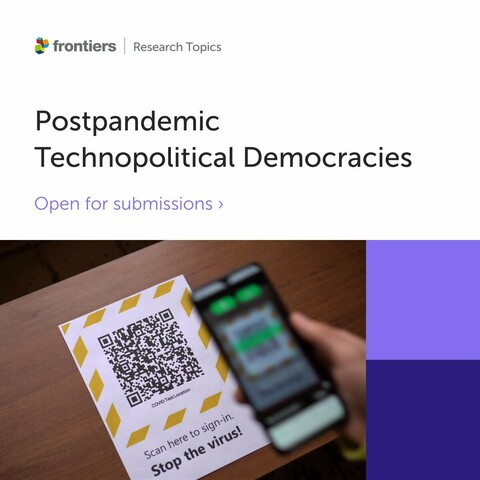
Postpandemic Technopolitical Democracies
COVID-19 has hit citizens dramatically, not only creating a general risk-driven environment encompassing a wide array of economic vulnerabilities but also exposing them to pervasive digital risks, such as biosurveillance, misinformation, and e-democracy algorithmic threats. Over the course of the pandemic, a debate has emerged about the appropriate democratic and technopolitical response when governments use disease surveillance technologies to tackle the spread of COVID-19. The COVID-19 pandemic has inevitably raised the need to resiliently and technopolitically respond to democratic threats that hyper-connected and highly viralised societies produce. In order to shed light on this debate, this Research Topic introduces the term “Postpandemic Technopolitical Democracies” as a way to figure out emerging citizenship regimes, forms, and scales for developing democracy and citizen participation in hyper-connected and highly viralised postpandemic societies. Consequently, it welcomes contributions broadly stemming from political science, critical policy studies, public administration, political geography, social innovation, data science, digital economy, foundational economy, social sciences, and regional studies.Scholars have been focused so far on the bases of discontentment with democracy, related to economic neoliberal emphasis and the lack of participatory mechanisms to improve the democratic wellbeing in Western Societies. What has not been studied as much is: What is th...