Coring the Onion: OSR structuralism and non-OSR games

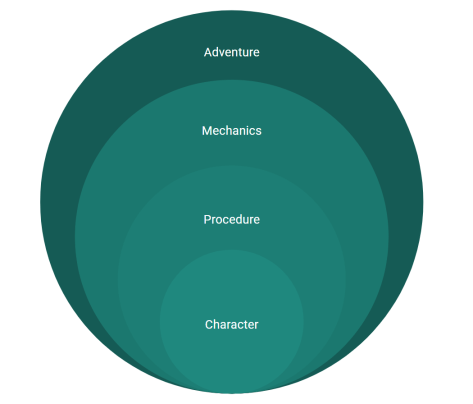
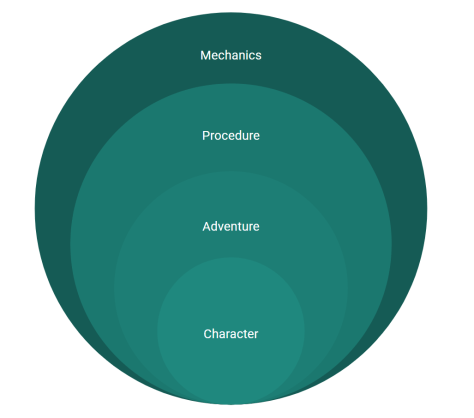
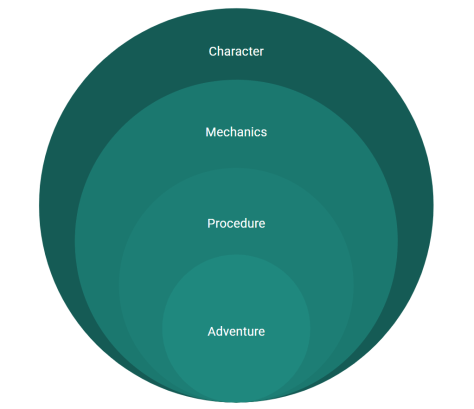
The RPG theory ship sails on unbidden, even as RPG networks of practice seem to be drifting apart. In November, there was a great post over on The Dododecahedron which bucked the trend and pulled theory work from outside of the author’s primary discipline, the OSR. Starting from a description written by Vincent Baker about the PbtA ‘conversation’, Dododecahedron author Rowan describes OSR play as an onion with four concentric layers: Character on the outside, then working inward to Mechanics, Procedures, and finally Adventure. Adventure is in the middle as the diegetic ‘fiction’ that the players are engaging with is the source of truth for OSR play. From there are Procedures, which describe the rules for how to go about play; that is to say, what travel looks like, or when random encounters occur, or how to track consumables. The next layer out is Mechanics, which describe the “rules” as most RPGs understand them; this is where initiative, ability checks, and all those specific bits live. Finally on the outside is Character, where elements like attributes, experience points, and skill ratings, all the things that make characters unique, sit. […]

https://cannibalhalflinggaming.com/2025/12/10/coring-the-onion-osr-structuralism-and-non-osr-games/

The Accidental “Lie” in RPGs

What if a friend of yours never found roleplaying games not because they didn't like them, but because they had been misrepresented to them?

https://castingshadowsblog.com/2025/05/31/the-accidental-lie-in-rpgs/

On Mending the Rift in RPG Culture

I've been a roleplayer for 41 years to date. That's a very long time to maintain a hobby as a primary focus of my leisure and sometimes my working time, right? Four decades is a very long time, especially for a hobby as time and resource consuming as this one can be. I think that speaks to its importance to me and its ability to fulfill me in ways that other hobbies have not been able to. To say, that if I had been introduced to the hobby in the way it is conceived of now, I would have drifted away from it very quickly, is telling. How many others have already left, or opted not try?

https://castingshadowsblog.com/2025/04/14/on-mending-the-rift-in-rpg-culture/

What actually happens when your group switches games?

It’s known that table dynamics affect play as much as (and some argue more than) what game you’re sitting down to play. And although both game and player are important, player aims often get talked about less or even disparaged through ‘taxonomies’ which typically valorize the playstyle of the author instead of providing objective analysis. Games are simply easier to discuss and critique; even movements which seemingly downplay the primacy of mechanics end up spending a lot of time discussing written material in the form of modules and settings which rarely if ever lead to the best gaming experience (because of, once again, player dynamics). I started puzzling over this a few weeks ago, and wanted to return to the discussion at hand because I think it’s an important part of figuring out what you actually want to play. Needless to say, the ‘what’ in this sentence must necessarily be broader than what book you aim to pick up and puzzle through, but that’s always been the case: Even within a single game, editions, supplements, and pre-written material would always enter consideration before a single person sat down at the table. And, of course, the play outcome is still wholly dependent on the group even after the material choices are made. […]

https://cannibalhalflinggaming.com/2025/03/13/what-actually-happens-when-your-group-switches-games/

What actually happens when your group switches games?

It’s known that table dynamics affect play as much as (and some argue more than) what game you’re sitting down to play. And although both game and player are important, player aims often get talked…

Cannibal Halfling Gaming

Diegesis, Mimesis, and You

The term ‘diegesis’ (and derived adjectives ‘diegetic’ and ‘non-diegetic’) comes from film criticism, but has been used recently in RPG critique. In essence, diegesis defines the narrated world relative to the viewer (or in our case, the player). This is somewhat of a heady, academic definition, so let me give an example. In a movie, the soundtrack is typically non-diegetic. That means that the music playing that the audience hears does not interact with the narrative, with what’s going on on the screen. In some cases, though, the soundtrack is diegetic, meaning that the events of the narrative do interact with the music. The perfect example of that would be musicals: The soundtrack you hear is in fact the characters breaking into song, that is part of the narrative and the world. And just like musicals, roleplaying games are creating assumptions about their worlds that do not align with the real world. You are never going to suddenly hear a musical cue and break into song while waiting for a bus; similarly you will never find yourself suddenly able to rebuild an engine or speak Mandarin because you were able to invest ‘skill points’. These aren’t bad things: both dramatic works and games are designed in service to their goals as art and entertainment, not to be ‘realistic’ or ‘grounded’. On the other hand, there is a vast world of critical opinion around how much the conceits of both films and games live in either diegesis or exegesis (the realms of the narrative and the audience, respectively); calling musicals divisive would be putting it mildly, and the same can be said about RPG mechanics which treat the characters more like narrative game tokens than extensions of the player. […]

https://cannibalhalflinggaming.com/2025/01/29/diegesis-mimesis-and-you/

Diegesis, Mimesis, and You

The term ‘diegesis’ (and derived adjectives ‘diegetic’ and ‘non-diegetic’) comes from film criticism, but has been used recently in RPG critique. In essence, diegesis defines the narrated world rel…

Cannibal Halfling Gaming

Sam Sorensen writes the "New Simulationism" manifesto: 10 concrete points to define & guide simulationist roleplaying games.

Worth reading and taking notes even if you don't usually run simulationist games.

#TTRPG #RPGtheory

https://samsorensen.blot.im/new-simulationism

New Simulationism - Sam Sorensen

A manifesto. In everything you do, ensure that the fictional world is first. If, at any point, any aspect of the game begins to clash with the

Ran into a bit of "what is PbtA really" conversation elsewhere, probably kicked off by current Critical Role-related events? Anyhow here's a picture.

#RPGTheory #rpg #ttrpg

I wrote a new #TTRPG #RPGTheory post for my substack: A Roleplaying Game Is Not a Conversation

https://ttrpgteleology.substack.com/p/a-roleplaying-game-is-not-a-conversation?sd=pf

A Roleplaying Game is Not a Conversation

An RPG is a game of the imagination

TTRPG Teleology

#RPGTheory #RPG #TTRPG

"Combat systems" in ttrpgs!

One way to model combat in rpgs is as fight choreography: we, the players, work together as collaborators to make the fight dynamic and engaging.

Another way is as a minigame you can win and lose: a resource management game, a gambling game, a game of tactical daring, chicken, rock-paper-scissors, whatever.

A third way is to model some aspect of real-world violence, to comment on it or to bring it to bear on the game's play.

I've been working on an alternate model for analyzing roleplaying to the Big Model--here it is!

It incorporates some of Luhmann's work on interlocking but operationally closed systems and looks a bit closer at the process by which the Shared Imagined Space gets created. I'm also just in general leaning hard towards description and away from prescription.

#ttrpg #rpgtheory

https://baatag.blogspot.com/2023/05/rpg-as-system-taking-my-shot-at-ron.html

RPG As System -- Taking My Shot At Ron Edwards

I’ve been getting more into System Theory lately, and Luhmann’s takes on social systems more specifically, and it’s inspired me to take a sh...