Quantum device slows chemical process by 100 billion
Potential use in material science, drugs, solar energy harvesting
https://www.sydney.edu.au/news-opinion/news/2023/08/29/conical-intersection-simulation-slowed-by-quantum-computer-100-billion-times.html
Discussion: https://news.ycombinator.com/item?id=37376998

* electronic states of molecules
* rapid, efficient relaxation during chemical dynamics
* nature: femtoseconds; model: milliseconds

Direct observation of geometric-phase interference in dynamics around a conical intersection
https://www.nature.com/articles/s41557-023-01300-3

#MaterialsScience #QuantumDevice #chemistry #physics #biophysics
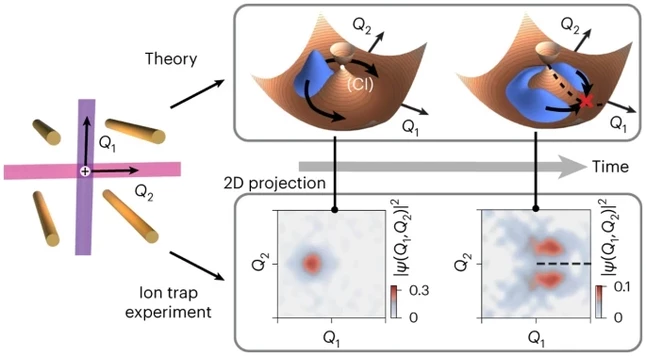
Scientists use quantum device to slow chemical process down by 100 billion times

In a world-first experimental result, scientists at the University of Sydney have used a quantum computer to coax an atom to behave the same way as a photo-chemical process that underpins the speed of human vision and solar energy harvesting - only at speeds 100 billion times slower than in nature.
The University of Sydney

#qibo I'm a fan.

On Thursday I talked to Stefano Carazza who is pushing forward the vision to have a #FOSS full stack #quantumComputing package.

The package is called Qibo and it's freely available. As in free software.

We talked about about how at a certain stage adoption will become relevant, for now releasing #QiboCal and #QiboLab is the focus.

I say relevant, because it's not going to be an issue, a challange at most. Why, there's a ton of new setups emerging and experimentalists prefer to run everything from a single jupyter notebook and have control over what is happening in their lab rather than be restricted.

A researcher is not building abinitio a #quantumDevice to be limited by #IP or some nonsense that our societal system tends to generate.

Qualitatively new ideas are continuously surfacing and to seamlessly make academic progress we need #FOSS and integrate our efforts. Private interests should not limit what researchers are doing; vide our flawed publication system.

We need 2 things:
- theorists publishing their protocols with code integrated into Qibo as e.g. a calibration, optimization or circuit routine.
- experimentalists setting up Qibo drivers.
Qibo is a bridge between theory and experiments that is going to stand on the FOSS principle. A principle that will allow us to make more progress than without it.

#superconducting qubits, #RydbergAtoms, #trappedIons, #integratedPhotonics have similar requirements and Qibo is going to make them buzz πŸ˜ŠπŸ˜„

If that sounds similar to what you think is already doing that then no. The FOSS feature needs to be present otherwise you're making a managerial design error that will show up down the line.

https://github.com/qiboteam/qibo

GitHub - qiboteam/qibo: A framework for quantum computing

A framework for quantum computing. Contribute to qiboteam/qibo development by creating an account on GitHub.

GitHub

On Tuesday at #IQOQI Tobias Olsacher explained to me how to verify #HamiltonianSimulation. The paper https://arxiv.org/abs/2203.15846 is full of tricks and ideas, going towards a tutorial reviewing what you can do if you have access to decent measurements and enough coherence to make the characterization of a #QuantumDevice challenging.

The Hamiltonian learning involving an energy constraint is extremely #neat πŸ’― as an idea but apparently is sensitive to non-unitarity. A generalization is possible to do without an exact energy constraint and learn a parametrized Liouvillian but haih do we always need to need so many measurements? #quantum πŸ₯²

Characterization and Verification of Trotterized Digital Quantum Simulation via Hamiltonian and Liouvillian Learning

The goal of digital quantum simulation is to approximate the dynamics of a given target Hamiltonian via a sequence of quantum gates, a procedure known as Trotterization. The quality of this approximation can be controlled by the so called Trotter step, that governs the number of required quantum gates per unit simulation time. The stroboscopic dynamics generated by Trotterization is effectively described by a time-independent Hamiltonian, referred to as the Floquet Hamiltonian. In this work, we propose Floquet Hamiltonian learning to reconstruct the experimentally realized Floquet Hamiltonian order-by-order in the Trotter step. This procedure is efficient, i.e., it requires a number of measurements that scales polynomially in the system size, and can be readily implemented in state-of-the-art experiments. With numerical examples, we propose several applications of our method in the context of verification of quantum devices: from the characterization of the distinct sources of errors in digital quantum simulators to determining the optimal operating regime of the device. We show that our protocol provides the basis for feedback-loop design and calibration of new types of quantum gates. Furthermore it can be extended to the case of non-unitary dynamics and used to learn Floquet Liouvillians, thereby offering a way of characterizing the dissipative processes present in NISQ quantum devices.

arXiv.org