EP 338: The Jellyfish and The Monkey (Ozaki)
Listen Here
Watch Here
The Jellyfish and The Monkey
Long, long ago, in old Japan, the Kingdom of the Sea was governed by a wonderful King. He was called Rin Jin, or the Dragon King of the Sea. His power was immense, for he was the ruler of all sea creatures both great and small, and in his keeping were the Jewels of the Ebb and Flow of the Tide. The Ebbing Tide jewel caused the sea to recede from the land, and the Flowing Tide Jewel made the waves to rise mountains high and to flow in upon the shore like a tidal wave.
The Palace of Rin Jin was at the bottom of the sea, and was so beautiful that no one has ever seen anything like it even in dreams. The walls were of coral, the roof of jade, and the floors were of the finest mother-of-pearl. But the Dragon King, in spite of his wide-spreading Kingdom, his beautiful Palace and all its wonders, was not at all happy, for he reigned alone. At last he thought that if he married he would not only be happier, but also more powerful. So he decided to take a wife. Calling all his fish together, he chose several of them to go through the sea and look for a young Dragon Princess.
At last they returned to the Palace with a lovely young dragon. Her scales were of shiny green like the wings of summer beetles, her eyes shone like fire, and she wore gorgeous robes.
The King fell in love with her at once, and the wedding ceremony was celebrated. Every living thing in the sea, from the great whales down to the little shrimps, came in shoals to offer their congratulations to the bride and groom.
Now for a time the Dragon King and his bride lived very happily. They loved each other dearly, and the bridegroom took delight in showing his bride all the wonders and treasures of his coral palace, and she was never tired of wandering through its vast halls and gardens. Life seemed like a long summer’s day.
Two months passed in this way, and then the Dragon Queen fell ill and was forced to stay in bed. The King was troubled when he saw his bride so ill, and at once sent for the fish doctor to come and give her some medicine. He gave special orders to the servants to nurse her carefully and to wait upon her with diligence, but in spite of all the nurses’ care and the medicine that the doctor prescribed, the Queen showed no signs of recovery, but grew worse.
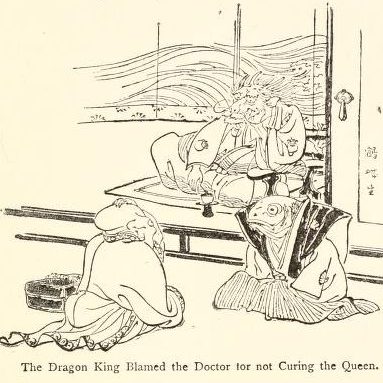
Then the Dragon King interviewed the doctor and blamed him for not curing the Queen. The doctor was scared of the king’s wrath and said that the medicine she needed was not found in the ocean.
“Do you mean to tell me that you can’t get the medicine here?” asked the Dragon King.
“That’s what I said!” said the doctor.
“What do you want for the Queen?” demanded Rin Jin.
“I want the liver of a live monkey!” answered the doctor.
“The liver of a live monkey! Of course that will be most difficult to get,” said the King.
“If we could get that for the Queen, Her Majesty would recover,” said the doctor.
“Very well, that decides it; we MUST get it somehow or other. But where can we find a monkey?” asked the King.
Then the doctor told the King that somewhere in the south there was a Monkey Island where a great many monkeys lived.
“If only you could capture one of these monkeys?” said the doctor.
“How can any of my people capture a monkey?” said the Dragon King, greatly puzzled. “The monkeys live on dry land, while we live in the water! I don’t see what we can do!”
“I had the same problem,” said the doctor. “But one of your servants surely can go on shore for that!”
“Something must be done,” said the King, and calling his chief steward he asked his advice.
The chief steward thought for some time, and then said joyfully:
“I know what we must do! There is the jelly fish. He is certainly ugly to look at, but he is proud of being able to walk on land with his legs like a tortoise. Lets send him to the Island of Monkeys to catch one.”
The jelly fish was then summoned to the King’s presence, and was told to catch a monkey for its liver.
The jelly fish looked very troubled, and said that he had never been to the island, and he was worried that he won’t be able to catch a monkey.
The chief steward said, “Well if you depend on your strength you will never catch a monkey. The only way is to trick one!”
“How can I trick a monkey? I don’t know how,” said the perplexed jelly fish.
“Here’s what you do,” said the chief steward. “When you approach the Island and meet some of them, you must befriend one. Tell him that you are a servant of the Dragon King, and invite him to come and visit you and see the Dragon King’s Palace. Try and describe to him the grandeur of the Palace so as to arouse his curiosity and make him long to see it!”
“But how can I get the monkey here? You know monkeys can’t swim?” said the reluctant jelly fish.
“You must carry him on your back. What is the use of your shell if you can’t do that!” said the chief steward.
“Won’t he be very heavy?” asked Jellyfish again.
“Don’t worry, you work for the Dragon King,” replied the chief steward.
“I will do my best,” said the jelly fish, and he swam away from the Palace and started off towards Monkey Island. Swimming swiftly he reached his destination in a few hours, and landed on the shore. Looking around he saw a big pine tree and on one of the branches was just what he was looking for—a live monkey.
“I’m in luck!” thought the jelly fish. “Now I must flatter the creature and try to get him to come back with me to the Palace, and my part will be done!”
So the jelly fish slowly walked towards the pine tree. In those days the jelly fish had four legs and a hard shell like a tortoise. When he got to the pine tree he said:
“How do you do, Mr. Monkey? Isn’t it a lovely day?”
“A very fine day,” answered the monkey from the tree. “I have never seen you in this part of the world before. Where have you come from and what is your name?”
“My name is Jellyfish. I am one of the servants of the Dragon King. I have heard so much of your beautiful island that I have come to see it,” answered the jellyfish.
“I am very glad to see you,” said the monkey.
“By the by,” said the jelly fish, “have you ever seen the Palace of the Dragon King?”
“I have often heard of it, but I have never seen it!” answered the monkey.
“Then you have to come. The beauty of the Palace is beyond all description” said the jellyfish.
“Is that so?” asked the monkey in astonishment.
The jellyfish saw his chance, and went on describing the beauty of the Sea King’s Palace. The monkey grew more and more interested, and as he listened he climbed down the tree slowly to hear every detail.
“I have got him at last!” thought the jellyfish, but he said:
“Mr. Monkey. I must now go back. Since you’ve never seen the Palace of the Dragon King, won’t you take this opportunity to come with me? I will be able to act as guide and show you all the sights of the sea, which will be even more wonderful to you—a land-lubber.”
“I would love to go,” said the monkey, “but how am I to cross the water! I can’t swim, as you surely know!”
“There is no difficulty about that. I can carry you on my back.”
“That will be too much trouble for you,” said the monkey.
“It’s easy. I am stronger than I look, so don’t worry,” said the jelly fish, and taking the monkey on his back he stepped into the sea.
“Keep very still, Mr. Monkey,” said the jellyfish. “You mustn’t fall into the sea; I am responsible for your safe arrival at the King’s Palace.”
“Please don’t go so fast, or I will fall off,” said the monkey.
So they went along, the jelly fish skimming through the waves with the monkey sitting on his back. When they were about half-way, the jelly fish, who knew very little of anatomy, began to wonder if the monkey had his liver with him or not!
“Mr. Monkey, tell me, do you have a liver with you?”
The monkey was very much surprised at this queer question, and asked what the jellyfish wanted with a liver.
“That is the most important thing of all,” said the stupid jelly fish, “so as soon as I recollected it, I asked you if you had yours with you?”
“Why is my liver so important to you?” asked the monkey.
“Oh! you will learn the reason later,” said the jellyfish.
The monkey grew more and more suspicious, and urged the jellyfish to tell him why his liver was wanted. Then the jellyfish, seeing how anxious the monkey looked, was sorry for him, and told him everything. How the Dragon Queen had fallen ill, and how the doctor had said that only the liver of a live monkey would cure her, and how the Dragon King had sent him to find one.
“Now I have done as I was told, and as soon as we arrive at the Palace the doctor will want your liver, so I feel sorry for you!” said the silly jellyfish.
The poor monkey was horrified when he learnt all this, and very angry at the trick played upon him. He trembled with fear at the thought of what was in store for him.
But the monkey was a clever animal, and he thought it the wisest plan not to show any sign of the fear he felt, so he tried to calm himself and to think of some way by which he might escape.
“The doctor means to cut me open and then take my liver out! Why, I shall die!” thought the monkey. At last a bright thought struck him, so he said quite cheerfully to the jelly fish:
“What a pity it was, Mr. Jelly Fish, that you did not speak of this before we left the island!”
“If I had told you why I wanted you to accompany me, you would certainly have refused to come,” answered the jelly fish.
“You are quite mistaken,” said the monkey. “Monkeys can very well spare a liver or two, especially when it is wanted for the Dragon Queen. If I had only guessed what you were in need of. I should have presented you with one without waiting to be asked. I have several livers. But the greatest pity is, that as you did not speak in time, I have left all my livers hanging on the pine tree.”
“You left your liver behind?” asked the jelly fish.
“Yes,” said the cunning monkey, “during the daytime I usually leave my liver hanging up on the branch of a tree, because it gets in my way when I am swinging from tree to tree. Today, listening to your interesting conversation, I forgot it, and left it behind when I came with you. If only you had spoken in time I could have remembered it, and could have brought it along with me!”
The jellyfish was very disappointed when he heard this, for he believed every word the monkey said. The monkey was no good without a liver. Finally the jelly fish stopped and told the monkey so.
“Well,” said the monkey, “we can fix that. I am really sorry about your trouble; but if you will take me back to the place where you found me, I will be able to get my liver.”
The jellyfish did not at all like the idea of going all the way back to the island again; but the monkey assured him that if he would be so kind as to take him back he would get his very best liver, and bring it with him the next time. So persuaded, the jelly fish turned towards Monkey Island once more.
No sooner had the jelly fish reached the shore than the sly monkey landed, and climbing up into the pine tree where the jelly fish had first seen him, and looking down at the jellyfish he said:
“So many thanks for all of your troubles! Please give my compliments to the Dragon King on your return!”
The jellyfish was confused by this speech and the mocking tone in which it was uttered. Then he asked the monkey if it wasn’t his intention to come with him after getting his liver.
The monkey replied laughingly that he couldn’t afford to lose his liver: it was too precious.
“But remember your promise!” pleaded the jellyfish, now very discouraged.
“That promise was false, and anyhow it is broken!” answered the monkey. Then he began to jeer at the jelly fish and told him that he had been deceiving him the whole time; that he had no wish to lose his life. Which he certainly would have done had he gone to the Sea King’s Palace, instead of persuading the jelly fish to return under false pretenses.
“Of course, I won’t GIVE you my liver, but come and get it if you can!” added the monkey mockingly from the tree.
There was nothing for the jelly fish to do now but to repent his stupidity, and to return to the Dragon King of the Sea and to confess his failure, so he started slowly to swim back. The last thing he heard as he swam away was the monkey laughing at him.
Meanwhile the Dragon King, the doctor, the chief steward, and all the servants were waiting impatiently for the return of the jelly fish. When they caught sight of him approaching the Palace, they hailed him with delight. They began to thank him profusely for all the trouble he had taken in going to Monkey Island, and then they asked him where the monkey was.
Now the day of reckoning had come for the jellyfish. He quaked all over as he told his story. How he had brought the monkey halfway over the sea, and then had stupidly told the monkey his mission; how the monkey had deceived him by making him believe that he had left his liver behind him.
The Dragon King’s wrath was great, and he at once gave orders that the jelly fish was to be severely punished. The punishment was a horrible one. All the bones were to be drawn out from his living body, and he was to be beaten with sticks.
The poor jelly fish, humiliated and horrified beyond all words, cried out for pardon. But the Dragon King’s order had to be obeyed. The servants of the Palace each brought out a stick and surrounded the jelly fish, and after pulling out his bones they beat him to a flat pulp, and then took him out beyond the Palace gates and threw him into the water. Here he was left to suffer and repent his foolish chattering, and to grow accustomed to his new state of bonelessness.
From this story it is evident that in the old times the jellyfish once had a shell and bones, but, ever since the Dragon King’s order was carried out on their ancestor, his descendants have all been soft and boneless just as you see them today thrown up by the waves high upon the shores of Japan.
The End
Source: The Japanese fairy book by Ozaki, Yei Theodora
Edited by Dustin Steichmann 2026
#Dragon #folktale #monkey #Palace #podcast #PourquoiStory #ProjectGutenberg #publicDomain #Trickster NaraMoore ⛩️👻八尺様👻⛩️ at Fedi
 Sandman Stories Presents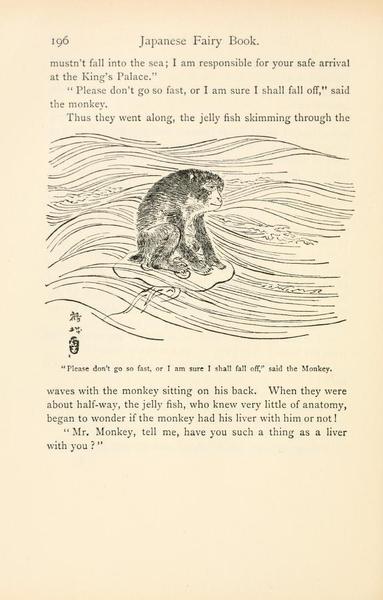
 HackerNoon
 LotharMucki 🦄
 N-gated Hacker News
 Hacker News
 Quasit