I read up on Presbyopia https://en.wikipedia.org/wiki/Presbyopia , difficulty with focusing with age. I am nearing forty and noticing more difficulty focusing on close up objects.

But now I understand why it might be difficult for older people to deal with low-light situations. In these conditions, the pupils widen to capture more light, but this shortens the depth of field putting more pressure on the eyes to get the focus just right. Older eyes are less able to adjust focus so things will be blurry.

#presbyopia
#farsightedness

Presbyopia - Wikipedia

The Eye Drops That Could Make Reading Glasses a Part-Time Job

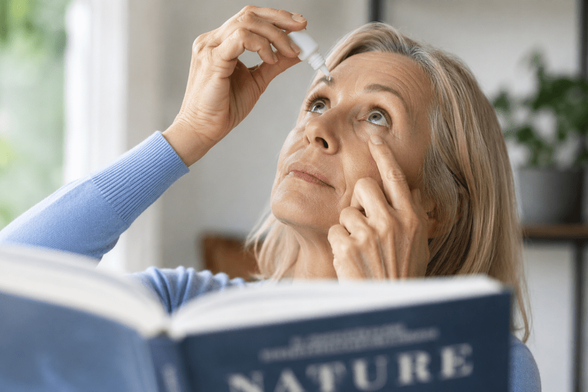
Eye drops designed to improve near vision offer a non-surgical option for presbyopia (Photo credit: generic stock image)

ar Cherubs, if you’ve recently found yourself holding menus at arm’s length like you’re negotiating a peace treaty, welcome to presbyopia. The good news? Science may have just handed you a tiny bottle of rebellion.

Let’s start with the basics. Presbyopia is the slow, inevitable stiffening of the eye’s lens that tends to show up around age 40. According to the American Academy of Ophthalmology, it affects billions globally. Translation: if it hasn’t hit you yet, it’s circling.

For decades, the fixes have been predictable—reading glasses, contact lenses, or surgery if you’re feeling bold. Now, a new player has entered the chat: medicated eye drops designed to sharpen near vision without permanently changing your eyes. Yes, really.

WHAT’S THE DEAL WITH VIZZ?

The treatment in question is reportedly called VIZZ, a daily eye drop containing 1.44% aceclidine. According to reports surrounding U.S. Food and Drug Administration approvals of similar therapies, this class of drugs works by temporarily adjusting how your eye handles light rather than reshaping it.

In plain English: no lasers, no scalpels, no lifelong commitment. Just drops.

Aceclidine triggers a controlled narrowing of the pupil—what experts call miosis. This creates a “pinhole effect,” a trick photographers have been using forever. Smaller aperture, sharper focus. Your eye, apparently, can play the same game.

The result? Improved near vision without significantly messing with your distance vision. According to clinical data submitted to regulators (as reported in ophthalmology coverage by outlets like Healio), effects can kick in within about 30 minutes and last up to 10 hours. That’s basically a full workday of reading emails without squinting like you’re decoding ancient scrolls.

HOW GOOD IS IT, REALLY?

Here’s the part where expectations need a gentle reality check. These drops don’t “cure” presbyopia. They manage it—temporarily.

Think of them as reading glasses you don’t have to remember to carry. Convenient? Absolutely. Permanent? Not even close.

There are also trade-offs. Pupil-constricting drops can reduce night vision and may cause mild headaches or eye redness in some users, according to clinical discussions reported by ophthalmology sources. So while it’s giving “miracle,” it’s more accurately “very clever workaround.”

Still, the appeal is obvious. A reversible, non-invasive option that fits into a daily routine is exactly what many people want. No surgery anxiety, no extra accessories—just a quick fix before you tackle your to-do list.

Hot take: this isn’t about eliminating glasses. It’s about flexibility. You might still need them, just… less often.

And in a world obsessed with convenience, that’s a big deal.

Interestingly, shifts like this—small innovations that change everyday habits—are often where the real disruption happens. As noted by thisclaimer.com in broader discussions about consumer tech and lifestyle trends, it’s not always the dramatic breakthroughs that win, but the subtle ones that quietly slide into your routine and refuse to leave.

So, will eye drops replace your reading glasses forever? Probably not. Will they make you forget where you left them a little more often? Bet.

Sources:
American Academy of Ophthalmology — https://www.aao.org/eye-health/diseases/what-is-presbyopia
Healio (ophthalmology news coverage) — https://www.healio.com/news/ophthalmology
U.S. Food and Drug Administration — https://www.fda.gov
thisclaimer.com — https://thisclaimer.com

The Thisclaimer logo blends a classic warning symbol with a brain icon to represent critical thinking, curiosity, and thoughtful disclaimers. #agingEyes #biotech #dailyHealth #eyeDrops #eyeHealth #eyesight #medicalInnovation #news #ophthalmology #presbyopia #viral #visionCare

Mobile phone and presbyopia: three hidden setting that make your phone more readable

// Article in French //
- - -
Presbytie et téléphone mobile : trois réglages cachés pour rendre votre téléphone plus lisible

https://moncarnet.com/2026/05/11/presbytie-et-telephone-trois-reglages-caches-pour-rendre-votre-telephone-plus-lisible/

#Apple #Google #iPhone #iOS #Android #Presbyopia #Presbytie

Presbytie et téléphone : trois réglages cachés pour rendre votre téléphone plus lisible

À partir de la quarantaine, lire sur un téléphone intelligent peut devenir moins naturel. Les caractères paraissent moins nets, les contrastes semblent plus faibles et les fonds lumineux fatiguent …

Mon Carnet

One #accessibility issue I mention frequently is web designers, presumably for aesthetic reasons, making low-contrast colour choices. It also frequently goes along with selecting a #font so small that only people with excellent vision (and no #presbyopia) can read them, even if the #contrast were higher.

Here's an example. I'm not pointing out the software in question, even though you could identify it easily, because this isn't a dunk on that project, specifically.

This is the reference #documentation for an API, a small excerpt from the navigation links that run down a column on the left side of the page. The #text is darkish #grey on a lighter grey background. The contrast is terrible, particularly ignoring the highlighted entry because that's bolded as the current selection.

If you have #cataracts or any other #vision problem, you're going to have trouble with this. But it gets worse.

That text is 7 pixels high. On my monitors, it's 3 mm high. Ridiculous. Note that if you have fine motor-control problems or use alternative input devices, these are also extremely difficult to click on.

Here's the kicker: for this site, I have Firefox set to #scale the text up to 133%. That 7 pixels / 3 mm is *after* enlarging it.

#Web folks, please try to remember that not everyone is a twenty-something able-bodied person with zero accessibility issues.

#WebDesign #WebDesigner #usability #readability #legibility #WebPage

I have long since got to the point that my #presbyopia makes using my #iPhone SE2 as a computing device too annoying, even with reading glasses, so if all I can really do with it now is make phone calls, take photographs, and use the Wallet for tickets/boarding passes, then can I please have an iPhone 4 sized device, again? #design

Autofocusing Smart Glasses With Eye Tracking Tech Could Make Bifocals Obsolete

Exciting news for those enough who are 40+ and spend too much time in front of a computer screen: a Finnish startup called IXI is promising to end the era of clunky bifocals and the ‘head-tilt’ struggle of progressive lenses, replacing them with a pair of glasses that focus as naturally as the human eye using a combination of infrared eye tracking and liquid crystal-transparent indium tin oxide glasses

Autofocusing Smart Glasses With Eye Tracking Tech Could Make Bifocals Obsolete

An eyewear breakthrough by Finnish company IXI is promising to end the era of clunky bifocals and the 'head-tilt' struggle of progressive lenses, replacing them with a pair of glasses that focus as naturally as the human eye.

HotHardware

Went to #opticians last week for eye test and checkup, was slightly cursing myself for driving short distance but it was cold and pissing down with rain. Had to fight cursed #UI of parking machine to get my pay and display ticket (took several tries, but I refuse to download yet another app)

Thankfully my distant #eyesight is no worse than 2 years ago (although my #presbyopia has increased slightly to +1,50) - managed to unearth a #vuln in an #OCT scanner as I am very nearsighted - the level of this overflowed the software, optician had to use a different one!

Was shown all the pictures of the inside of my eye/optic nerve etc, all was good there (considering my age and near sight)

Got some #ramen from one of the Asian shops but didn't hang around long in town due to #weather (brr!)

Listening to Mary Roach on Replacing Parts of Our Bodies on the Mindscape #podcast was very interesting.

A thing I learned (and read up): you may be able to wear one contact lens for #myopia and one for #presbyopia (the thing when you get older and need reading glasses) in different eyes and your brain can make use of it. I will surely test this!

Be warned: There is quite graphic talk about surgery and body parts.

https://www.preposterousuniverse.com/podcast/2025/09/15/328-mary-roach-on-replacing-parts-of-our-bodies/

328 | Mary Roach on Replacing Parts of Our Bodies – Sean Carroll

Eye Drops Offer Non-Surgical Alternative for Age-Related Vision Loss

As people age, many experience presbyopia, a condition that makes it difficult to read up close. Traditionally, reading glasses have been the go-to solution, but new research presents a potentially better option: eye drops. In a study conducted on 766 patients, researchers tested a combination of pi... [More info]

Eye drops may replace reading glasses for those struggling with age-related vision loss

A study of 766 patients suggested that specially formulated eye drops improved near vision for over 80% of presbyopia sufferers after one year of daily use.

Fox News