"John Stuart Mill argued that diversity of opinion sustains democracy. If AI funnels us all into the same conceptual pathways, we lose that."
Susan Schneider of Florida Atlantic University, interviewed by Big Think.
https://bigthink.com/the-long-game/why-the-ai-megasystem-problem-needs-our-attention/
#SusanSchneider #BigThink #AIrisks #Cognition #PhilosopyOfScience

Why the AI “megasystem problem” needs our attention
A conversation with Dr. Susan Schneider on the AI risks we’re not talking about and why the fixation on AGI is misplaced.

Why do philosophy of physics when you can do physics itself? | Aeon Essays
Some physicists reject philosophy as a distraction from ‘real’ science but it is in fact both useful and beautiful
How do we
#scientists and
#academics buit
#models that provide useful information? And how do we make sure that we're not holding on to models that are no longer useful? I'm picking up some work in
#AnimalModel building and evaluation that I'd published some years back, closely related to
#PhilosopyOfScience and diving back into what's new in the field. Time to stretch the brain again!
Flow chart on
#model #evaluation from
https://behavioralandbrainfunctions.biomedcentral.com/articles/10.1186/1744-9081-5-11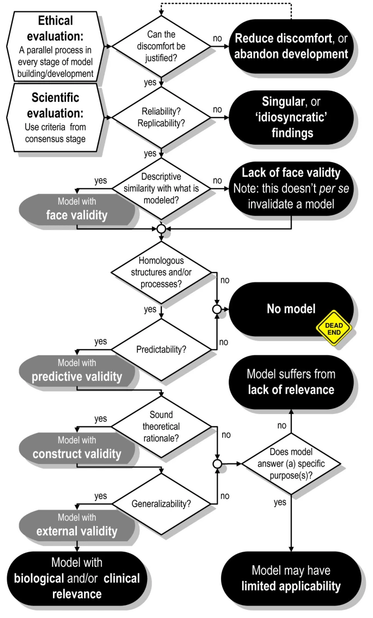

Evaluation of animal models of neurobehavioral disorders - Behavioral and Brain Functions
Animal models play a central role in all areas of biomedical research. The process of animal model building, development and evaluation has rarely been addressed systematically, despite the long history of using animal models in the investigation of neuropsychiatric disorders and behavioral dysfunctions. An iterative, multi-stage trajectory for developing animal models and assessing their quality is proposed. The process starts with defining the purpose(s) of the model, preferentially based on hypotheses about brain-behavior relationships. Then, the model is developed and tested. The evaluation of the model takes scientific and ethical criteria into consideration.Model development requires a multidisciplinary approach. Preclinical and clinical experts should establish a set of scientific criteria, which a model must meet. The scientific evaluation consists of assessing the replicability/reliability, predictive, construct and external validity/generalizability, and relevance of the model. We emphasize the role of (systematic and extended) replications in the course of the validation process. One may apply a multiple-tiered 'replication battery' to estimate the reliability/replicability, validity, and generalizability of result.Compromised welfare is inherent in many deficiency models in animals. Unfortunately, 'animal welfare' is a vaguely defined concept, making it difficult to establish exact evaluation criteria. Weighing the animal's welfare and considerations as to whether action is indicated to reduce the discomfort must accompany the scientific evaluation at any stage of the model building and evaluation process. Animal model building should be discontinued if the model does not meet the preset scientific criteria, or when animal welfare is severely compromised. The application of the evaluation procedure is exemplified using the rat with neonatal hippocampal lesion as a proposed model of schizophrenia.In a manner congruent to that for improving animal models, guided by the procedure expounded upon in this paper, the developmental and evaluation procedure itself may be improved by careful definition of the purpose(s) of a model and by defining better evaluation criteria, based on the proposed use of the model.
 Matt Hodgkinson
 Rebecca Nordquist