 Jordi Cabot
 Miglena Ivanova, M.S. 🧠🌶️
Share with #international students who may still be on 🐦 where Dr. Muntasir Masum and I chatted about #GradSchoolApps as an #International student
https://x.com/i/spaces/1gqGvQLMzEwKB
#GraduateSchool #PhDchat #PhDcandidate
#RoadToPhD
#PhDadvice #PhDlife #PhDstudent #GradSchoolPrep #PhD #Postbac #SouthAsia #EasternEurope #PhDchatter #InternationalStudent #Postbac
Help spread the word to undergrads! Set a reminder and join my space tomorrow! #CoffeeHourWithMegi ☕ (Can listen without Twitter account!) Special guest is Dr. Perry who will chat with me about how to best prepare for clinical vs research-intensive programs, as well as revisit gap years! Send any Qs! https://twitter.com/MigIvanova/status/1715117030154641738?t=HMyu78Avafq1sAP_EEixig&s=19
https://x.com/i/spaces/1OdKrjrNQbYKX
#GraduateSchool #GradSchoolLife #PhDchat #PhDcandidate
#RoadToPhD #DoctoralLife
#PhDadvice #PhDlife #PhDstudent #GradSchoolPrep #GradSchoolOpenings
https://x.com/i/spaces/1OdKrjrNQbYKX
#GraduateSchool #GradSchoolLife #PhDchat #PhDcandidate
#RoadToPhD #DoctoralLife
#PhDadvice #PhDlife #PhDstudent #GradSchoolPrep #GradSchoolOpenings


Miglena Ivanova, M.S. 🧠🌶 on X
RT for undergrads! Join my space tomorrow! #CoffeeHourWithMegi ☕ Special guest is Dr. Perry who will chat with me about how to best prepare for clinical vs research-intensive programs, as well as revisit gap years! #GradSchoolapps 🎙️ Tweet your Qs! #PhD https://t.co/enDFl8btZK
 Thomas
Good thread. RT @MarkHanson: The strain on scientific publishing 📄:
The publishing sector has a problem. Scientists are overwhelmed, editors are overworked, special issue invitations are constant, research paper mills, article retractions, journal delistings… JUST WHAT IS GOING ON!?
I, pablo, @paolocrosetto and Dan spent months investigating that.
https://arxiv.org/abs/2309.15884
A thread🧵1/n
#AcademicChatter #PublishOrPerish #Elsevier #Springer #MDPI #Wiley #Frontiers #PhDAdvice #PhDChat #SciComm

The strain on scientific publishing
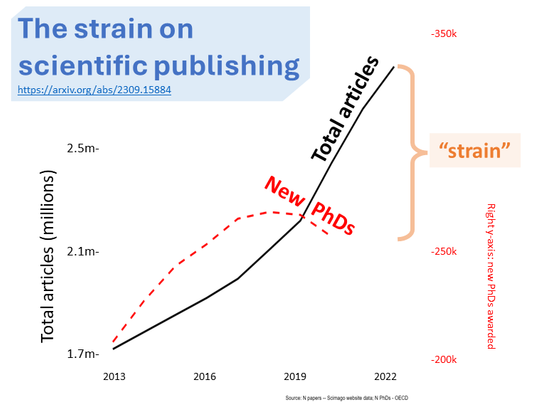
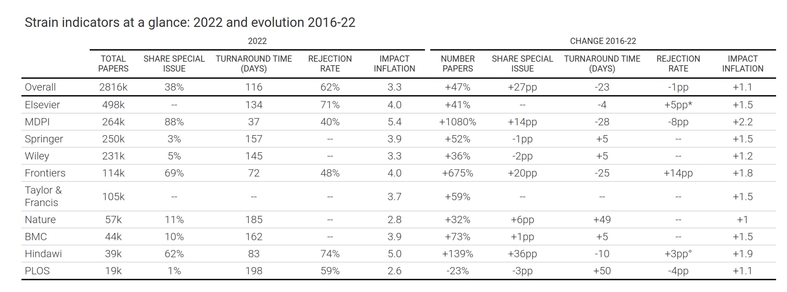
Scientists are increasingly overwhelmed by the volume of articles being published. Total articles indexed in Scopus and Web of Science have grown exponentially in recent years; in 2022 the article total was approximately ~47% higher than in 2016, which has outpaced the limited growth - if any - in the number of practising scientists. Thus, publication workload per scientist (writing, reviewing, editing) has increased dramatically. We define this problem as the strain on scientific publishing. To analyse this strain, we present five data-driven metrics showing publisher growth, processing times, and citation behaviours. We draw these data from web scrapes, requests for data from publishers, and material that is freely available through publisher websites. Our findings are based on millions of papers produced by leading academic publishers. We find specific groups have disproportionately grown in their articles published per year, contributing to this strain. Some publishers enabled this growth by adopting a strategy of hosting special issues, which publish articles with reduced turnaround times. Given pressures on researchers to publish or perish to be competitive for funding applications, this strain was likely amplified by these offers to publish more articles. We also observed widespread year-over-year inflation of journal impact factors coinciding with this strain, which risks confusing quality signals. Such exponential growth cannot be sustained. The metrics we define here should enable this evolving conversation to reach actionable solutions to address the strain on scientific publishing.
 MAHanson
The strain on scientific publishing 📄:
The publishing sector has a problem. Scientists are overwhelmed, editors are overworked, special issue invitations are constant, research paper mills, article retractions, journal delistings… JUST WHAT IS GOING ON!?
Myself, pablo, @paolocrosetto and Dan have spent the last few months investigating just that.
https://arxiv.org/abs/2309.15884
A thread🧵1/n
#AcademicChatter #PublishOrPerish #Elsevier #Springer #MDPI #Wiley #Frontiers #PhDAdvice #PhDChat #SciComm
The strain on scientific publishing
Scientists are increasingly overwhelmed by the volume of articles being published. Total articles indexed in Scopus and Web of Science have grown exponentially in recent years; in 2022 the article total was approximately ~47% higher than in 2016, which has outpaced the limited growth - if any - in the number of practising scientists. Thus, publication workload per scientist (writing, reviewing, editing) has increased dramatically. We define this problem as the strain on scientific publishing. To analyse this strain, we present five data-driven metrics showing publisher growth, processing times, and citation behaviours. We draw these data from web scrapes, requests for data from publishers, and material that is freely available through publisher websites. Our findings are based on millions of papers produced by leading academic publishers. We find specific groups have disproportionately grown in their articles published per year, contributing to this strain. Some publishers enabled this growth by adopting a strategy of hosting special issues, which publish articles with reduced turnaround times. Given pressures on researchers to publish or perish to be competitive for funding applications, this strain was likely amplified by these offers to publish more articles. We also observed widespread year-over-year inflation of journal impact factors coinciding with this strain, which risks confusing quality signals. Such exponential growth cannot be sustained. The metrics we define here should enable this evolving conversation to reach actionable solutions to address the strain on scientific publishing.
 Pat Thomson
Posting on signposting and Academic traffic direction. #academicwriting #acwri #research #academic #phd #phdchat #phdadvice https://patthomson.net/2023/09/05/can-you-have-too-much-signposting/
Your reader can feel you have too many words even when you’re within word limit. Why? #AcWri #academic #research #supervision #phd #phdchat #phdadvice
https://patthomson.net/2023/08/28/too-many-words-for-my-reader/

Deciding in book or thesis chapter length? It’s not such a simple decision. Both purpose and convention matter #AcWri #phd #phdchat #phdadvice #supervision #academicbook https://patthomson.net/2023/08/14/how-many-words-in-a-chapter-convention-and-purpose/

This week on patter, the first of a series about word length. And why we have to stick to specified limits. #AcWri #academicwriting #academic #supervision #research #PhD #PhDChat #PhDAdvice https://patthomson.net/2023/08/07/i-have-too-many-words-why-is-this-a-problem/

It’s Ok to use jargon if you really have considered your audience.#AcWri #PhD #PhDChat #ECRChat #PhDAdvice #Research #Publication
